Polka Dot
Yayoi Kusama
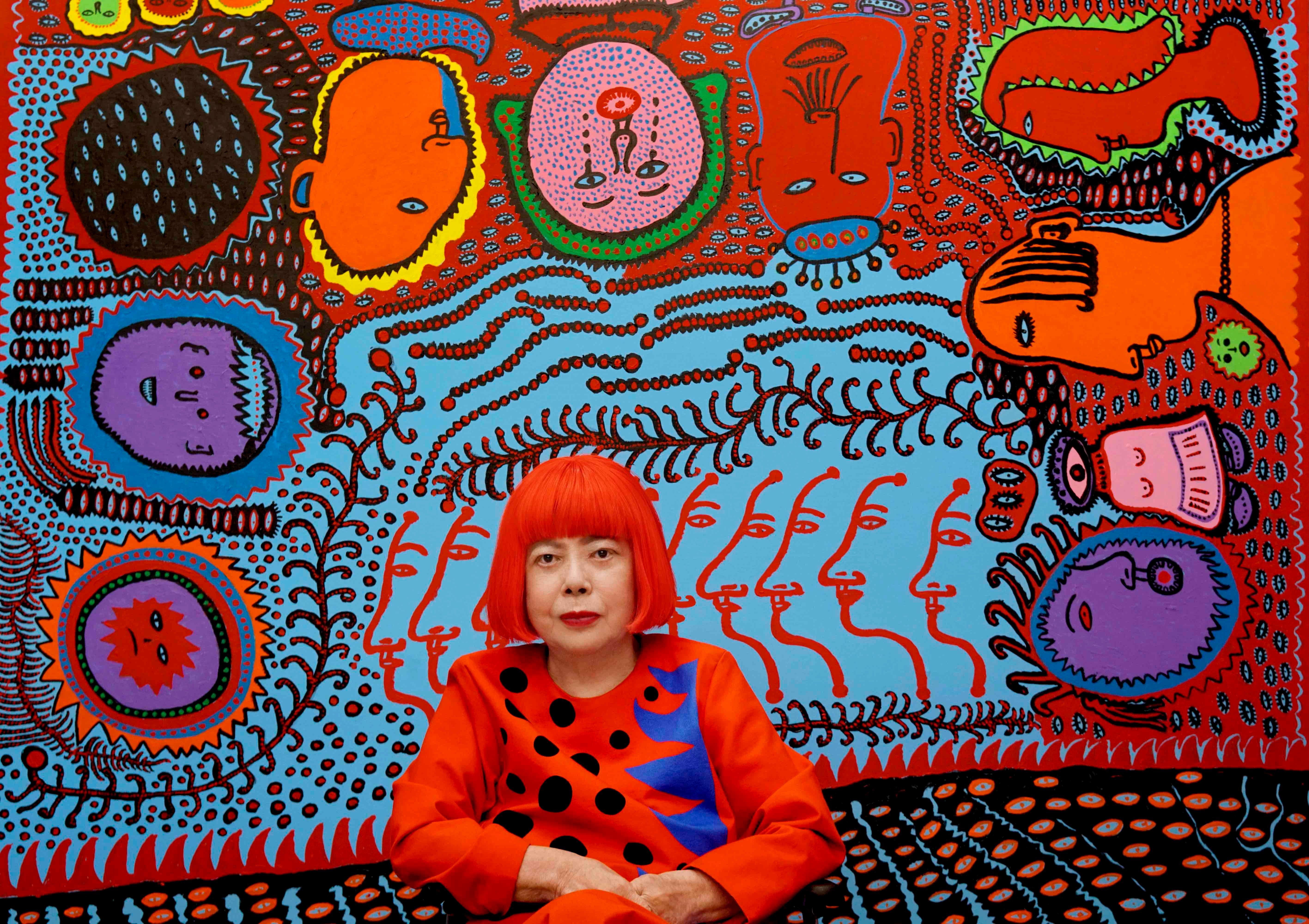
The Ripple, 1985
Artists
The Dot That Swallowed the Universe
There is something almost primal about the circle. Before language, before perspective, before the entire apparatus of Western art history, human hands were pressing pigment into stone and leaving behind dots. That impulse, so ancient and so bodily, threads through centuries of ornament, pattern, and ritual to arrive at one of the most charged and recognizable motifs in contemporary art. The polka dot is deceptively simple.
It is also, depending on who is wielding it and why, a tool of obsession, liberation, joy, or dissolution. The dot as a deliberate artistic strategy rather than mere decoration gains real traction in the nineteenth century, when Georges Seurat and Paul Signac developed Pointillism in the 1880s. Their method was rigorously scientific, drawing on the color theory of Michel Eugène Chevreul and Ogden Rood to argue that small discrete touches of pure pigment, viewed from a distance, would blend optically and produce a luminosity impossible to achieve by mixing paint on a palette. Seurat's monumental canvas A Sunday on La Grande Jatte, completed in 1886 and shown at the eighth and final Impressionist exhibition that same year, announced that the dot was not merely a mark but a system, a philosophy, a way of reorganizing perception itself.
Yayoi Kusama
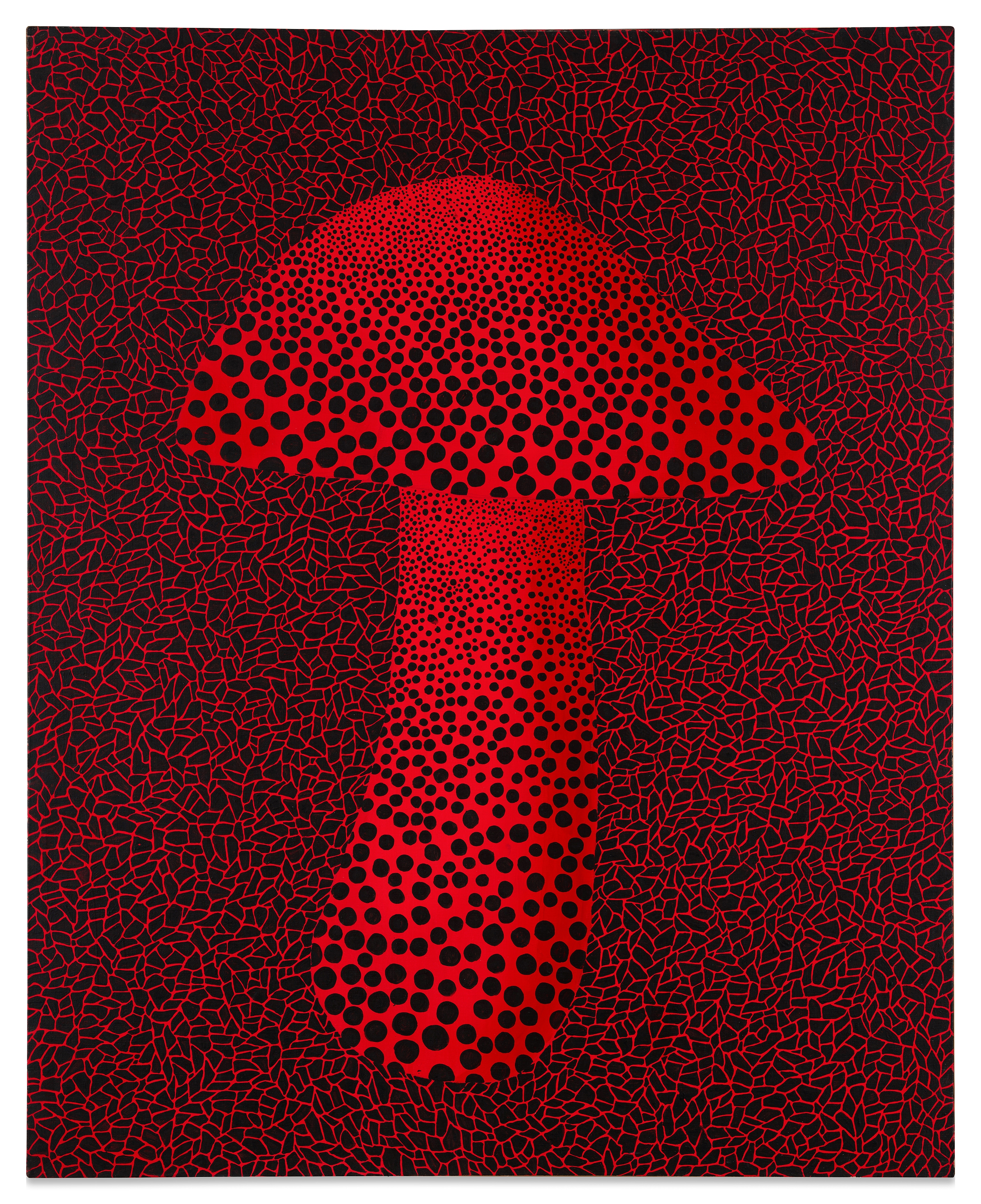
Mushroom, 1980
From Pointillism the dot migrated and mutated through the twentieth century, showing up in the flat graphic fields of Roy Lichtenstein's Ben Day dots in the early 1960s, in the optical shimmer of Bridget Riley's early paintings, and in the ceremonial body painting traditions of Aboriginal Australian artists whose use of dotted grounds long predated any Western avant garde claim on the motif. Each of these lineages reminds us that the dot means something different depending on whose hand is holding the brush and what cultural logic surrounds the act. Lichtenstein was raiding commercial printing for its impersonal, mechanical surface. Riley was investigating how the eye deceives the mind.
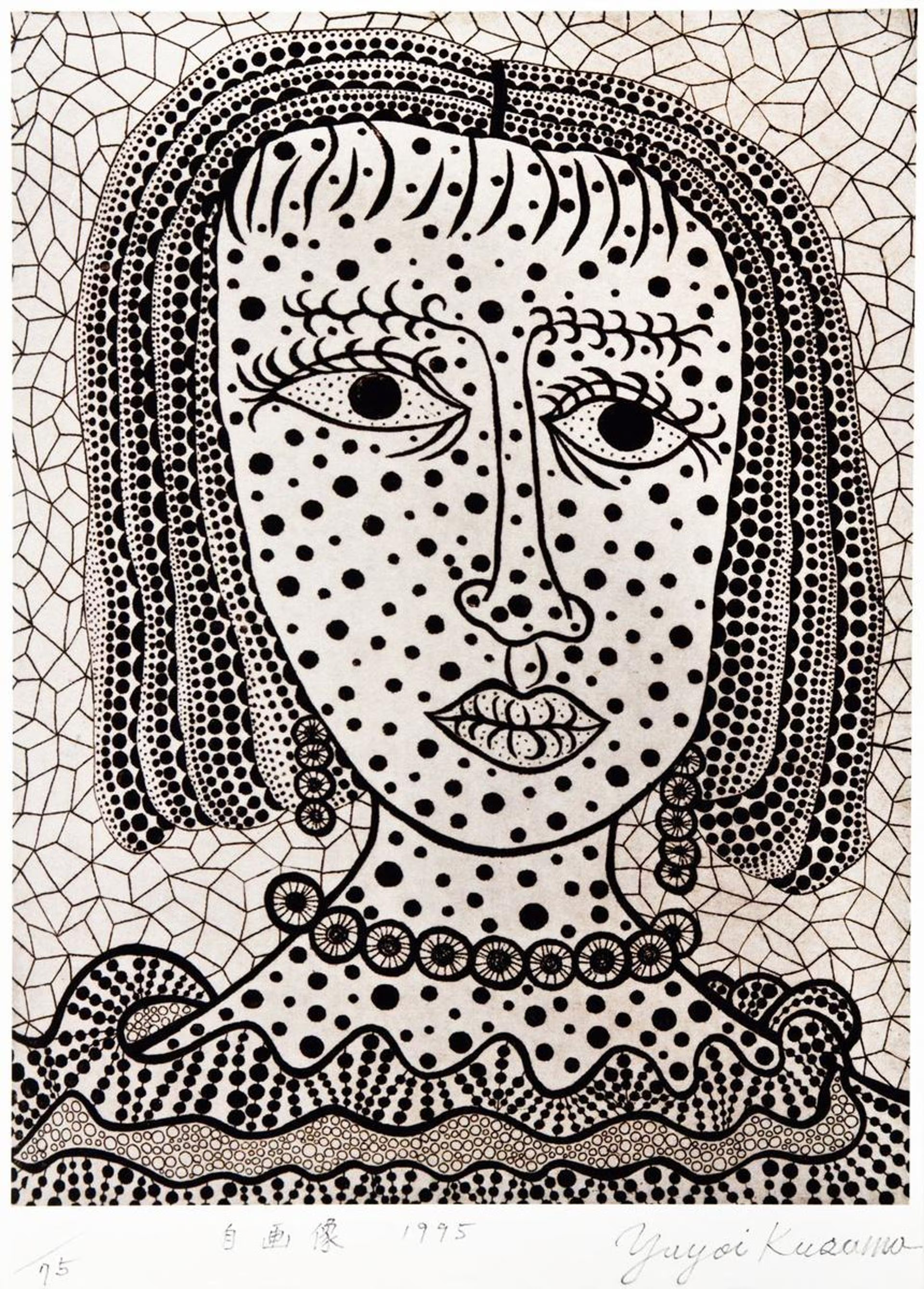
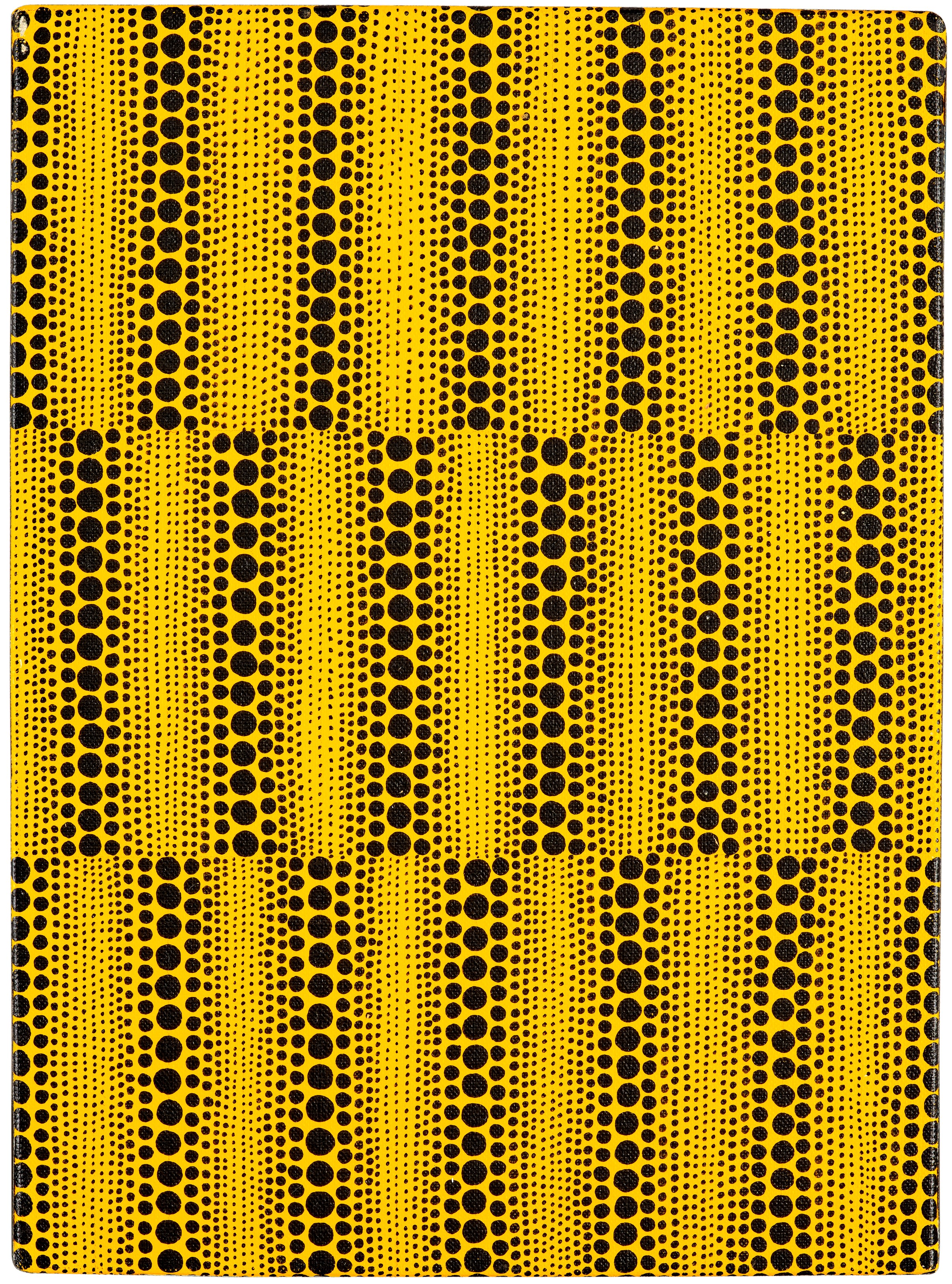
Aboriginal painters were encoding land, story, and ceremony into forms that carried immense spiritual weight. No artist, however, has made the dot more entirely and more personally her own than Yayoi Kusama. Born in Matsumoto, Japan, in 1929, Kusama began painting obsessively as a child, describing hallucinatory visions in which flowers spoke to her and fields of dots consumed the world around her. She moved to New York in 1958 and began exhibiting her Infinity Net paintings, enormous canvases covered in undulating arcs of repeated marks that created a vertiginous, all over field with no center and no edge.
The critic Donald Judd, not given to easy enthusiasm, praised these works early and singled out their radical spatial logic. For Kusama, repetition was never decorative. It was therapeutic, a way of externalizing an interior experience that threatened to overwhelm her. The dot was simultaneously the symptom and the cure.
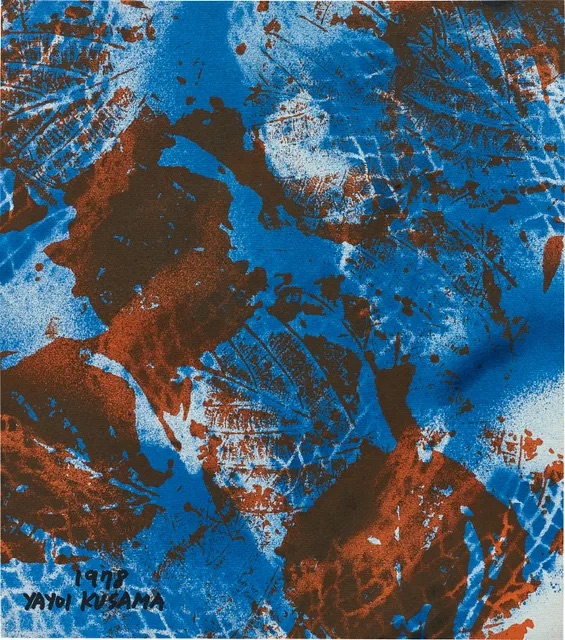
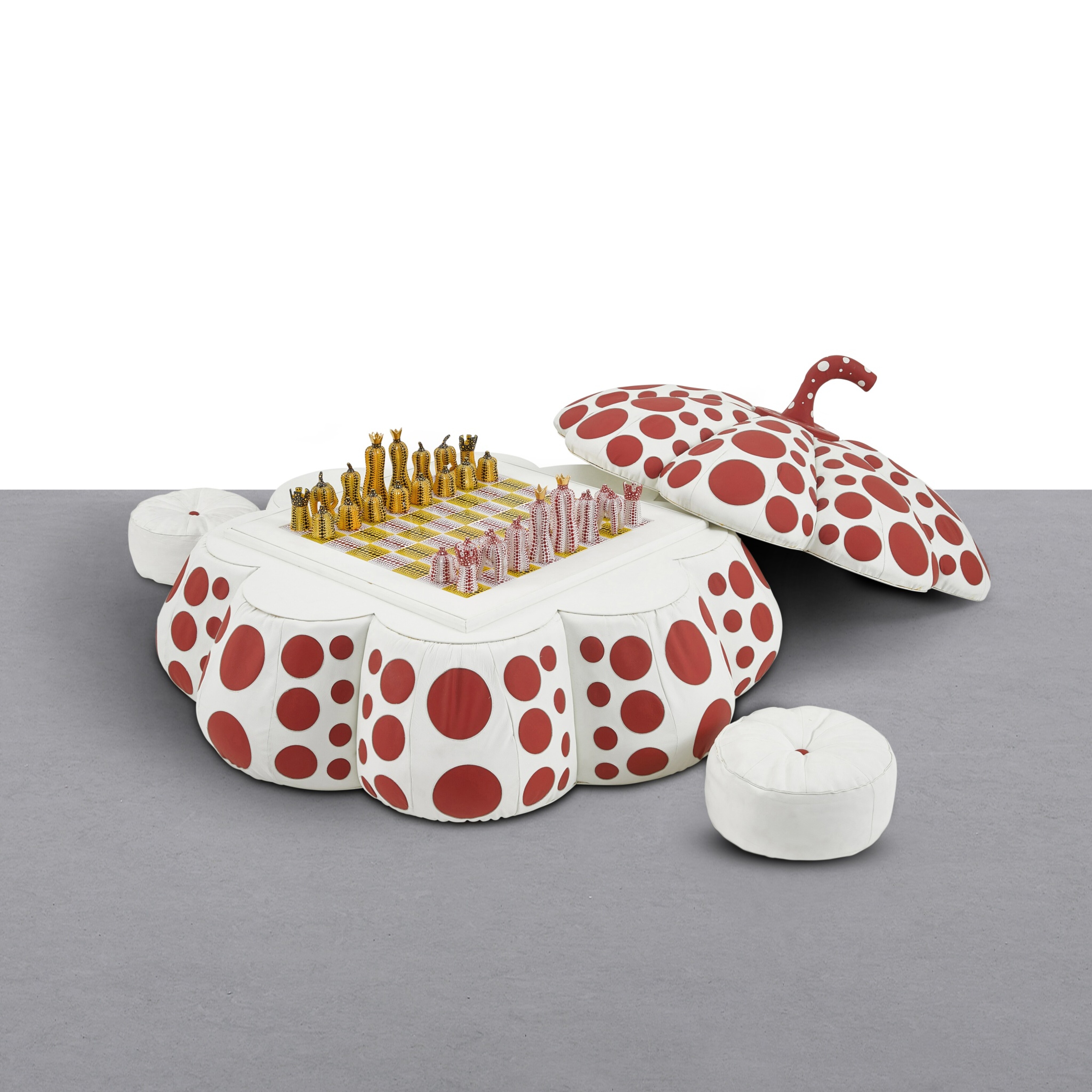
Kusama's dot work expanded from canvas into installation, sculpture, fashion, and eventually into the Infinity Mirror Rooms that have made her a phenomenon of a scale few living artists achieve. Her 1966 participation at the Venice Biennale, where she scattered mirror balls across the Italian Pavilion's garden and sold them for two dollars each, was a provocation directed at the art market itself. The dots in her world proliferate without permission, seeding themselves onto pumpkins, onto polka dot dresses, onto entire landscapes. What is striking about Kusama's practice, and what her works on The Collection make tangible, is how the dot retains its psychological urgency even as it becomes globally legible.
The image that began as private necessity became universal language. Conceptually, the polka dot occupies an interesting tension between the individual mark and the collective field. A single dot is almost nothing. A thousand dots, evenly distributed, becomes pattern.
A million dots, covering every surface in a room, becomes environment, becomes immersion, becomes something that calls into question where the artwork ends and the viewer begins. This scalar quality, the way the dot operates differently at different densities and distances, is part of what gives the motif such enduring generative power. Artists working across painting, textile, ceramics, and digital practice return to it precisely because it rewards thinking at every scale. The arrival of AI as a creative medium has opened new territory for dot based aesthetics in ways that feel genuinely connected to the motif's history rather than merely novelty.
AI image generation excels at producing pattern, repetition, and the kind of saturated all over composition that the dot has always gravitated toward. There is something philosophically apt in this. The dot was always, in a sense, a pixel before pixels existed. Seurat's Pointillist grid, Kusama's obsessive accumulation, and the raster logic of digital imaging share a common structural premise: that reality can be rebuilt from discrete units, that the whole emerges from the sum of its smallest parts.
When AI works engage with polka dot imagery they are not just borrowing a visual shorthand. They are participating in a long argument about how images are made and what units of perception actually are. To collect works in this territory today is to hold several art histories simultaneously. You are holding Seurat's faith in optical science, Kusama's confrontation with her own psyche, the ceremonial knowledge encoded in Aboriginal dot painting, and the new questions that computational image making is beginning to ask.
The dot looks simple because it is round and repeating and almost childlike in its basic form. But the collector who looks closely will find that it contains worlds within worlds, each one opening onto the next, with no final boundary in sight.