Join The Collection to save, track, and explore works like this.

Henri Manguin — Roses
Henri Manguin

Roses

1916

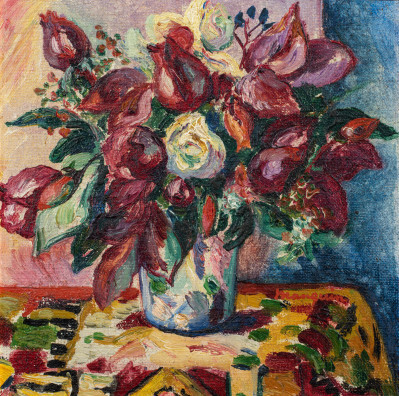
Painted in 1916, Henri Manguin's "Roses" presents a compact yet luminous arrangement of blooms rendered in the artist's characteristically warm, vibrant palette. Working within a perfectly square format of just 22.5 by 22.5 centimetres, Manguin demonstrates how intimate scale can amplify rather than diminish visual impact, drawing the eye into a dense field of color where petals dissolve into brushwork and light seems to emanate from within the composition itself. The square canvas imposes a satisfying symmetry that focuses attention entirely on the flowers, free from the distraction of expansive background space. Manguin was a central figure among the Fauves, exhibiting alongside Matisse and Marquet at the landmark 1905 Salon d'Automne, and his mature handling of color is fully evident in this wartime still life. That a work of such sensory richness and calm was produced during 1916, one of the most turbulent years of the First World War, speaks to the enduring commitment Manguin maintained toward beauty and painterly pleasure even under difficult historical circumstances. Roses function throughout his oeuvre as a recurring subject, one that allowed him to explore chromatic relationships with a freedom that approached abstraction without ever abandoning the tangible, sensuous presence of the natural world. For collectors, this small canvas offers a rare opportunity to acquire an original signed oil from a fully realized period in Manguin's career. Works of this intimacy tend to reward close, repeated looking, revealing new relationships between warm reds, soft creams, and the greens threading through the composition. Currently offered through Bailly Gallery, "Roses" represents both a historically grounded acquisition and a work of genuine daily pleasure.

Medium
Oil on canvas
Overall
Signed
Yes
Location
BAILLY GALLERY, Paris

Start the Discussion

Request access to join the discussion

Collectors with works by Henri Manguin

About this work

Henri Manguin, Roses, 1916

Painted in 1916, Henri Manguin's "Roses" presents a compact yet luminous arrangement of blooms rendered in the artist's characteristically warm, vibrant palette. Working within a perfectly square format of just 22.5 by 22.5 centimetres, Manguin demonstrates how intimate scale can amplify rather than diminish visual impact, drawing the eye into a dense field of color where petals dissolve into brushwork and light seems to emanate from within the composition itself. The square canvas imposes a satisfying symmetry that focuses attention entirely on the flowers, free from the distraction of expansive background space. Manguin was a central figure among the Fauves, exhibiting alongside Matisse and Marquet at the landmark 1905 Salon d'Automne, and his mature handling of color is fully evident in this wartime still life. That a work of such sensory richness and calm was produced during 1916, one of the most turbulent years of the First World War, speaks to the enduring commitment Manguin maintained toward beauty and painterly pleasure even under difficult historical circumstances. Roses function throughout his oeuvre as a recurring subject, one that allowed him to explore chromatic relationships with a freedom that approached abstraction without ever abandoning the tangible, sensuous presence of the natural world. For collectors, this small canvas offers a rare opportunity to acquire an original signed oil from a fully realized period in Manguin's career. Works of this intimacy tend to reward close, repeated looking, revealing new relationships between warm reds, soft creams, and the greens threading through the composition. Currently offered through Bailly Gallery, "Roses" represents both a historically grounded acquisition and a work of genuine daily pleasure.

Medium
Oil on canvas
Dimensions
overall: 22.5 x 22.5 cm
Year
1916
Signed
Hand-signed by the artist
Seen at
BAILLY GALLERY, Paris

More works by Henri Manguin

Collected by

Musée d'Art Moderne de Paris