Join The Collection to save, track, and explore works like this.

Henri Manguin — Bouquet D’Anémones Devant La Fenêtre
Henri Manguin

Bouquet D’Anémones Devant La Fenêtre

1942

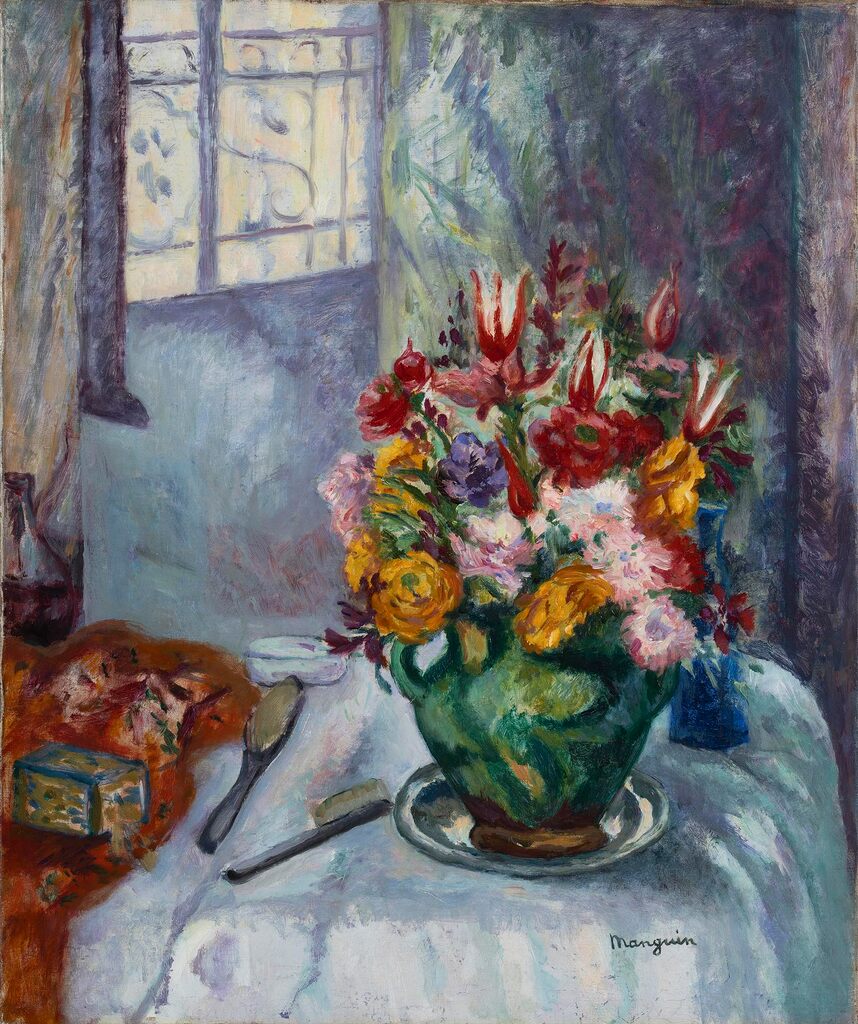
A vivid cluster of anemones fills the foreground of this 1942 canvas, their saturated petals rendered in Manguin's characteristically bold chromatic range against the luminous geometry of a window behind them. Painted during a period when the artist had settled in Saint-Tropez, the work exemplifies the sensory directness that had defined his practice since his Fauve years alongside Matisse and Marquet, yet here that energy is channeled into something quieter and more contemplative. The window, a recurring motif in Manguin's interior scenes, functions less as an architectural element than as a field of diffused light that amplifies the floral forms in the foreground, creating a dialogue between domestic intimacy and the luminous world beyond. At 73 by 60 centimeters, the composition achieves a sense of generous presence without the monumental scale that can overwhelm a private interior, making it well-suited to a refined domestic setting. Manguin's brushwork here is assured and unhurried, layering warm and cool tones with the ease of an artist who had spent decades observing the Mediterranean light and learning to distill its effects onto canvas. The work is signed by the artist and accompanied by a certificate of authenticity issued by Mrs. Claude Holstein Manguin, dated June 10, 2025, providing firm scholarly grounding for the acquisition. It is offered through Helene Bailly Marcilhac, a Paris gallery with longstanding expertise in early twentieth-century French painting.

Medium
Oil on canvas
Overall
Signed
Yes

Start the Discussion

Request access to join the discussion

Collectors with works by Henri Manguin

About this work

Henri Manguin, Bouquet D’Anémones Devant La Fenêtre , 1942

A vivid cluster of anemones fills the foreground of this 1942 canvas, their saturated petals rendered in Manguin's characteristically bold chromatic range against the luminous geometry of a window behind them. Painted during a period when the artist had settled in Saint-Tropez, the work exemplifies the sensory directness that had defined his practice since his Fauve years alongside Matisse and Marquet, yet here that energy is channeled into something quieter and more contemplative. The window, a recurring motif in Manguin's interior scenes, functions less as an architectural element than as a field of diffused light that amplifies the floral forms in the foreground, creating a dialogue between domestic intimacy and the luminous world beyond. At 73 by 60 centimeters, the composition achieves a sense of generous presence without the monumental scale that can overwhelm a private interior, making it well-suited to a refined domestic setting. Manguin's brushwork here is assured and unhurried, layering warm and cool tones with the ease of an artist who had spent decades observing the Mediterranean light and learning to distill its effects onto canvas. The work is signed by the artist and accompanied by a certificate of authenticity issued by Mrs. Claude Holstein Manguin, dated June 10, 2025, providing firm scholarly grounding for the acquisition. It is offered through Helene Bailly Marcilhac, a Paris gallery with longstanding expertise in early twentieth-century French painting.

Medium
Oil on canvas
Dimensions
overall: 73 x 60 cm
Year
1942
Signed
Hand-signed by the artist
Seen at
HELENE BAILLY MARCILHAC

More works by Henri Manguin

Collected by

Musée d'Art Moderne de Paris