Join The Collection to save, track, and explore works like this.

Art Institute of Chicago

Spotted

Sylvia Plimack Mangold — In Memory of My Father
Sylvia Plimack Mangold

In Memory of My Father

1976

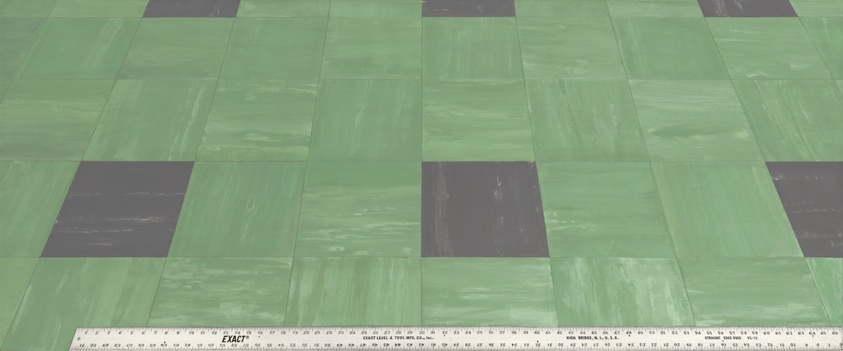
In the late 1960s, Sylvia Plimack Mangold turned to her immediate surroundings as a source for imagery, making almost photorealistic paintings of interior spaces, including the wood and tile floors of her studio and home. By the 1970s she began to insert meticulous trompe l’oeil elements as well, including metal rulers and masking tape painted along the borders of her images. The artist has explained that the painted rulers measured or marked the physical dimensions of a work’s edge, while the painted floors measured or marked illusionistic space. In Mangold’s words, “The works of this period were like catalogues of these different realities in painting.” In their constant reappraisal of the relationship between painting and picture, and in their frequent recourse to the grid-like structures of flooring, Mangold’s works can operate like rigorous abstractions, aligned with Minimal and Conceptual practices of the time. Yet they often derive their affect from more subjective, even personal content as well. For instance, the ruler in this painting, which stops on the right edge of the canvas at 66 ¾ inches, serves as an intimate tribute, corresponding to the age of the artist’s father at his death. This is the only work in her oeuvre that offers such an overtly biographical, memorializing reference. The green linoleum floor, which is also exclusive to this work, was inspired by a small section of old flooring the artist discovered in her basement. Here Mangold painted, with her customary precision, an imagined reconstruction as opposed to an observed reality.

Medium
Acrylic on canvas
Dimensions

Start the Discussion

Request access to join the discussion

Spotted works by Sylvia Plimack Mangold

About this work

Sylvia Plimack Mangold, In Memory of My Father, 1976

In the late 1960s, Sylvia Plimack Mangold turned to her immediate surroundings as a source for imagery, making almost photorealistic paintings of interior spaces, including the wood and tile floors of her studio and home. By the 1970s she began to insert meticulous trompe l’oeil elements as well, including metal rulers and masking tape painted along the borders of her images. The artist has explained that the painted rulers measured or marked the physical dimensions of a work’s edge, while the painted floors measured or marked illusionistic space. In Mangold’s words, “The works of this period were like catalogues of these different realities in painting.” In their constant reappraisal of the relationship between painting and picture, and in their frequent recourse to the grid-like structures of flooring, Mangold’s works can operate like rigorous abstractions, aligned with Minimal and Conceptual practices of the time. Yet they often derive their affect from more subjective, even personal content as well. For instance, the ruler in this painting, which stops on the right edge of the canvas at 66 ¾ inches, serves as an intimate tribute, corresponding to the age of the artist’s father at his death. This is the only work in her oeuvre that offers such an overtly biographical, memorializing reference. The green linoleum floor, which is also exclusive to this work, was inspired by a small section of old flooring the artist discovered in her basement. Here Mangold painted, with her customary precision, an imagined reconstruction as opposed to an observed reality.

Medium
Acrylic on canvas
Dimensions
76.5 x 183 cm
Year
1976
Seen at
Art Institute of Chicago, Chicago, IL

Related themes

Acrylic, Unique Work, Large Scale, Painting, Contemporary

More works by Sylvia Plimack Mangold

Collected by

Art Institute of Chicago