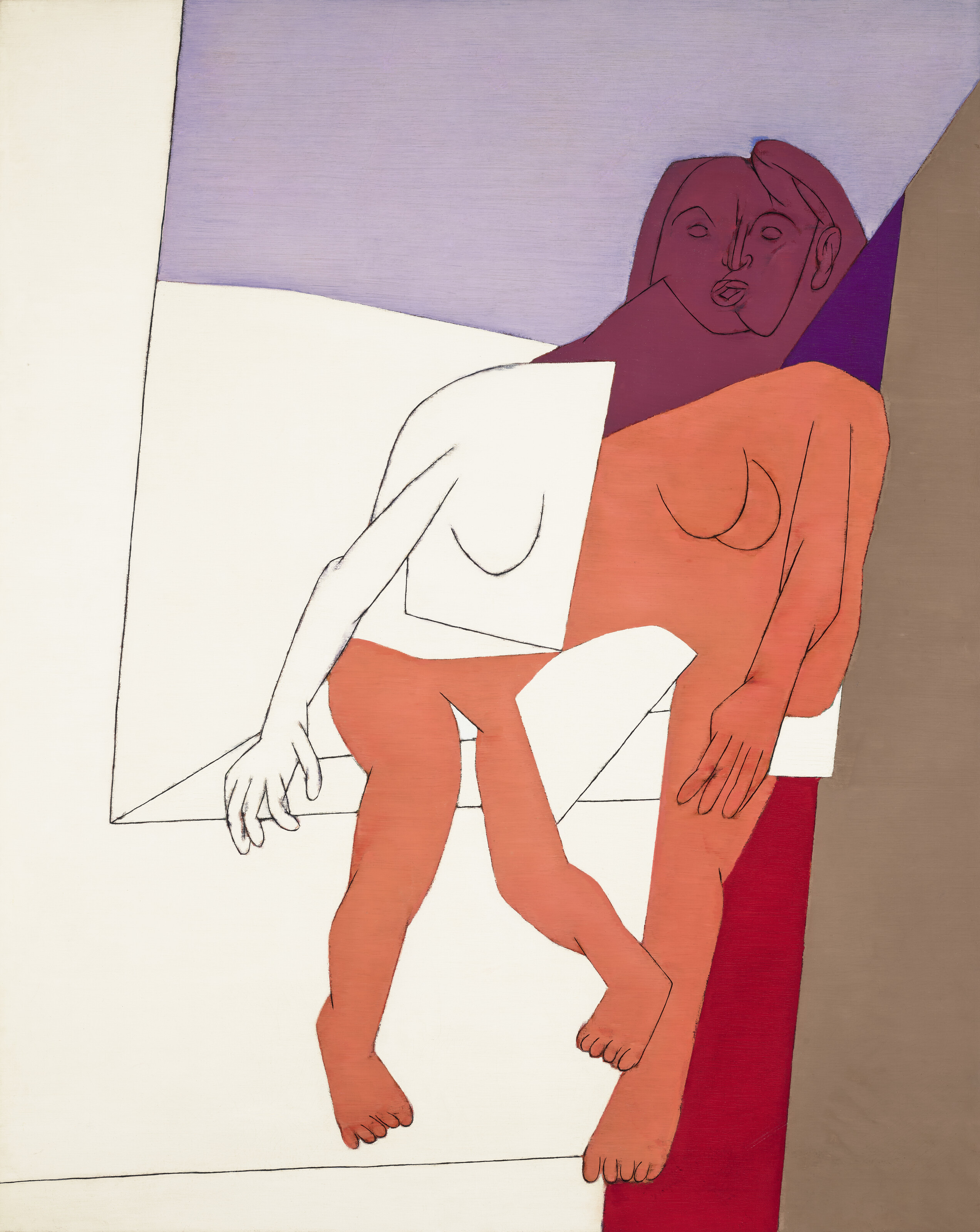
Gesture
"Gesture" by Tyeb Mehta exemplifies the Indian modernist's characteristic style, featuring bold, gestural brushstrokes and a dramatically simplified human form rendered in the artist's signature earthy palette. The work captures movement and emotion through abstraction while maintaining a figurative anchor, reflecting Mehta's synthesis of Western abstract expressionism with Indian artistic traditions. Created during his mature period, the painting demonstrates his preoccupation with the human body as a vehicle for expressing psychological and physical tension.
- Signed
- Yes
- Spotted At
- Auction House · Christie's
Notes
LOT ESSAY “Tyeb Mehta is striving for simple, clean solutions to the problems of painting. This simplicity is the hardest thing to achieve” (G. and U. Beier, ‘Falling Figures – The Art of Tyeb Mehta’, Aspect: Art and Literature, Sydney, no. 23, January 1982, p. 79). Over the course of his six decade long career, Tyeb Mehta strove to distil the existential struggles of humanity in the twentieth century into powerful pictorial form. Recognized as one of India’s greatest modern masters, Mehta began his career as a filmmaker before turning to painting after befriending members of the Progressive Artists’ Group in Bombay. This unique trajectory sets Mehta apart as a quintessential image-maker. Working with a carefully restricted repertoire of motifs, he returned to these images repeatedly over the years in order to refine, compress and intensify their meaning. From his early images of trussed bulls that underline the plight of the helpless animal in Bombay’s slaughterhouses, to fractured and falling figures, diagonal slashes, battling deities and disenfranchised rickshaw pullers, Mehta’s paintings articulate struggle on both cosmic and pragmatic registers. From the 1950s onward, Mehta experimented with different stylistic devices, including flattened and simultaneous perspectives, the juxtaposition of linear and voluminous representations of form and varying frontal and profiled lines of sight. A comprehensive retrospective of Mehta’s body of work is currently on view in the exhibition Tyeb Mehta: Bearing Weight (with the Lightness of Being) at the Kiran Nadar Museum of Art in New Delhi, offering viewers an encyclopaedic look at the development of his unique visual vocabulary. Early in his career, Mehta’s images were rendered through visceral, often violent brushwork, with thick impasto and a pronounced physicality. Painterly force was deployed directly to convey trauma and suffering. Works from this period are formally antithetical to the artist’s signature stylized fractured bodies seen in the current lot, a work from 1977 titled Gesture, a difference that reflects a decisive turning point in Mehta’s artistic development. This change followed the artist’s year-long stay in New York on a Rockefeller III Fund Fellowship in 1968. Immersed in the contemporary American art scene and particularly affected by the work of artists such as Barnett Newman, Mehta moved away from expressionistic facture toward pristine planes of saturated color applied to surfaces on which no brushstroke is apparent. Mehta recalls the significance of this moment in his artistic development, noting, “My encounter with minimalist art was a revelation. I had seen minimalist reproductions previously, but I hadn't seen the works in the original. Had I not seen the original, I might have dismissed many of them as gimmicks, just another tricky idea. But when I saw my first original [Barnett Newman], for example, I had such an incredible emotional response to it. The canvas had no image, but the way the paint had been applied, the way the scale had been worked out, the whole area proportioned – there was something about it which is inexpressible. Let’s say there must have been a point of saturation in my work before I went to New York, which my confrontation with the contemporary art scene brought to the surface. I was open to new ideas. About the same time, I became interested in using pure color. Normally brush marks suggest areas of direction. I wanted to avoid all this to bring elements down to such a minimal level that the image alone would be sufficient to speak for itself” (Artist statement, N. Ty-Tomkins Seth, Tyeb Mehta: Ideas, Images, Exchanges, New Delhi, 2005, p. 342).
🔨 Auction Lot
South Asian Modern + Contemporary Art
March 25, 2026
Estimate: $2,000,000 – $3,000,000
Lot 321
Start the Discussion
Request access to join the discussion