Join The Collection to save, track, and explore works like this.

Christopher Wool — Over the course of his over four decades long career, Christopher Wool has reestablished and reasserted the primacy of painting, most notably the possibilities inherent within abstraction. Employing a variety of appropriated symbols, novel application techniques, and compositional variety in his work, Wool has found critical success trailblazing new forms of expression in an age oversaturated with communication. Wool’s art manifests a wholly unique power in its conceptual core – the idea of how to make a picture that resonates with self-contained and self-reflected authority in an age of visually overstimulated meaninglessness. Wool most often does so by drawing the viewer in to investigate the very nature of the painting itself, utilizing an economy of means that focusses one’s attention on only the most pertinent of questions, more how and why than what. This simplicity is what led him to the industrial stamp-roller frequently employed by urban slumlords to decorate dilapidated tenement buildings. Utilizing a basic floral motif, Wool coolly establishes in his early painting,
Christopher Wool

Over the course of his over four decades long career, Christopher Wool has reestablished and reasserted the primacy of painting, most notably the possibilities inherent within abstraction. Employing a variety of appropriated symbols, novel application techniques, and compositional variety in his work, Wool has found critical success trailblazing new forms of expression in an age oversaturated with communication. Wool’s art manifests a wholly unique power in its conceptual core – the idea of how to make a picture that resonates with self-contained and self-reflected authority in an age of visually overstimulated meaninglessness. Wool most often does so by drawing the viewer in to investigate the very nature of the painting itself, utilizing an economy of means that focusses one’s attention on only the most pertinent of questions, more how and why than what. This simplicity is what led him to the industrial stamp-roller frequently employed by urban slumlords to decorate dilapidated tenement buildings. Utilizing a basic floral motif, Wool coolly establishes in his early painting,

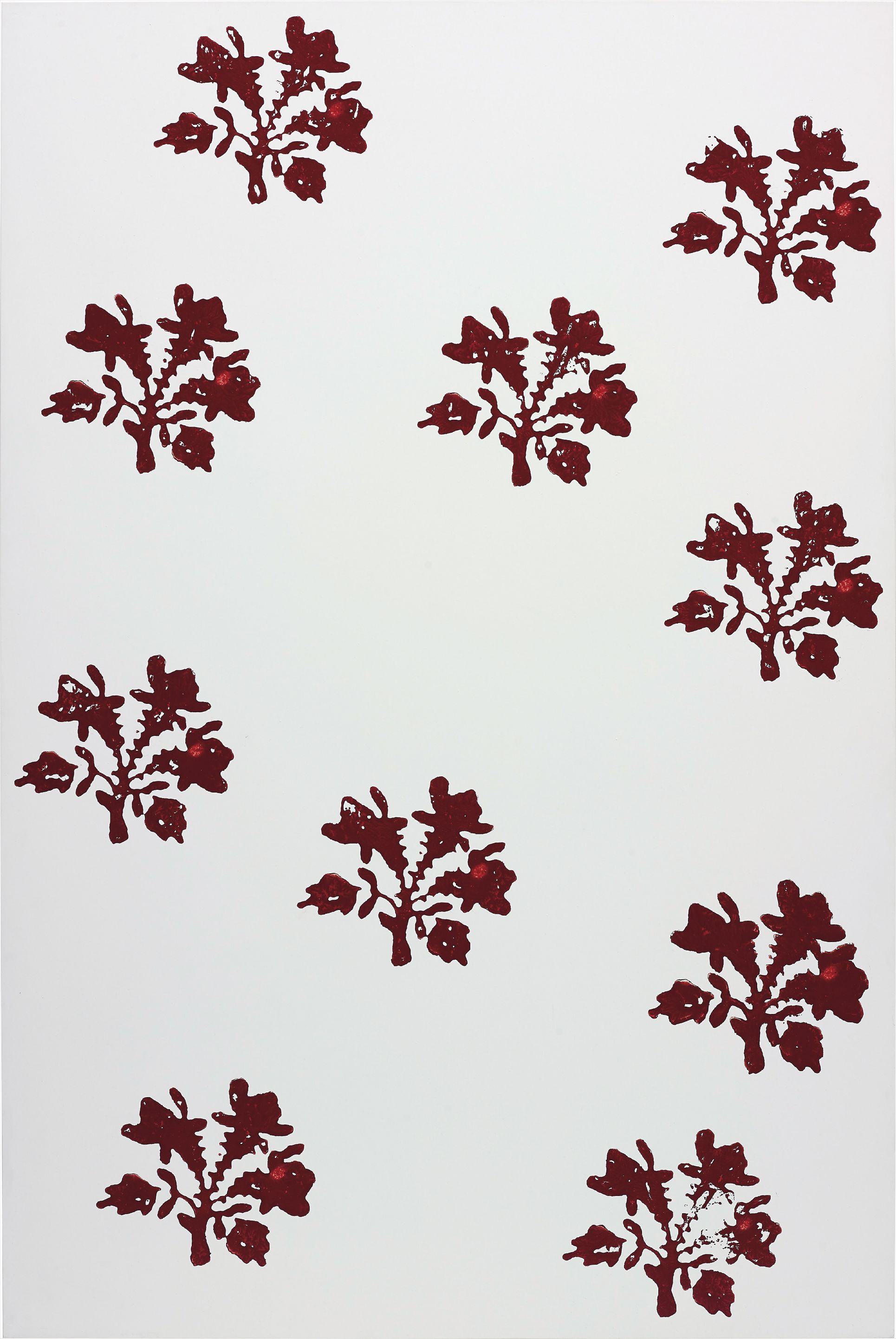
Using industrial stamp-rollers typically associated with urban tenement decoration, Christopher Wool applies a repeating floral motif in alkyd and acrylic onto an aluminum support, transforming a mundane vernacular tool into a vehicle for sophisticated painterly inquiry. The cool, detached application of the pattern onto the hard metallic surface creates a tension between the decorative and the conceptual, inviting the viewer to question the very mechanisms of mark-making and visual repetition. The work exemplifies Wool's signature economy of means, stripping painting down to its most essential questions of process and materiality.

Medium
alkyd and acrylic on aluminum

🔨 Auction Lot

20th Century & Contemporary Art Evening Sale

May 8, 2016

Start the Discussion

Request access to join the discussion

About this work

Christopher Wool, Over the course of his over four decades long career, Christopher Wool has reestablished and reasserted the primacy of painting, most notably the possibilities inherent within abstraction. Employing a variety of appropriated symbols, novel application techniques, and compositional variety in his work, Wool has found critical success trailblazing new forms of expression in an age oversaturated with communication. Wool’s art manifests a wholly unique power in its conceptual core – the idea of how to make a picture that resonates with self-contained and self-reflected authority in an age of visually overstimulated meaninglessness. Wool most often does so by drawing the viewer in to investigate the very nature of the painting itself, utilizing an economy of means that focusses one’s attention on only the most pertinent of questions, more how and why than what. This simplicity is what led him to the industrial stamp-roller frequently employed by urban slumlords to decorate dilapidated tenement buildings. Utilizing a basic floral motif, Wool coolly establishes in his early painting,

Using industrial stamp-rollers typically associated with urban tenement decoration, Christopher Wool applies a repeating floral motif in alkyd and acrylic onto an aluminum support, transforming a mundane vernacular tool into a vehicle for sophisticated painterly inquiry. The cool, detached application of the pattern onto the hard metallic surface creates a tension between the decorative and the conceptual, inviting the viewer to question the very mechanisms of mark-making and visual repetition. The work exemplifies Wool's signature economy of means, stripping painting down to its most essential questions of process and materiality.

Medium
alkyd and acrylic on aluminum
Seen at
Phillips, New York, London, Hong Kong

Related themes

Industrial Technique, Cool Toned, Aluminum Support, Floral Pattern, Minimalist Aesthetic, Minimalist, Male Artist, Floral Motif, Conceptual Art, Industrial Motif, Abstract Painting, Pattern And Repetition, Contemporary Artist, American Artist, Alkyd And Acrylic, Late 20th Century, Industrial Aesthetic, Minimalist Composition, Neutral Tones

More works by Christopher Wool

Collected by

Hamilton Selway Gallery, Alex Capecelatro, Lisa Rembrandt