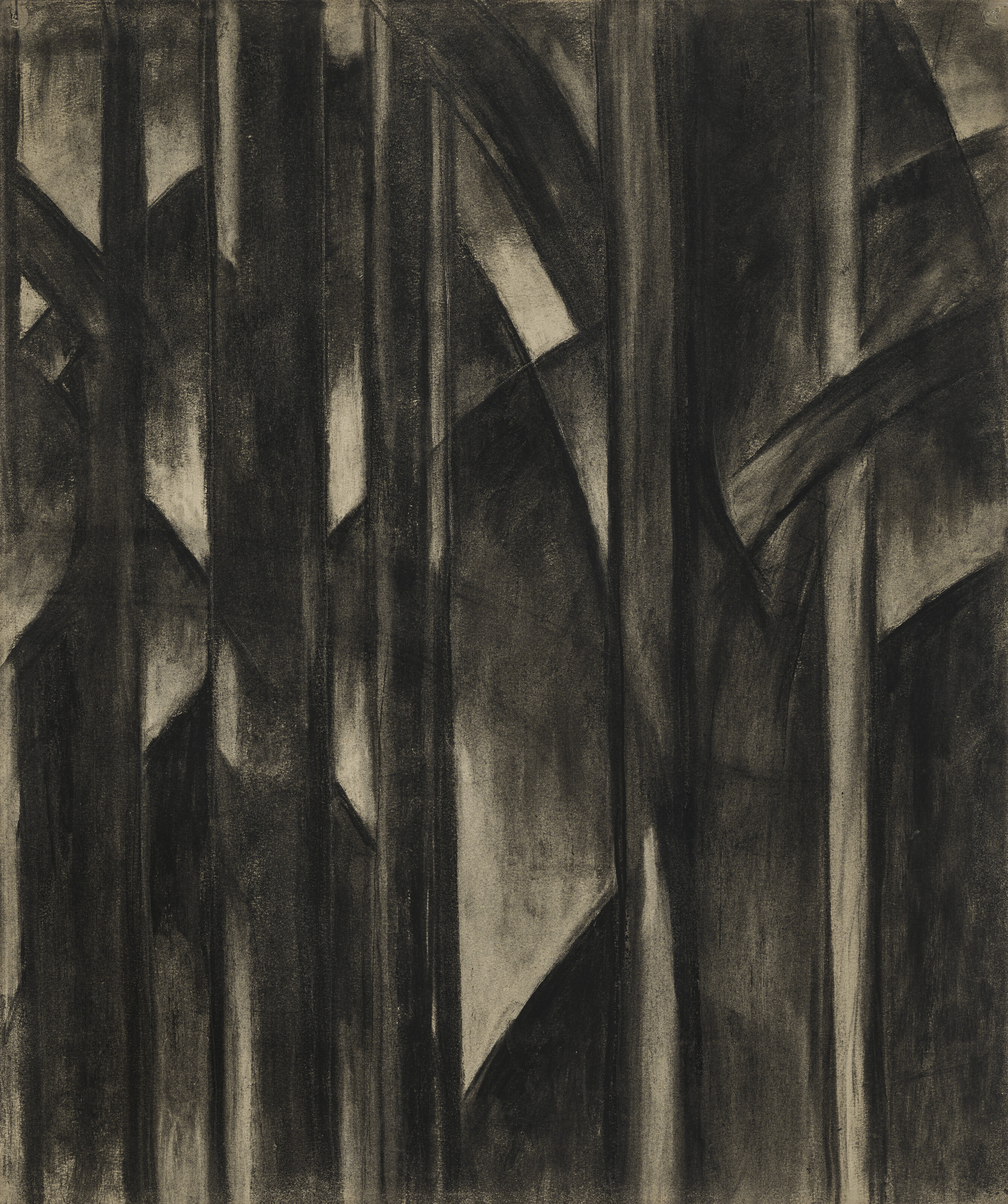
Study for 'Dark Abstraction'
Arthur Dove's Study for 'Dark Abstraction' is an abstract composition that explores form and color through non-representational means. The work exemplifies the artist's pioneering approach to American modernism and abstraction.
- Spotted At
- Auction House · Christie's
Notes
LITERATURE A.L. Morgan, Arthur Dove: Life and Work, With a Catalogue Raisonné, Newark, Delaware, 1984, p. 49. B.B. Stretch, "The Enigmatic Arthur Dove," ArtNews, vol. LXXXIV, no. 1, January 1985, p. 91, illustrated. EXHIBITED Washington, D.C., The Phillips Collection; Atlanta, Georgia, High Museum of Art; Kansas City, Missouri, Nelson-Atkins Museum of Art; Houston, Texas, Museum of Fine Arts; Columbus, Ohio, Columbus Museum of Art; Seattle, Washington, Seattle Art Museum; Milwaukee, Wisconsin, New Milwaukee Art Center, Arthur Dove and Duncan Phillips: Artist and Patron, June 13, 1981-November 14, 1982, pp. 78, 146, no. 12, pl. 14, illustrated. New York, Hirschl & Adler Galleries, Inc., Realism and Abstraction: Counterpoints in American Drawing, 1900-1940, 1983, p. 86, no. 99, illustrated. (Probably) New York, Barbara Mathes Gallery, Arthur Dove: Paintings, Watercolors, Drawings, Collages, November 3-December 29, 1984. New York, Hirschl & Adler Galleries, Inc., The Art of Collecting, 1984, p. 55, no. 41, illustrated. Houston, Texas, Janie C. Lee Gallery, Charcoal Drawings, 1880-1985, October-November 1985, n.p., no. 7, illustrated. Venice, Italy, Palazzo Grassi, Futurismo & Futurismi, 1986, p. 364, illustrated. New York, Hirschl & Adler Galleries, Inc., Modern Times: Aspects of American Art, 1907-1956, November 1-December 6, 1986, pp. 38-39, no. 31, illustrated. New York, Terry Dintenfass Gallery, Inc., Arthur G. Dove: Pastels, Charcoals, Watercolors, February 6-March 13, 1993, pp. 17, 41, no. 9, illustrated. Conditions of sale Brought to you by Quincie Dixon Associate Specialist, Head of Sale Check the condition report or get in touch for additional information about this QDIXON@CHRISTIES.COM +1 212 636 2141 VIEW CONDITION REPORT LOT ESSAY Present lot illustrated (detail). Throughout his career, Arthur Dove sought to convey the inner spirit he saw in the “things” of nature by reducing each component to its most basic form. Nowhere is this simplification more evident and innovative than in the charcoals and pastels of his early career, including Study for ‘Dark Abstraction.’ Sasha Newman writes, “As in many of his most significant works, Dove probes the gap between realism and abstraction. Study for ‘Dark Abstraction’ has elements of landscape – verticals that recall trees and conical masses that evoke mountains – but these are taken to the threshold of abstraction through formal reduction and simplification.” (Arthur Dove and Duncan Phillips: Artist and Patron, Washington, D.C., 1981, p. 147) Left: Present lot illustrated. Right: Arthur Dove, Dark Abstraction (Woods), c. 1920. Private collection. Dove is acknowledged as the first artist to exhibit purely abstract art in America in 1912 and continued to create a substantial body of abstract work before 1920. He also experimented with a variety of styles and media throughout his career, including works on paper in pastel, charcoal and watercolor, assemblages made of found objects, and oil painting. Between 1917 and 1920, however, Dove exclusively worked in charcoal, executing an important series of 14 astounding works drawing in large part on his most highly regarded theme: nature. Many of these works are housed in museum collections including the Museum of Modern Art, New York; Metropolitan Museum of Art, New York; National Gallery of Art, Washington, D.C.; Arkansas Museum of Fine Arts, Little Rock, Arkansas; and Stanley Museum of Art, Iowa City, Iowa. Left: Arthur Dove, Thunderstorm, c. 1917-20. Stanley Museum of Art, Iowa City, Iowa. Right: Arthur Dove, Thunderstorm, 1921. Columbus Museum of Art, Ohio. He began painting again in 1920 and utilized some of his charcoals as starting points, including the present work that served as his inspiration for Dark Abstraction (Woods) (circa 1920, Private Collection). Indeed, several other works from the series served as the basis for major paintings, such as the Stanley Museum of Art’s charcoal Thunderstorm executed circa 1917-20 that inspired a 1921 oil painting of the same name in the Columbus Museum of Art, Ohio. However, Dove’s series of charcoals not only anticipated some of his most major works to come; they also relate back to his earliest and most historically important forays into complete abstraction. With its focus on the underlying patterns of nature and rhythmic repetitions of form, Study for ‘Dark Abstraction’ is a closely related successor of Dove’s seminal Ten Commandments pastels of 1911-12, which are widely recognized as the first works of abstraction to ever be exhibited by an American artist. Barbara Haskell writes, “The black and white charcoal drawings from this period are compositionally and philosophically related to these pastels as well as to certain black and white paintings by the Futurist Giacomo Balla.” (Arthur Dove, exhibition catalogue, San Francisco, California, 1974, p. 29) Arthur Dove, Movement No. 1, c. 1911-12. Part of the Ten Commandments Series. Columbus Museum of Art, Ohio. Dove’s abstractions on paper employ an extraordinary use of line and pattern to convey natural rhythms. Haskell writes, “Dove believed that…each object had a certain configuration that captured its spirit or inner structure but that did not necessarily conform to its objectively perceived shape…Dove came to describe this identifying form through ‘force lines’ or ‘growth lines.’ Force lines did not refer to the physical outlines of an object but to the forces or tensions alive within it…Dove wrote, ‘…When mariners say ‘the wind has weight,’ a line seems to express that better than bulk.’” (Arthur Dove, p. 7) In the present work, Dove’s “force lines” of overlapping verticals and diagonals communicate splaying tree forms, broken up by passages of negative space conveying their inner light or inherent energy. Within these negative spaces, Dove creates gradients of pigment that exploit the creaminess of his chosen medium and complicate the movement of light within the abstracted view. Profoundly sophisticated and historically important, works such as Study for ‘Dark Abstraction’ represent the pinnacle of Modern artistic expression in early 20th century America. READ MORE OF THE LOT ESSAY The collection In 1981 my husband, Jim, and I began to focus on collecting American Modernist works, having an affinity for this early 20th century movement, much of which paralleled our youth. The range of subjects and styles, and the spirit of American art, 1900-1950, resonated with us and living with these works has been deeply rewarding. Toto Fisher Jim and Toto Fisher, 1980s. Photograph courtesy the Fisher family. Edith ‘Toto’ Fisher and her husband Jim were pillars of the Pittsburgh, Pennsylvania arts community. In addition to thoughtfully assembling an impressive Modern American Art collection of their own, the Fishers dedicated themselves to their local arts institutions, not only as donors, but most importantly as civic leaders inspiring generations to come. Born in Grand Rapids, Michigan, in 1929, Toto graduated from Garland Junior College before beginning her career as a primary school teacher in Massachusetts and later New York City. In 1955, she married Jim Fisher, a native of Pittsburgh and executive at Fisher Scientific Co. (now Thermo Fisher Scientific), which was founded by his father. Described by Jim as “an active outgoing young woman who was caring, gregarious, loving, enormously devoted to others,” Toto quickly embraced her new hometown and became active in local organizations, such as the Phipps Conservatory and Botanical Gardens and Pittsburgh Cultural Trust. An avid fan of the symphony, in 1973 Toto helped to launch a local classical music radio station, WQED-FM. The Andy Warhol Museum simply would not exist were it not for the passion and foresight of Toto and Jim. Patrick Moore, former director of The Andy Warhol Museum Shortly after Andy Warhol died in 1987, the Fishers advocated for Pittsburgh as the best home for the Warhol Museum. As Patrick Moore, the former director of The Andy Warhol Museum and vice president of Carnegie Museums of Pittsburgh, recounted, “The Andy Warhol Museum simply would not exist were it not for the passion and foresight of Toto and Jim. Their relationship with Fred Hughes, Warhol’s former business manager, was central to bringing the project to fruition. And their continued support and advocacy after the museum opened were critical to it being the success it is today.” Left: Georgia O’Keeffe, Red Cannas, circa 1918-20, Carnegie Museum of Art, Bequest of Edith H. and James A. Fisher. © 2025 Georgia O'Keeffe Museum / Artists Rights Society (ARS), New York. Right: Joseph Stella, Song of Barbados, 1938, Carnegie Museum of Art, Bequest of Edith H. and James A. Fisher. The Fishers were particularly dedicated to the Carnegie Museum of Art. Jim was a trustee emeritus and longtime Institute vice president, playing a key role in two capital campaigns. He also helped lead the effort to establish the Carnegie Science Center, now the most visited museum in Western Pennsylvania. Also a Carnegie Institute and Museum trustee, Toto co-founded the museum’s docent program, was president of the Women’s Committee and spearheaded the fundraising publication of the Carnegie Treasures Cookbook of recipes associated with the museum community. In 1975, they funded the commission of a major Louise Nevelson sculpture on the occasion of the opening of the Sarah Scaife wing. In addition, the Edith H. Fisher Fund helped acquire a number of important paintings for the institution, including works by Milton Avery, Burgoyne Diller, Agnes Martin and Robert Ryman. Reginald Marsh, Pennsylvania Mining Town, 1932, Carnegie Museum of Art, Bequest of Edith H. and James A. Fisher As neither Jim nor Toto were raised in homes with fine art, they developed their collecting interests together. Beginning with local artists at Pittsburgh fairs, they explored the Cobra artists from Copenhagen, Brussels and Amsterdam before transitioning to early 20th Century American art. Toto explained, “We realized the [Carnegie] Museum of Art was moving more toward American and contemporary art. We talked to [director] Jack Lane about collecting with the intention to fill voids in the museum’s collection.” Indeed, personal bequests to the Carnegie from the Fishers’ own collection included Georgia O’Keeffe’s important early flower watercolor Red Cannas, Reginald Marsh’s magnificent tempera Pennsylvania Mining Town and Joseph Stella’s wonderful Song of Barbados. The Fisher Look is often lyrical, frequently somewhat surreal, always serious. There is a palpable sense of art history. Harry Schwalb, Pittsburgh, October 1985 The most important uniting factor is the high quality of each work. As Toto explained, “I don’t say I want an O’Keeffe. I want a significant painting by O’Keeffe. The painting, not the name…Exposure to the best lets you recognize the best.” The Fisher collection includes the best of Precisionism, including a stellar industrial painting by Ralston Crawford and a wonderfully intricate drawing by Charles Sheeler of the artist’s photography studio. Important early works by Arthur Dove and Patrick Henry Bruce converse alongside a meditative late-career Marsden Hartley. Throughout, there is an interplay of media: a sculpture by Gaston Lachaise beside paintings in oil and works on paper in charcoal and conté crayon. Toto summarized, “The collection is very eclectic but there is a relationship. There are milestones in it…The art has a sense of timelessness and beauty.” Toto Fisher with Hans Hofmann’s Atelier (Still Life: Table with White Vase). Photograph courtesy the Fisher family. Toto Fisher’s advice to new collectors: You buy the painting, then decide where it’s going in your home. It will find a place. Paintings of comparable quality will get along together even though each is very different. The idea is not to buy a painting by a particular artist but a significant work of art. Christie’s is honored to present The Collection of Toto & Jim Fisher to the next generation of passionate art collectors. READ MORE OF THE COLLECTION
🔨 Auction Lot
Modern American Art
April 16, 2026
Estimate: $150,000 – $250,000
Lot 12
Start the Discussion
Request access to join the discussion