Join The Collection to save, track, and explore works like this.

Anthony van Dyck — Philip, Lord Wharton
Anthony van Dyck

Philip, Lord Wharton

1632

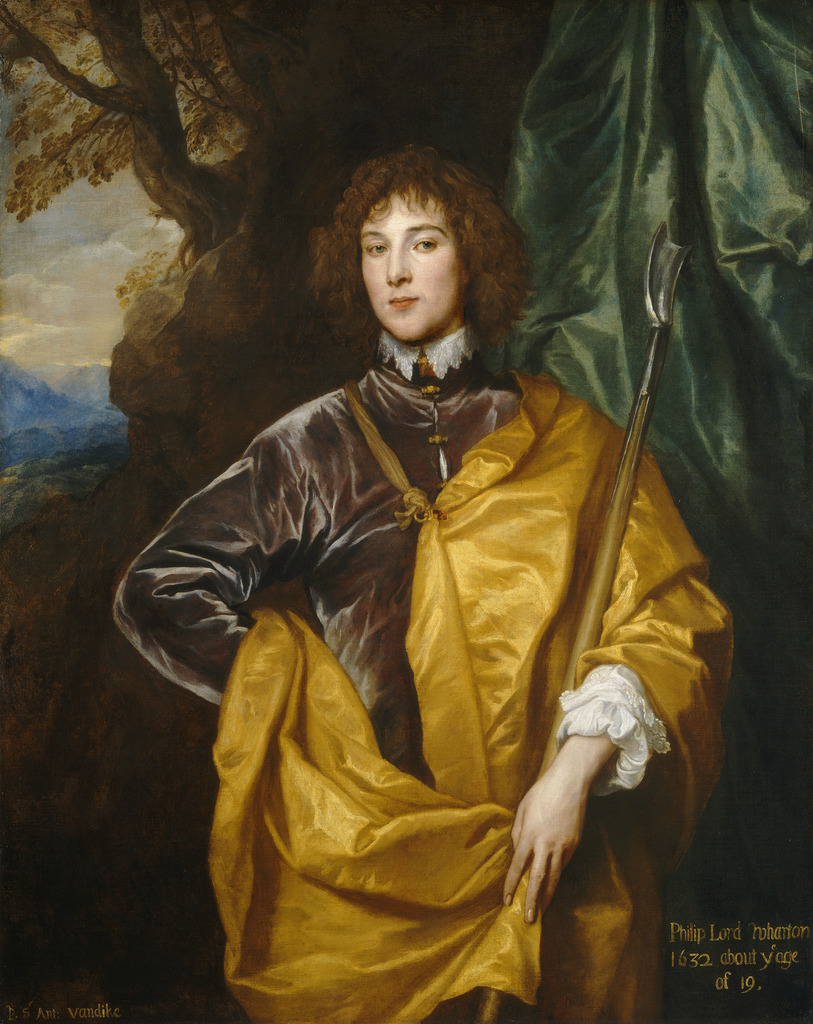
Painted in 1632, when Anthony van Dyck was at the height of his powers as court painter to Charles I, this commanding portrait captures Philip, Lord Wharton at the age of nineteen, already projecting the composed authority of a young nobleman destined for prominence. Against a landscape backdrop of silvery light and soft atmospheric depth, Wharton stands with an ease that speaks to van Dyck's unparalleled gift for rendering aristocratic bearing without stiffness, the sitter's silk costume rendered in those luminous, fluid passages of paint that defined portraiture across Europe for generations to come. At 133 by 106 centimeters, the canvas occupies exactly the scale demanded by its subject, large enough to assert presence, intimate enough to reward close looking. Van Dyck's genius here lies in the synthesis of psychological acuity and surface splendor. The young lord's gaze carries a slight, almost wary intelligence, and the handling of the lace collar and embroidered doublet demonstrates the kind of technical bravura that distinguished van Dyck from every contemporary working in England at the time. The landscape element, loosely indicated yet evocative, places the sitter in a tradition of Venetian portraiture that van Dyck had absorbed during his Italian years, transposed now into a distinctly northern sensibility. The signed canvas is a rare and fully resolved statement of the artist's English period. Works of this provenance and period by van Dyck appear on the market with exceptional infrequency, and the portrait is currently held in the collection of the National Gallery of Art, Washington, D.C., a circumstance that speaks directly to its art historical standing. For a collector seeking a portrait of international museum caliber, few candidates in any generation could match the combination of subject, condition, scale, and authorship that this canvas represents.

Medium
Oil on canvas
Overall
Signed
Yes

Start the Discussion

Request access to join the discussion

Spotted works by Anthony van Dyck

About this work

Anthony van Dyck, Philip, Lord Wharton, 1632

Painted in 1632, when Anthony van Dyck was at the height of his powers as court painter to Charles I, this commanding portrait captures Philip, Lord Wharton at the age of nineteen, already projecting the composed authority of a young nobleman destined for prominence. Against a landscape backdrop of silvery light and soft atmospheric depth, Wharton stands with an ease that speaks to van Dyck's unparalleled gift for rendering aristocratic bearing without stiffness, the sitter's silk costume rendered in those luminous, fluid passages of paint that defined portraiture across Europe for generations to come. At 133 by 106 centimeters, the canvas occupies exactly the scale demanded by its subject, large enough to assert presence, intimate enough to reward close looking. Van Dyck's genius here lies in the synthesis of psychological acuity and surface splendor. The young lord's gaze carries a slight, almost wary intelligence, and the handling of the lace collar and embroidered doublet demonstrates the kind of technical bravura that distinguished van Dyck from every contemporary working in England at the time. The landscape element, loosely indicated yet evocative, places the sitter in a tradition of Venetian portraiture that van Dyck had absorbed during his Italian years, transposed now into a distinctly northern sensibility. The signed canvas is a rare and fully resolved statement of the artist's English period. Works of this provenance and period by van Dyck appear on the market with exceptional infrequency, and the portrait is currently held in the collection of the National Gallery of Art, Washington, D.C., a circumstance that speaks directly to its art historical standing. For a collector seeking a portrait of international museum caliber, few candidates in any generation could match the combination of subject, condition, scale, and authorship that this canvas represents.

Medium
Oil on canvas
Dimensions
overall: 133 x 106 cm
Year
1632
Signed
Hand-signed by the artist
Seen at
National Gallery of Art, Washington, D.C.

More works by Anthony van Dyck

Collected by

Cleveland Museum of Art