Join The Collection to save, track, and explore works like this.

Anthony van Dyck — Portrait of a Cavalier
Anthony van Dyck

Portrait of a Cavalier

1634

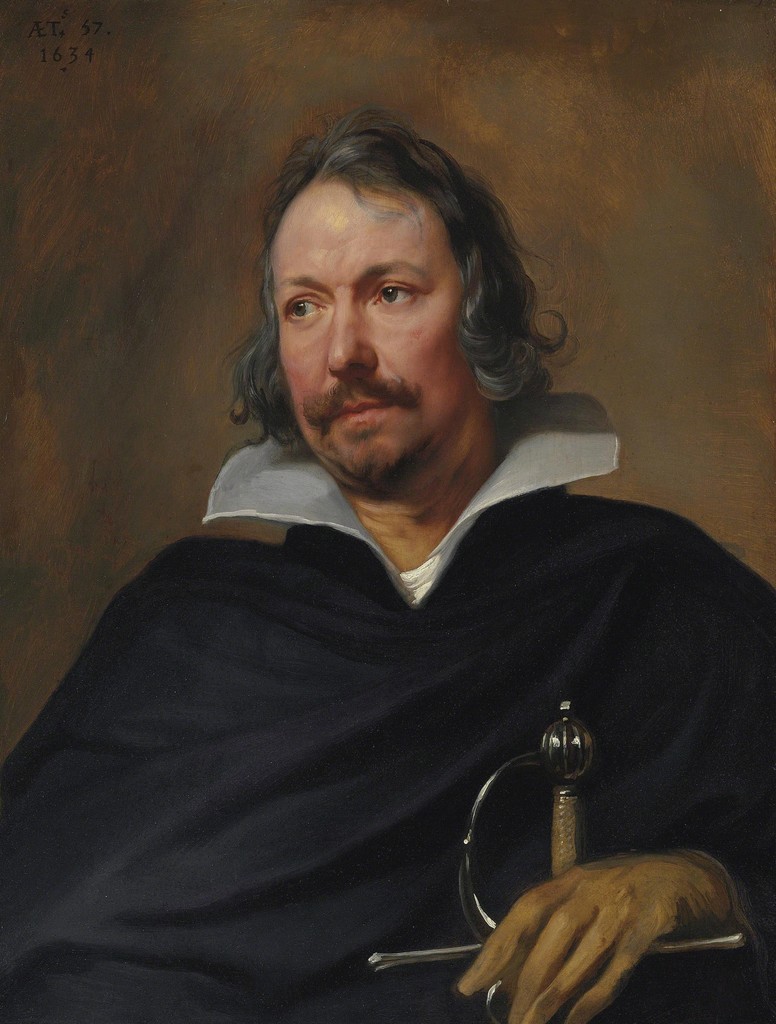
In this signed oil on panel from 1634, Anthony van Dyck reduces portraiture to its most elemental and commanding form. A cavalier in black turns his face slightly to the left, his curling hair charmingly disheveled, one gloved hand resting with studied ease on the hilt of his sword. The restrained palette and spare composition only amplify the sitter's presence, allowing Van Dyck's extraordinary sensitivity to character and surface to carry the full weight of the picture. The elongated fingers, the angled gaze, and the crisp white collar against dark fabric recall the artist's earlier Italian period portraits, notably his depiction of Lucas van Uffel now in the Metropolitan Museum of Art, confirming that by 1634 Van Dyck had fully mastered the language of aristocratic self-possession. The work belongs to one of the most distinguished phases of Van Dyck's career. Having trained under Rubens, served at the English court of James I, traveled extensively through Italy, and painted for Archduchess Isabella in Antwerp, Van Dyck was appointed court painter to Charles I and knighted in 1632. The precise location of this portrait's execution, whether in the Netherlands or England, remains an open question, though scholar Erik Larsen places it after the artist's return to London. The handling of the brushwork invites comparison with the Wallace Collection's Philippe Le Roy of 1630, similarly inscribed with the sitter's age and date, situating this panel firmly within Van Dyck's mature portraiture. The provenance of this work is both distinguished and historically significant. Once part of the collection of Baron Nathaniel de Rothschild in Vienna, the painting likely hung at Schillersdorf castle in Silesia, where it bore the family's inventory label and coat of arms. Seized during the Second World War, it was recovered from a salt mine near the Loser Plateau in Austria in 1945 and subsequently restituted to the Rothschild family. By 1959 it had entered the Kimbell Art Foundation in Fort Worth, Texas, where Michael Jaffé confirmed the attribution to Van Dyck in a letter of December 1971. The portrait appears at Christie's Old Masters carrying both scholarly authentication and a provenance narrative of exceptional depth.

Medium
Oil on panel
Overall
Signed
Yes

For Sale — $500000

Start the Discussion

Request access to join the discussion

Spotted works by Anthony van Dyck

About this work

Anthony van Dyck, Portrait of a Cavalier, 1634

In this signed oil on panel from 1634, Anthony van Dyck reduces portraiture to its most elemental and commanding form. A cavalier in black turns his face slightly to the left, his curling hair charmingly disheveled, one gloved hand resting with studied ease on the hilt of his sword. The restrained palette and spare composition only amplify the sitter's presence, allowing Van Dyck's extraordinary sensitivity to character and surface to carry the full weight of the picture. The elongated fingers, the angled gaze, and the crisp white collar against dark fabric recall the artist's earlier Italian period portraits, notably his depiction of Lucas van Uffel now in the Metropolitan Museum of Art, confirming that by 1634 Van Dyck had fully mastered the language of aristocratic self-possession. The work belongs to one of the most distinguished phases of Van Dyck's career. Having trained under Rubens, served at the English court of James I, traveled extensively through Italy, and painted for Archduchess Isabella in Antwerp, Van Dyck was appointed court painter to Charles I and knighted in 1632. The precise location of this portrait's execution, whether in the Netherlands or England, remains an open question, though scholar Erik Larsen places it after the artist's return to London. The handling of the brushwork invites comparison with the Wallace Collection's Philippe Le Roy of 1630, similarly inscribed with the sitter's age and date, situating this panel firmly within Van Dyck's mature portraiture. The provenance of this work is both distinguished and historically significant. Once part of the collection of Baron Nathaniel de Rothschild in Vienna, the painting likely hung at Schillersdorf castle in Silesia, where it bore the family's inventory label and coat of arms. Seized during the Second World War, it was recovered from a salt mine near the Loser Plateau in Austria in 1945 and subsequently restituted to the Rothschild family. By 1959 it had entered the Kimbell Art Foundation in Fort Worth, Texas, where Michael Jaffé confirmed the attribution to Van Dyck in a letter of December 1971. The portrait appears at Christie's Old Masters carrying both scholarly authentication and a provenance narrative of exceptional depth.

Medium
Oil on panel
Dimensions
overall: 72.5 x 55.3 cm
Year
1634
Signed
Hand-signed by the artist
Seen at
Christie's Old Masters

More works by Anthony van Dyck

Collected by

Cleveland Museum of Art