Join The Collection to save, track, and explore works like this.

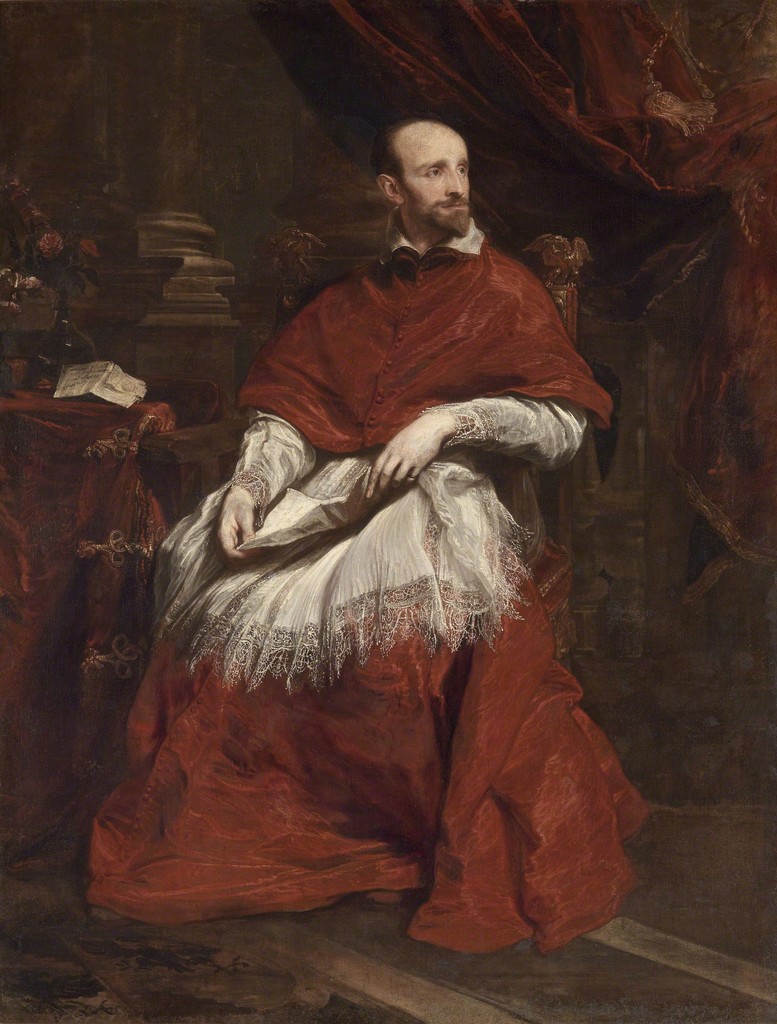
Anthony van Dyck — Cardinal Guido Bentivoglio
Anthony van Dyck

Cardinal Guido Bentivoglio

1623

Painted in Rome in 1623, during the most formative years of Anthony van Dyck's early career, this commanding portrait of Cardinal Guido Bentivoglio stands as one of the supreme achievements of Baroque portraiture. Van Dyck captures the Cardinal with extraordinary psychological acuity, rendering the sitter's intelligence and quiet authority through a subtle interplay of gaze, posture, and the luminous fall of crimson robes against a darkened ground. The handling of fabric is breathtaking in its technical ambition, with cascading silk and lace rendered in loose, confident brushwork that anticipates the painterly freedoms Van Dyck would carry northward to the courts of Europe. Bentivoglio, a distinguished papal diplomat and man of letters, is presented not merely as an ecclesiastical figure but as a fully realized individual, alert and composed in equal measure. The work belongs to a celebrated corpus of portraits Van Dyck produced during his Italian sojourn, a period in which he absorbed the lessons of Titian and Rubens while developing a sensibility that was unmistakably his own. The influence of Titian is legible in the warm chromatic palette and the dignified spatial arrangement, yet the emotional directness and the loosening of academic convention speak to Van Dyck's singular genius. This portrait is held in the permanent collection of the Galleria Palatina at Palazzo Pitti in Florence, one of the great dynastic collections of Europe, which alone testifies to the esteem in which the work has been held across centuries. For collectors with a serious interest in Old Master portraiture, the opportunity to encounter this painting at The Frick Collection, itself one of the most distinguished contexts in which such works can be seen, is a rare and significant event. The painting rewards prolonged study, revealing new subtleties of handling and expression with each viewing, and it occupies a central place in any understanding of how Van Dyck transformed the European portrait tradition from the inside out.

Medium
Oil on canvas
Signed
Yes
Location
The Frick Collection, New York, NY

Start the Discussion

Request access to join the discussion

Spotted works by Anthony van Dyck

About this work

Anthony van Dyck, Cardinal Guido Bentivoglio, 1623

Painted in Rome in 1623, during the most formative years of Anthony van Dyck's early career, this commanding portrait of Cardinal Guido Bentivoglio stands as one of the supreme achievements of Baroque portraiture. Van Dyck captures the Cardinal with extraordinary psychological acuity, rendering the sitter's intelligence and quiet authority through a subtle interplay of gaze, posture, and the luminous fall of crimson robes against a darkened ground. The handling of fabric is breathtaking in its technical ambition, with cascading silk and lace rendered in loose, confident brushwork that anticipates the painterly freedoms Van Dyck would carry northward to the courts of Europe. Bentivoglio, a distinguished papal diplomat and man of letters, is presented not merely as an ecclesiastical figure but as a fully realized individual, alert and composed in equal measure. The work belongs to a celebrated corpus of portraits Van Dyck produced during his Italian sojourn, a period in which he absorbed the lessons of Titian and Rubens while developing a sensibility that was unmistakably his own. The influence of Titian is legible in the warm chromatic palette and the dignified spatial arrangement, yet the emotional directness and the loosening of academic convention speak to Van Dyck's singular genius. This portrait is held in the permanent collection of the Galleria Palatina at Palazzo Pitti in Florence, one of the great dynastic collections of Europe, which alone testifies to the esteem in which the work has been held across centuries. For collectors with a serious interest in Old Master portraiture, the opportunity to encounter this painting at The Frick Collection, itself one of the most distinguished contexts in which such works can be seen, is a rare and significant event. The painting rewards prolonged study, revealing new subtleties of handling and expression with each viewing, and it occupies a central place in any understanding of how Van Dyck transformed the European portrait tradition from the inside out.

Medium
Oil on canvas
Year
1623
Signed
Hand-signed by the artist
Seen at
The Frick Collection, Manhattan, United States

More works by Anthony van Dyck

Collected by

Cleveland Museum of Art