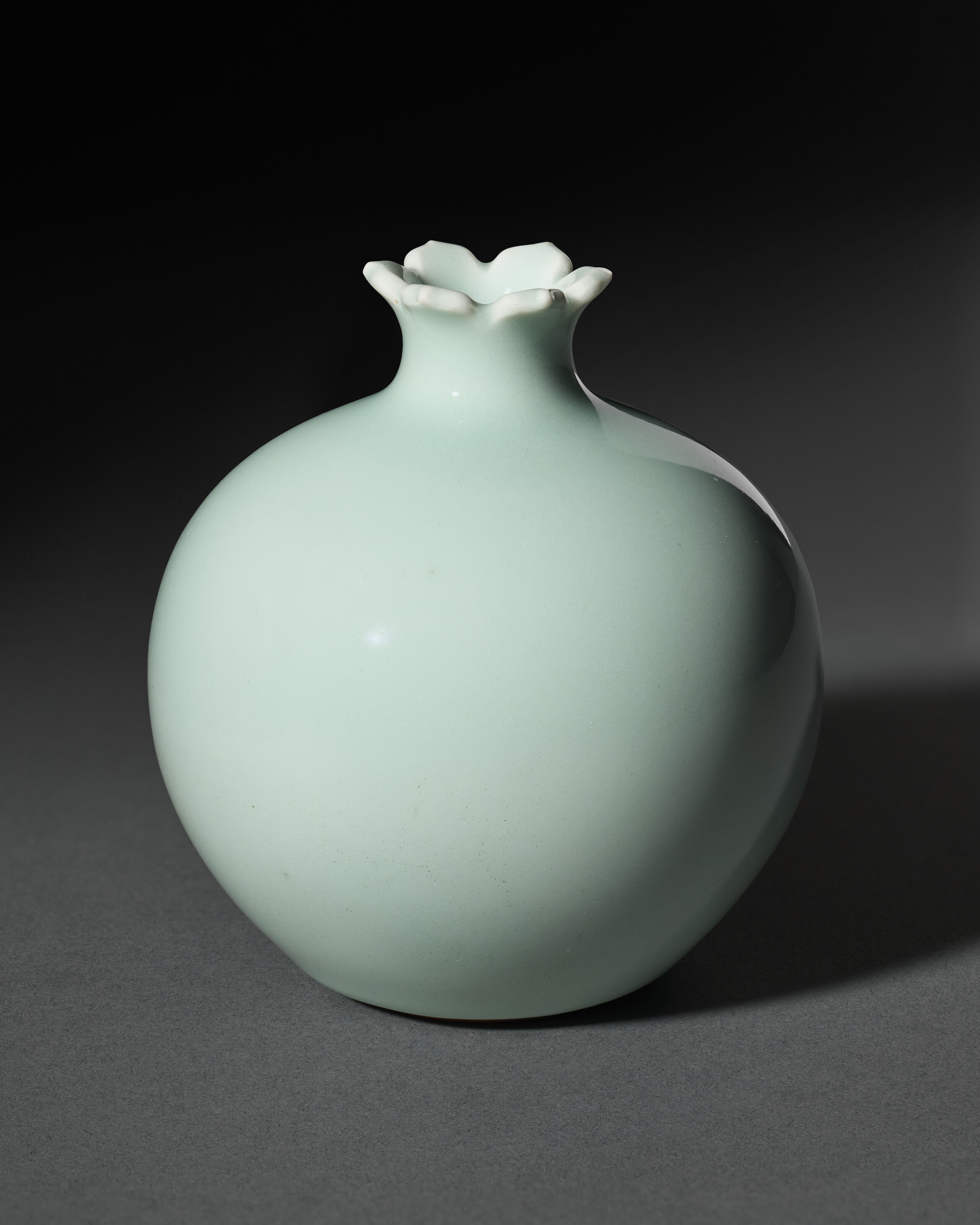
A Very Rare Small Celadon-glazed Pomegranate-form Vase
QIANLONG SEAL MARK IN UNDERGLAZE BLUE AND OF THE PERIOD (1736-1795)
This rare celadon vase from the Qianlong period exhibits the refined taste and technical mastery characteristic of 18th century Chinese imperial porcelain production. The pomegranate form, a traditional auspicious motif symbolizing fertility and abundance, is executed with remarkable naturalism in the subtle, jade like green celadon glaze. The underglaze blue seal mark confirms its authenticity and imperial provenance, indicating this small vessel was produced in the palace kilns during one of China's most celebrated periods of ceramic achievement.
- Spotted At
- Auction House · Christie's
Notes
LITERATURE H. A. Link, ed., Asian Orientations: Treasures from Honolulu's Oriental Art Society, Honolulu, 1985, p. 39, no. 26. EXHIBITED Honolulu, Honolulu Academy of Arts, Asian Orientations: Treasures from Honolulu's Oriental Art Society, 11 July- 25 August 1985. Conditions of sale Brought to you by Rufus Chen (陳嘉安) Head of Sale, AVP, Specialist Check the condition report or get in touch for additional information about this ASIANARTNY@CHRISTIES.COM +1 212 636 2180 VIEW CONDITION REPORT LOT ESSAY Fruit and floral forms provided rich inspiration for Qing-dynasty potters, their naturalistic shapes translated into vessel forms and decorative motifs often imbued with auspicious meaning. The pomegranate, a long-standing emblem of fertility and numerous progeny, functions as a rebus for zi (子), meaning 'seed' or 'offspring'. Introduced to China during the Tang dynasty, the motif became as popular as the peach, symbolizing longevity, and its compact, rounded proportions lent particularly well to small vessels such as the present vase. This elegant, easily-handled form appears to have been first produced in the Yongzheng reign (AD 1723-1735) with a range of monochrome glazes. A comparable celadon-glazed example bearing a Yongzheng mark is in the National Palace Museum, Taipei, illustrated in Catalogue of the Special Exhibition of K’ang-hsi, Yung-cheng and Ch’ien-lung Porcelain Ware from the Ch’ing Dynasty in the National Palace Museum, Taipei, 1986, p. 93, no. 62. A teadust-glazed Yongzheng-marked example in the Nanjing Museum is published in The Official Kiln Porcelain of the Qing Dynasty, Shanghai, 2003, p. 206. Another example in the Musée Guimet, Paris, is illustrated in Oriental Ceramics: The World’s Great Collections, vol. 7, Tokyo, 1981, no. 47. A further Yongzheng-marked vessel with a flambé glaze, in the National Museum of China, Beijing, is illustrated in Zhongguo guojia bowuguan guancang wenwu yanjiu congshu: ciqi juan – Qing dai, Shanghai, 2007, p. 95, no. 61.
🔨 Auction Lot
Important Chinese Art
March 26, 2026
Estimate: $120,000 – $180,000
Sold: $381,000
Lot 631
Start the Discussion
Request access to join the discussion