Join The Collection to save, track, and explore works like this.

Friedrich Drake & Heinrich Strack — Berlin Victory Column (Siegessäule)

Berlin Victory Column (Siegessäule)

1873

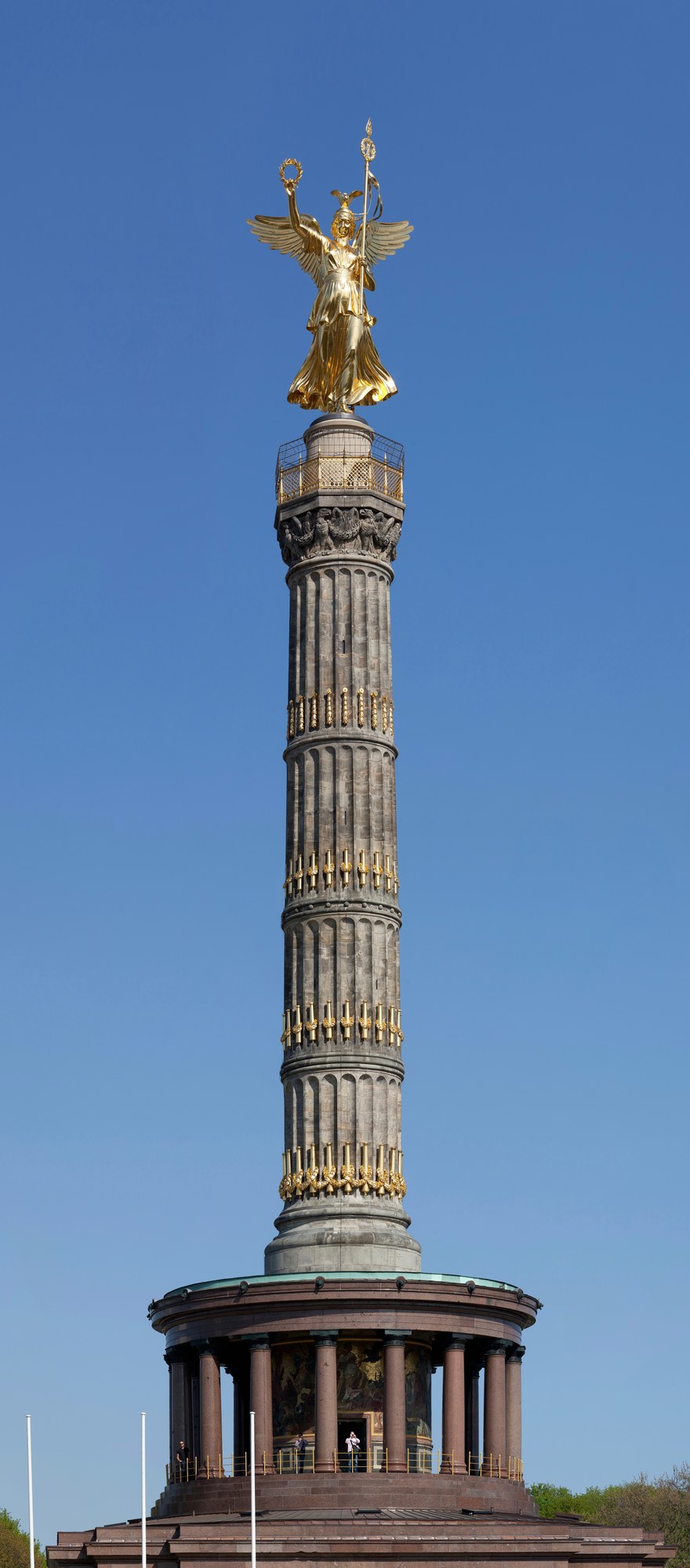
The Berlin Victory Column stands as a monumental celebration of Prussian military triumph, its slender cylindrical shaft rising majestically from a circular pavilion topped with classical colonnades. Designed by architects Friedrich Drake and Heinrich Strack, the structure is clad in rusticated sandstone with gilded bronze ornamentation bands that catch the light along its segmented shaft. Crowning the 67-meter column is a colossal gilded bronze winged figure, the Goddess of Victory, holding laurel wreath and scepter aloft against the Berlin sky. Originally erected in 1873 at the Reichstag, the column was relocated to its present location in the Tiergarten in 1938 and remains one of Germany's most recognizable public monuments. The work exemplifies the grandiose architectural language of imperial Germany, merging neoclassical vocabulary with ambitious scale to commemorate national power and cultural identity. Wikimedia Commons (CC BY-SA)

Medium
Sandstone and gilded bronze

Start the Discussion

Request access to join the discussion

About this work

Friedrich Drake & Heinrich Strack, Berlin Victory Column (Siegessäule), 1873

The Berlin Victory Column stands as a monumental celebration of Prussian military triumph, its slender cylindrical shaft rising majestically from a circular pavilion topped with classical colonnades. Designed by architects Friedrich Drake and Heinrich Strack, the structure is clad in rusticated sandstone with gilded bronze ornamentation bands that catch the light along its segmented shaft. Crowning the 67-meter column is a colossal gilded bronze winged figure, the Goddess of Victory, holding laurel wreath and scepter aloft against the Berlin sky. Originally erected in 1873 at the Reichstag, the column was relocated to its present location in the Tiergarten in 1938 and remains one of Germany's most recognizable public monuments. The work exemplifies the grandiose architectural language of imperial Germany, merging neoclassical vocabulary with ambitious scale to commemorate national power and cultural identity. Wikimedia Commons (CC BY-SA)

Medium
Sandstone and gilded bronze
Year
1873
Seen at
Großer Stern, Tiergarten

Related themes

Nineteenth Century, Monument, Victory Symbolism, Bronze, Urban Landmark, Civic Monument, Winged Figure, Commemorative, Public Art, Sandstone, Architectural Landmark, Berlin Landmark, Classical Revival, Monumental Sculpture, Gilded, Column Monument, Neoclassical, Iconic Landmark, German Architecture, Outdoor Sculpture