Victor Brauner
Victor Brauner: Visionary Worlds Within Worlds
Artist Spotlight · The Collection Editorial
“I believe in the magic of painting. I believe that a painting can act upon the world.”
Victor Brauner
When the Centre Pompidou mounted its sweeping survey of Surrealism's international dimensions, one name kept surfacing with particular insistence among scholars and curators alike: Victor Brauner. The Romanian born painter, occultist, and mythmaker spent decades on the margins of the movement's official histories, overshadowed by louder personalities in the Paris circle, yet his work has proven to possess a staying power that grows more compelling with each passing generation. Today, as collectors and institutions alike reassess the full geographic and intellectual breadth of the Surrealist project, Brauner stands revealed as one of its most singular and quietly radical contributors. Brauner was born in 1903 in Piatra Neamț, Romania, into a family with deep roots in Jewish mysticism and spiritualism.
Victor Brauner
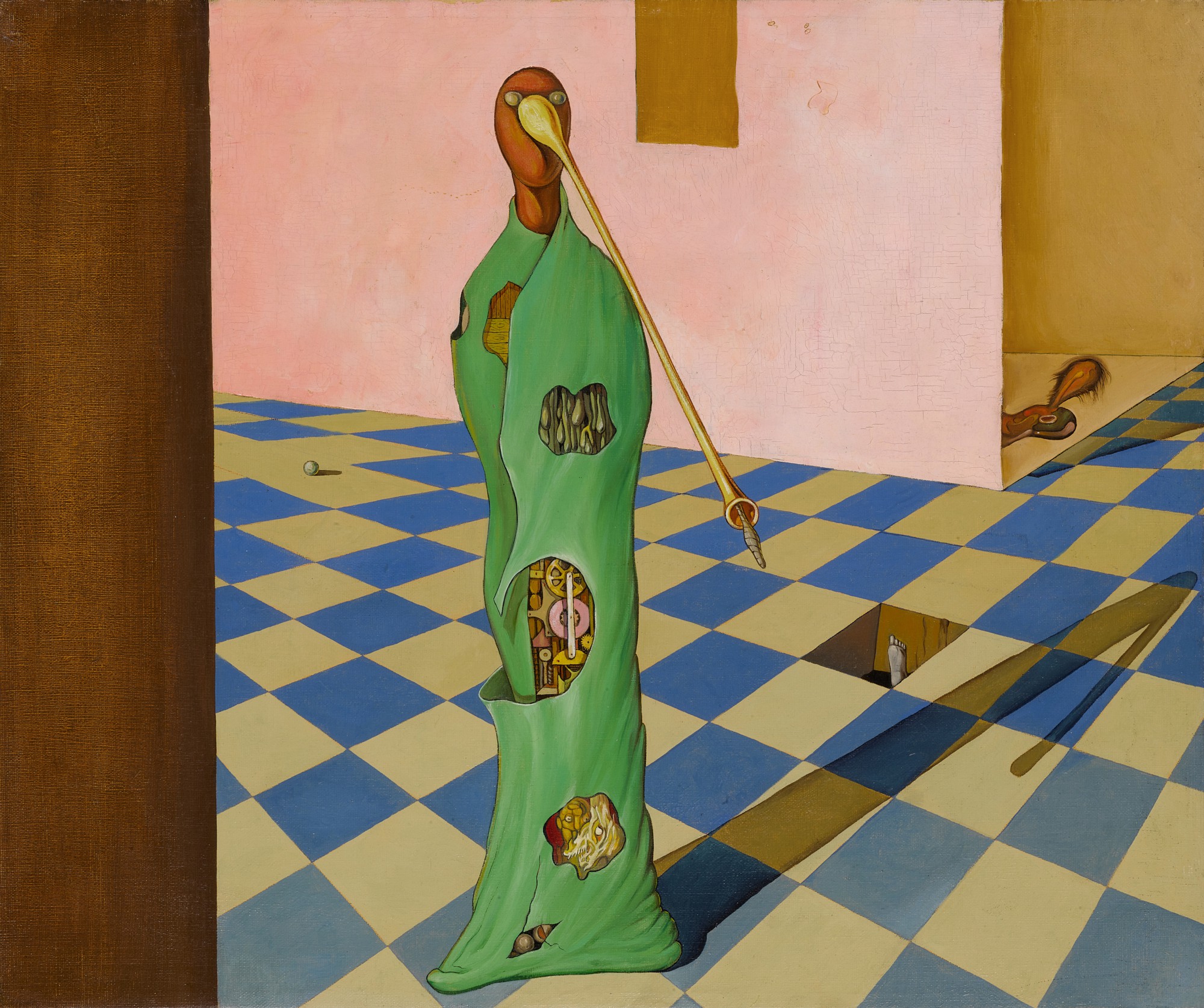
Indicateur de l'espace, 1934
His father was an ardent follower of various esoteric traditions, and the household Brauner grew up in was saturated with ideas about the occult, the hidden order of things, and the symbolic language of ancient belief systems. This early immersion in mystical thought was not incidental to his art: it became the very architecture of his imagination. He studied at the School of Fine Arts in Bucharest in the early 1920s, and by 1924 he was already experimenting with avant garde ideas, co founding the journal 75HP and positioning himself within Romanian Dadaism alongside the poet Ilarie Voronca. Brauner first arrived in Paris in 1925, and though he returned to Bucharest for a period, he settled definitively in the French capital by 1930, drawn irresistibly into the orbit of André Breton and the Surrealist group.
He was formally welcomed into the movement in 1933, and his friendship with the sculptor Alberto Giacometti proved formative during these years. His early Parisian paintings already demonstrated an uncanny ability to conjure hybrid figures: creatures assembled from animal, human, and architectural parts, hovering in spaces that obeyed their own internal logic rather than any recognizable law of the physical world. There was a quality to his line even then that suggested a man transcribing visions rather than composing compositions. The biographical fact that has followed Brauner through art history with almost mythological persistence is the loss of his left eye in 1938, the result of an accident during an altercation between two other artists at a party.
Victor Brauner
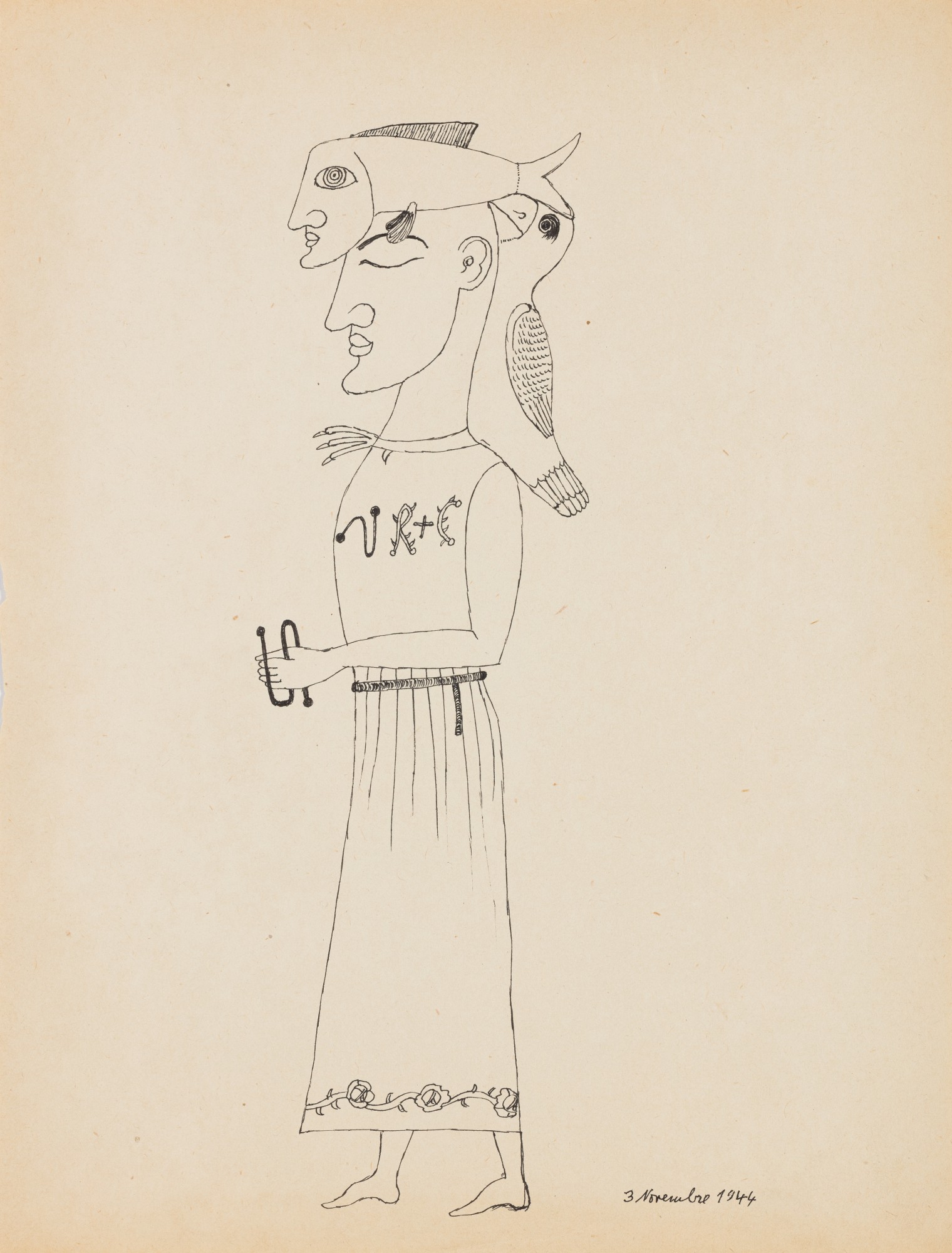
Egyptienne (Variation originale autour du thème de la femme rose-croix)
The remarkable dimension of this event was that Brauner had depicted figures with damaged or missing eyes in his paintings years before it occurred, most hauntingly in a 1931 self portrait showing himself with a gouged eye socket. Whether one reads this as premonition, coincidence, or the unconscious working through obsessive imagery, it deepened the aura of the prophetic that clung to his practice throughout his life. Rather than diminishing his output, the experience seemed to intensify his commitment to exploring what lay beneath visible reality. During the Second World War, Brauner was forced into hiding in the French Alps, unable to travel due to his lack of identity papers and his status as a Romanian Jewish refugee.
Isolated and without access to traditional art supplies, he developed his celebrated encaustic technique, working with wax mixed with pigment on whatever surfaces he could find. This enforced constraint became one of the most generative pressures of his career. The wax medium lent his surfaces a translucent, almost amber luminosity, as though the images were preserved specimens of a dream life, sealed permanently against the outside world. Works from this period have an intimacy and a formal density that marks them as among the most personal objects he ever produced.
Victor Brauner
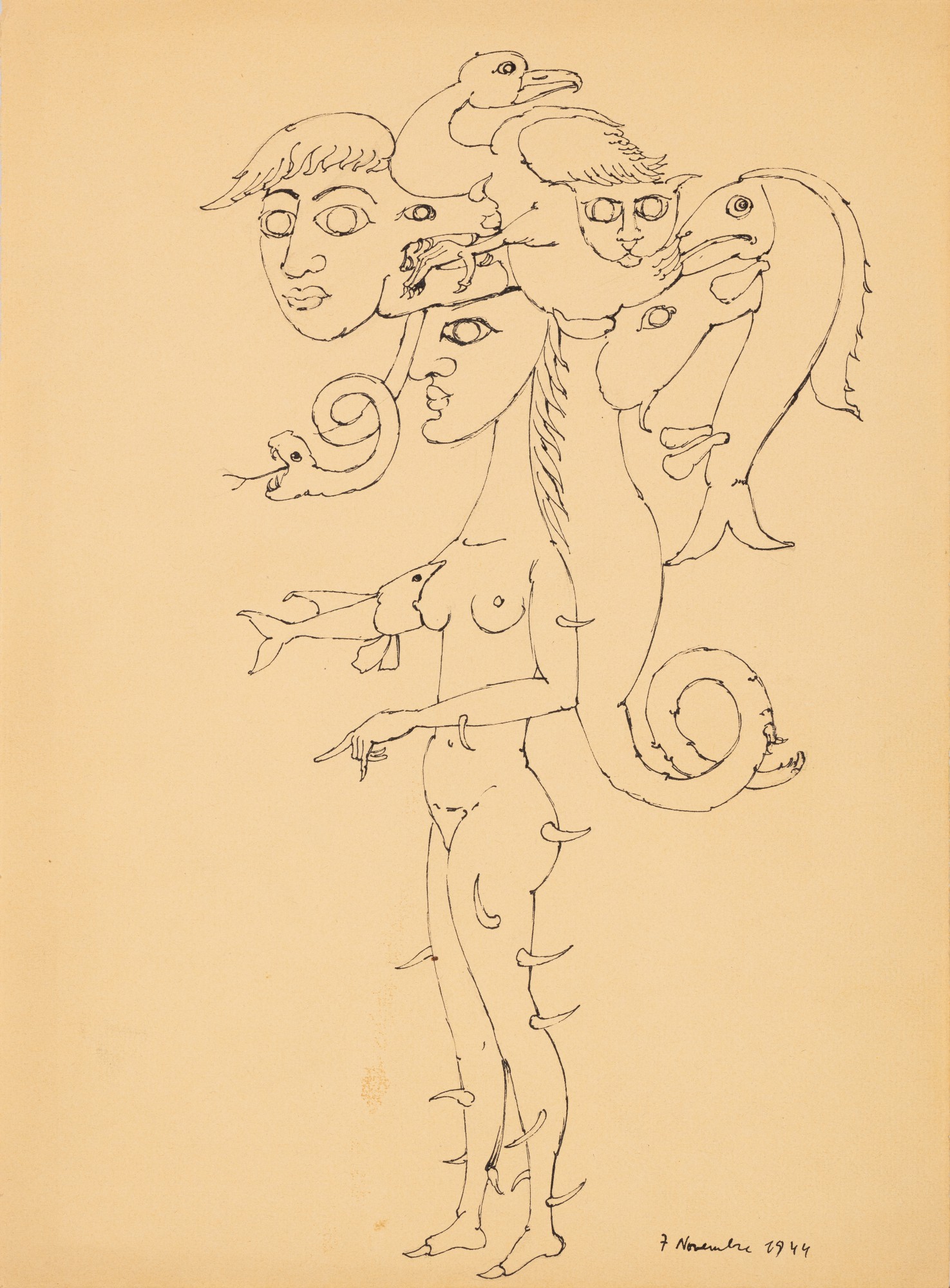
Femme à la coiffe (Variation originale autour du thème de la femme rose-croix), novembre 1944
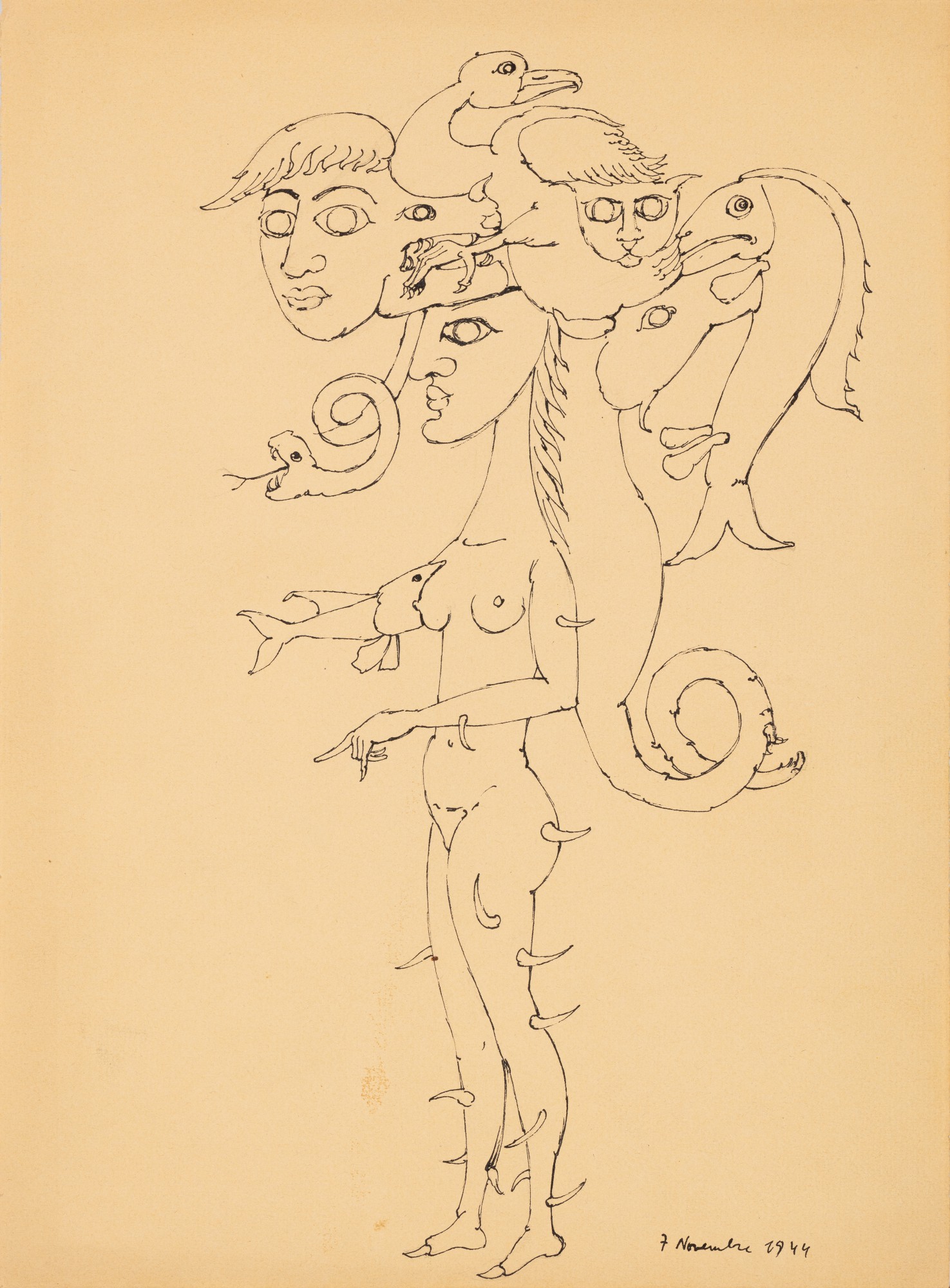
The body of work now available through The Collection offers a rich cross section of Brauner's obsessions and his formal evolution across several decades. "Indicateur de l'espace" from 1934 belongs to his early Parisian surrealist period and exemplifies his gift for constructing enigmatic spatial puzzles that hold the eye without ever fully resolving themselves. The series of ink and pencil works bearing the subtitle "Variation originale autour du thème de la femme rose croix" from November 1944 reveal the depth of his engagement with Rosicrucian symbolism and the feminine as a cosmological principle rather than a merely human subject. "Tête de Femme Feuille ou Capitale de la plante" from 1955 demonstrates his mature synthesis, wherein the human figure dissolves into botanical and architectural forms with breathtaking formal confidence.
"Visage, étreinte du corps aimé" from 1961 and "Portrait du côté maison" from 1959 show a late period artist still restlessly experimenting, layering mixed media with the ease of someone for whom technique has long since become transparent to vision. For collectors, Brauner represents something genuinely rare in the Surrealist field: a body of work that is both intellectually serious and visually ravishing, rooted in a coherent personal mythology that rewards sustained attention. His works appear at auction with meaningful regularity at houses including Christie's and Sotheby's, where major oil paintings have achieved results in the hundreds of thousands, while works on paper and encaustic pieces offer entry points for collectors building relationships with his practice. The diversity of media he employed, from oil and encaustic to ink, pencil, lithograph, and wax on cardboard, means that his collecting universe is genuinely varied.
Victor Brauner
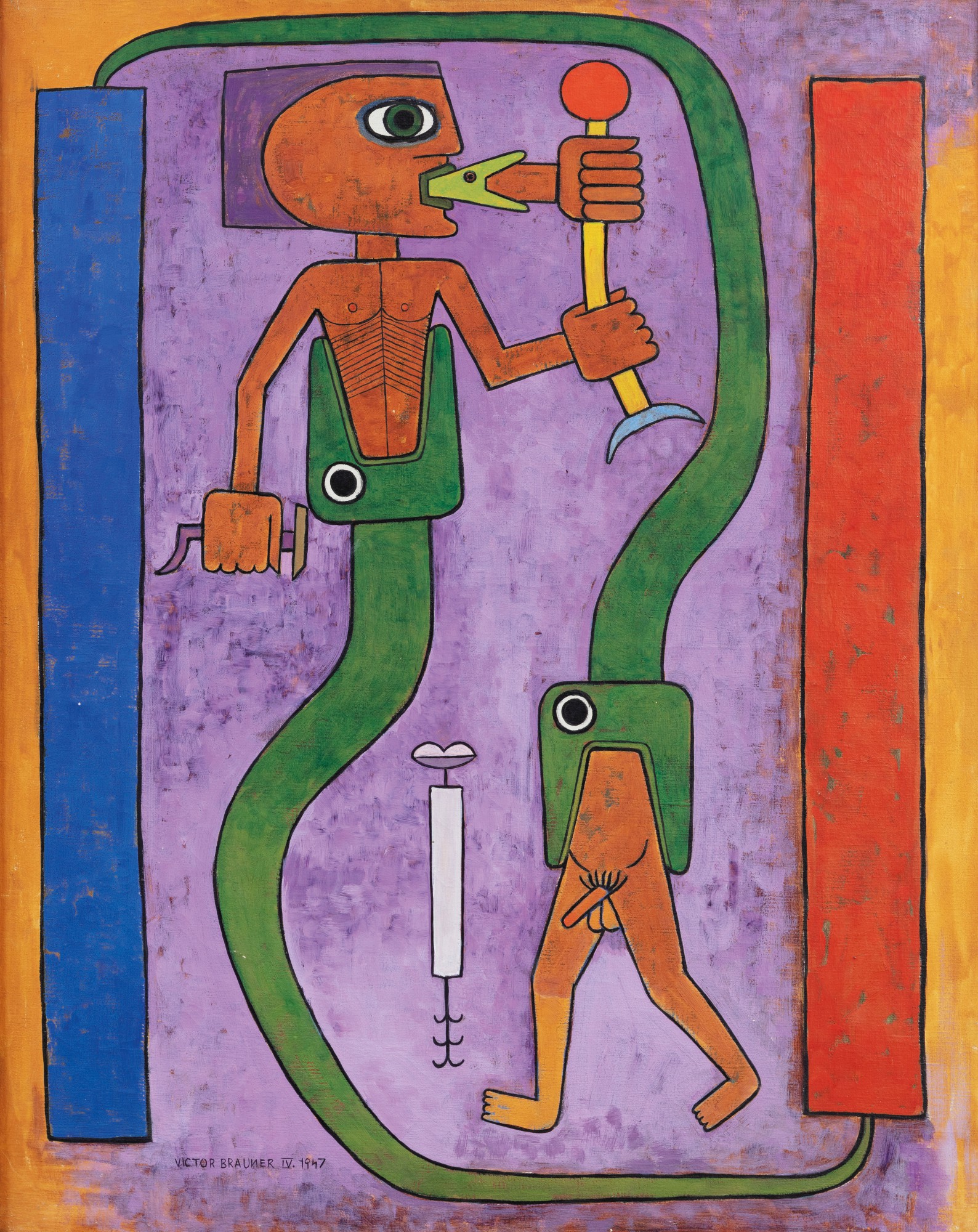
Le Codex du Poète, Mythologie du Poète, Première Naissance
Connoisseurs tend to prize the encaustics most highly for their rarity and the directness with which they communicate his wartime isolation, but the ink works on paper are arguably where his draughtsmanship is most purely on display. Brauner belongs to a constellation of Surrealist artists whose work gains enormously from being understood in relation to one another. His closest affinities are perhaps with Remedios Varo and Leonora Carrington, artists who similarly drew on esoteric traditions and constructed personal symbolic systems within the Surrealist framework rather than simply illustrating Freudian orthodoxies. The German Swiss artist Meret Oppenheim shared his interest in the object as a site of transformation, and the work of Roberto Matta offers a parallel example of a non French artist who brought an entirely distinct imaginative vocabulary into the Paris circle.
Understood in this company, Brauner reads not as a peripheral figure but as a central node in one of modernism's most intellectually adventurous networks. Victor Brauner died in Paris in 1966, leaving behind a body of work that took decades to receive the institutional attention it deserved. The reassessment has been gathering pace since the 1990s, driven by renewed scholarly interest in Surrealism's esoteric dimensions and by the market's growing appetite for artists whose work operates at the intersection of image making and systems of belief. He matters today not only as a historical figure to be recovered and properly placed, but as an artist whose questions about the nature of vision, symbol, and psychic reality feel urgently alive.
To encounter a Brauner for the first time is to understand that some painters are not merely depicting an inner world but genuinely reporting back from one.
Explore books about Victor Brauner
Victor Brauner: Retrospective Exhibition
Michel Tapié
Victor Brauner
Sarane Alexandrian
Victor Brauner: A Retrospective
Reinhard Spieler
Victor Brauner: Magic and Painting
Octavio Paz
Victor Brauner: Catalogue Raisonné
Lavinia Cernuschi
Victor Brauner: Le Surréalisme et l'Occulte
Alain Joubert
Victor Brauner: The Eye and the Void
Dawn Ades