Malcolm Morley
Malcolm Morley, Master of Perpetual Reinvention
Artist Spotlight · The Collection Editorial
“I paint from photographs because I want to be free of the anxiety of a subject that can move or change.”
Malcolm Morley, interview with Lawrence Alloway, 1974
When the Turner Prize jury announced its inaugural recipient in 1984, the art world took note of a name that had been quietly reshaping the boundaries of contemporary painting for nearly two decades. Malcolm Morley, a British born artist working from New York, received the honor not as a coronation of a single style but as recognition of an entire career built on restless transformation. The prize acknowledged something rare: an artist who had already pioneered one major movement and was in the middle of inventing another, with no sign of slowing down. Morley was born in Highgate, London, in 1931, and his early years were defined by disruption and survival rather than comfort or privilege.
Malcolm Morley
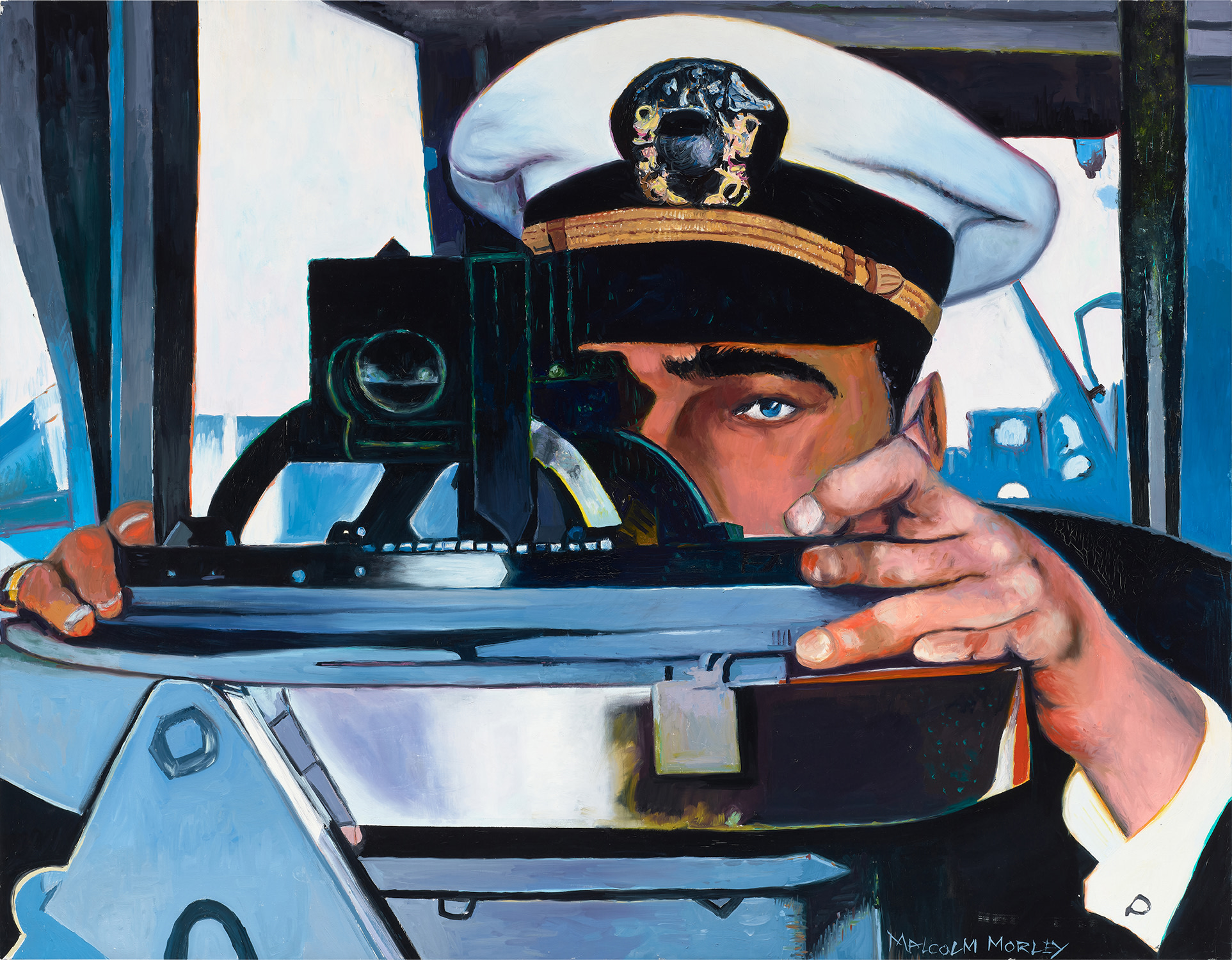
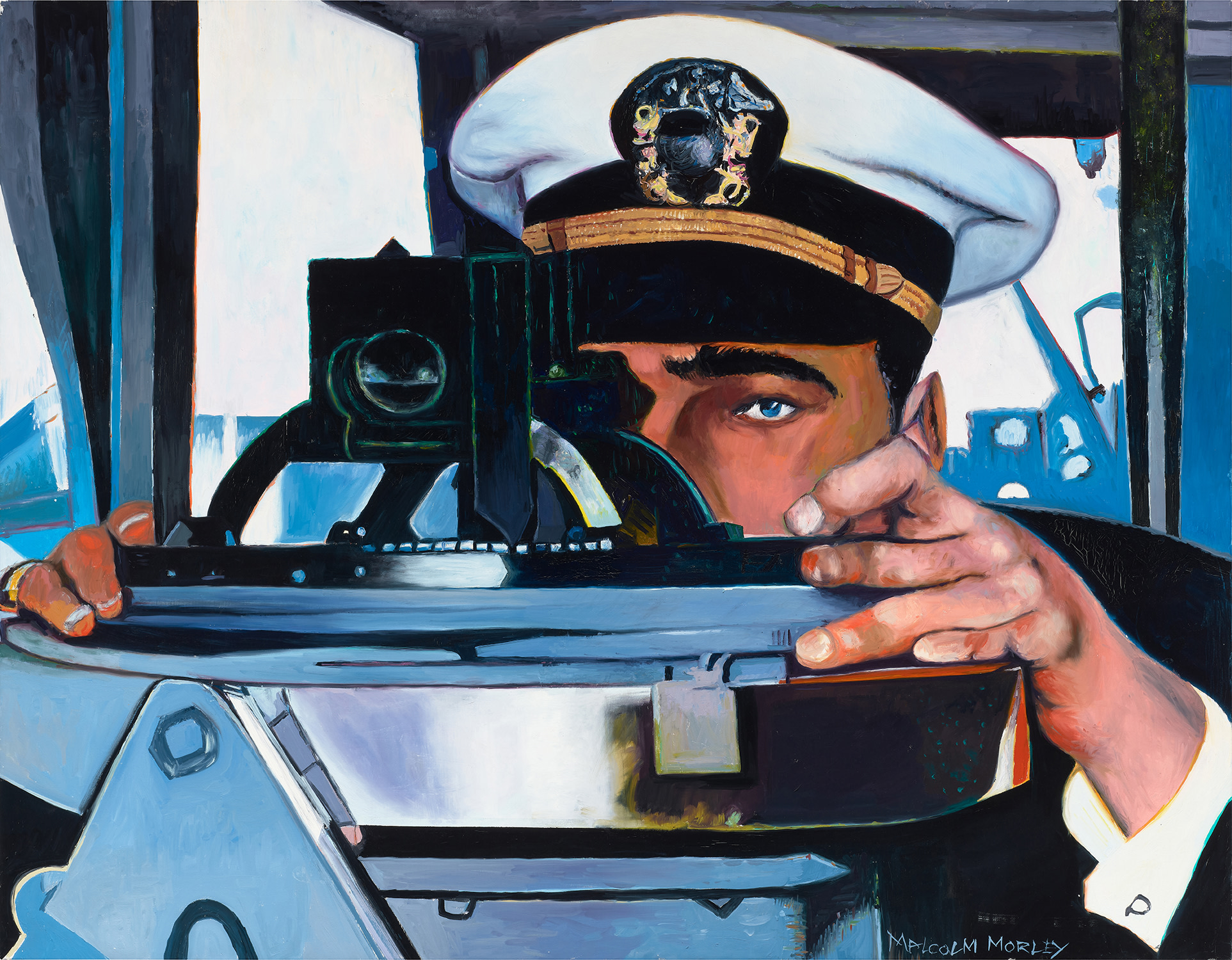
The Sailor, 1997
He was evacuated from London during the Second World War, a formative displacement that marked his sensibility in ways that would surface throughout his working life in images of vessels, journeys, and the charged tension between safety and peril. He spent time in a borstal as a teenager, and later served in the merchant navy, an experience that seeded a lifelong fascination with ships, the sea, and the romantic weight of maritime imagery. He went on to study at the Camberwell School of Arts and Crafts and later the Royal College of Art, before making the pivotal move to New York in the early 1960s, the city that would become his permanent creative home. In New York, Morley found himself surrounded by the dominant energies of Abstract Expressionism and the rising cool of Pop Art, yet he carved a startlingly original path through both.
By the mid 1960s he had begun producing large scale paintings derived directly from photographic sources, postcards, and printed reproductions, rendered with a meticulous, almost mechanical fidelity that anticipated what would later be called Photorealism. Works from this period depicted ocean liners, cruise ships, and tourist imagery with an uncanny surface precision. He developed a distinctive working method, painting through a grid system that isolated each section of the composition and allowed him to render the image without ever seeing the whole until it was complete. This approach brought a radical detachment to the act of looking, treating the photograph not as a window onto reality but as an object in its own right.
Malcolm Morley
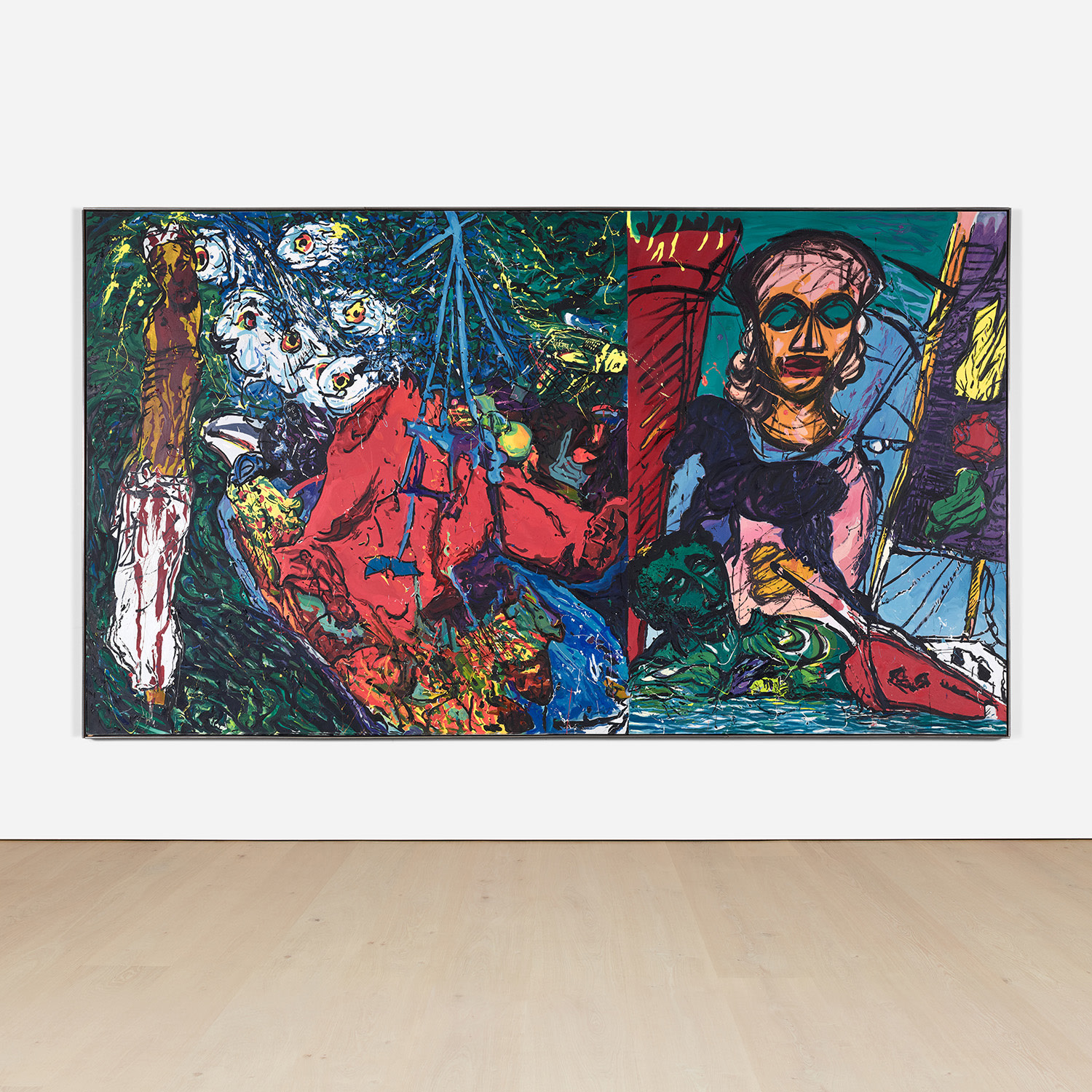
Aegean Crime, 1987
The work from this era, including pieces held by MoMA and the Tate, established Morley as a significant figure in American and international painting circles well before the Turner Prize brought him wider recognition. His 1972 painting School of Athens, now in major institutional collections, exemplified his ability to take inherited cultural imagery and subject it to a kind of loving but alienating scrutiny. Yet even as collectors and critics were absorbing the implications of his Photorealist breakthrough, Morley was already pulling away from it. By the late 1970s and into the 1980s, his canvases erupted into something altogether different: gestural, fragmented, painterly, and charged with expressive urgency.
He emerged as a vital figure in the Neo Expressionist moment, sharing an international stage with painters like Georg Baselitz, Sigmar Polke, and Anselm Kiefer, while maintaining a distinctly personal mythology rooted in maritime history, classical antiquity, and raw physical sensation. The works available through The Collection span some of the richest decades of Morley's output and offer a genuinely compelling survey of his range. Aegean Crime (1987) and Gale Warning (1987), both executed in oil and wax on canvas, capture the turbulent energy of his mature Neo Expressionist period, with their surfaces alive with visible process and emotional temperature. The wax medium he favored in this era gave his paintings a luminous, almost geological depth, as though layers of time and sensation had been compressed into the surface.
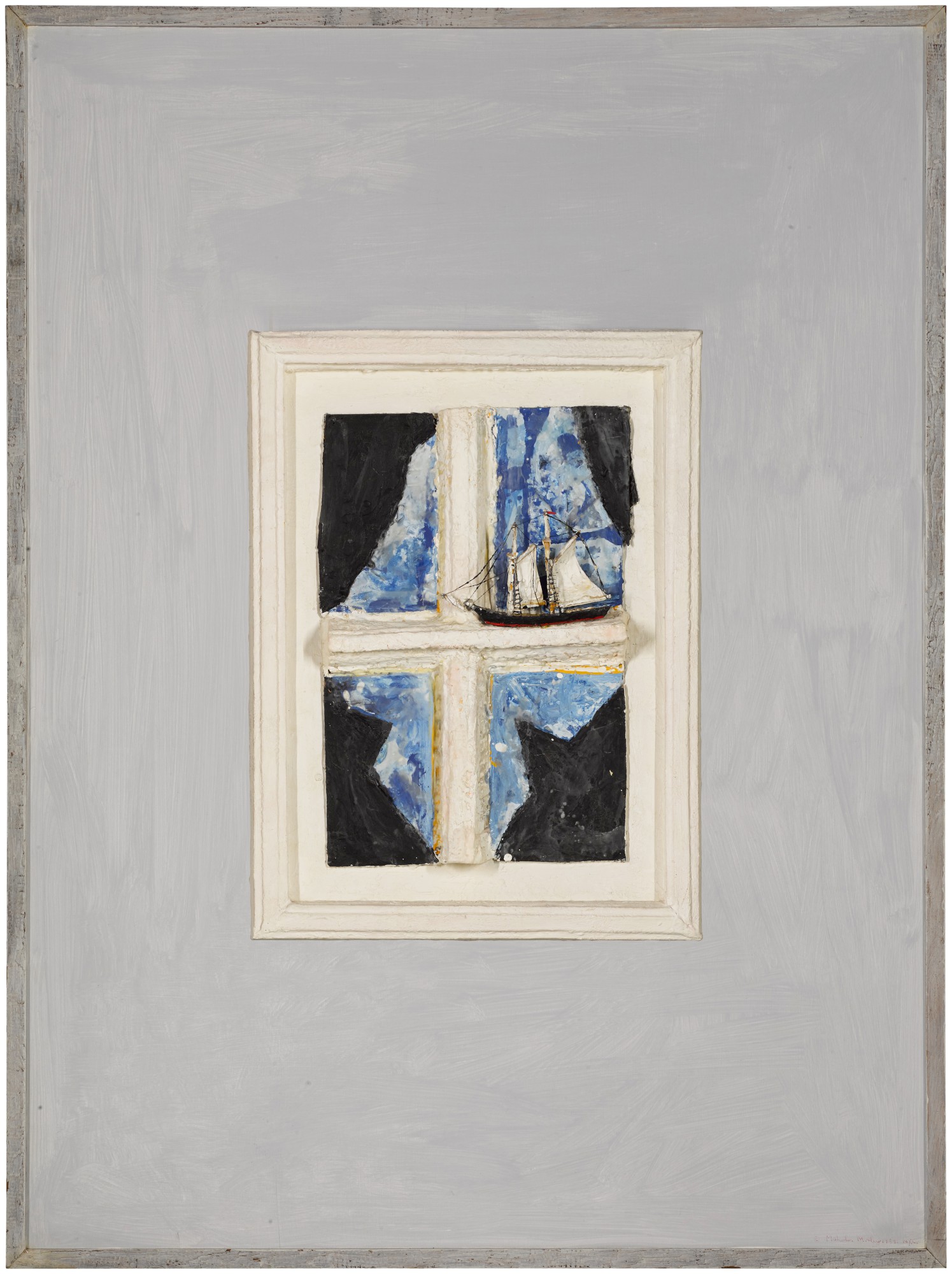
Malcolm Morley
The Flying Dutchman
Approaching Valhalla (1997) and The Sailor (1997), both in oil, show a slightly later Morley: still commanding, still reaching toward mythic registers, but with a compositional confidence that comes from decades of accumulated risk taking. The Boat, The Knight, The Tank (1990), a triptych in oil on linen, is among the more structurally ambitious works on offer, its three panel format inviting meditation on conflict, heroism, and the persistence of symbolic imagery across history. For collectors, Morley presents an unusually rich proposition. His prints, including the lithographs Beach Scene with Parasailor and Beach Scene (T.
374), as well as the unique monotype V (Lifeboat), demonstrate that his graphic work was never secondary to his painting practice but an extension of the same restless intelligence. The monotype in particular, unique by definition, carries the directness and immediacy of his best canvases while offering a point of entry that rewards close attention. The Flying Dutchman, with its layered combination of oil, acrylic, wax, and collage on board and its inclusion of an artist made frame, is a reminder that Morley thought about the entire object, not merely the image within it. Works like this, where the boundary between painting and sculptural presence becomes genuinely porous, represent Morley at his most inventive and are likely to attract significant collector interest as his legacy continues to be assessed.
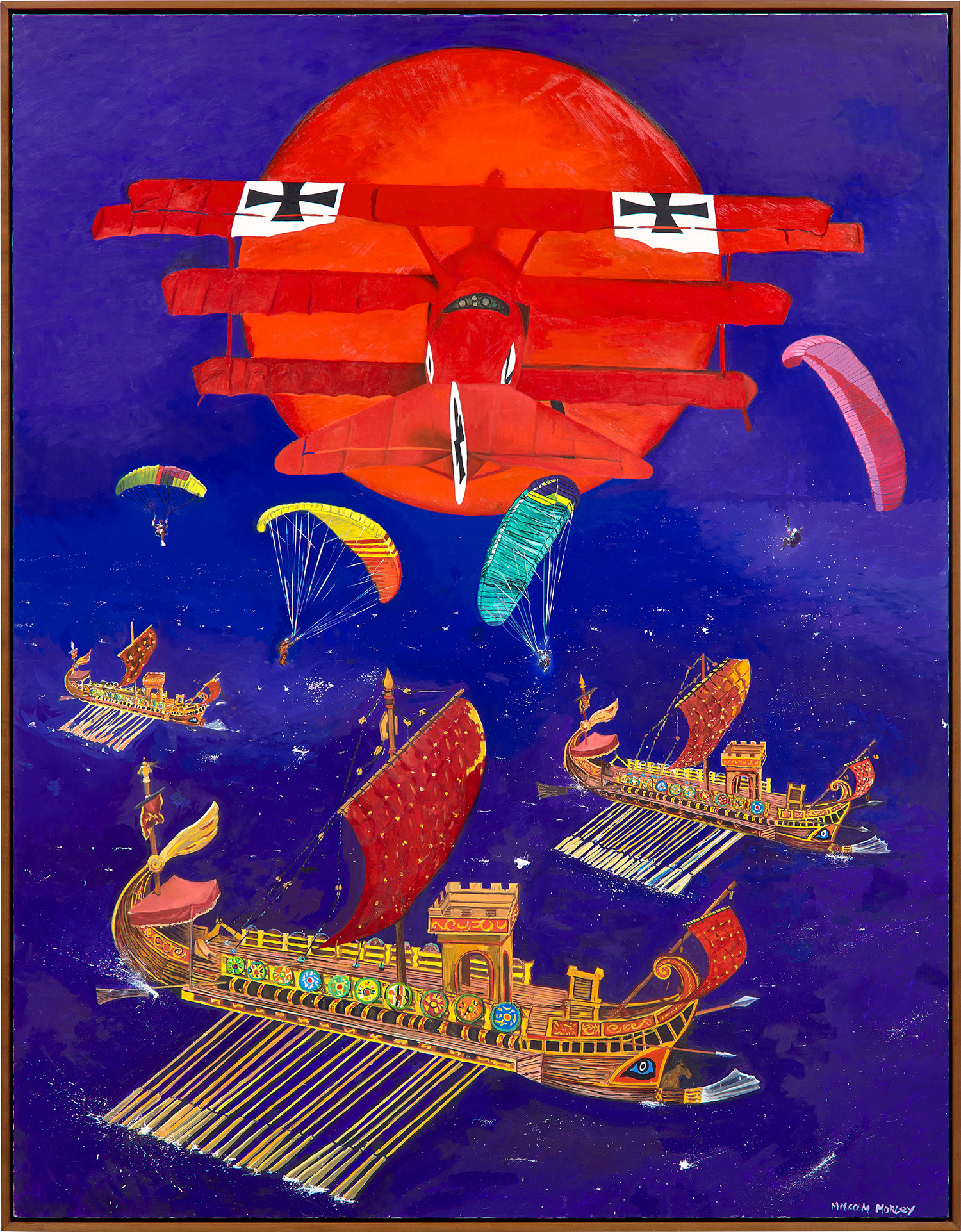
Malcolm Morley
Approaching Valhalla, 1997
In the broader context of postwar art history, Morley occupies a singular position. He was there at the beginning of Photorealism without ever being defined by it. He contributed to Neo Expressionism without being subsumed into its more fashionable currents. Artists as different as Chuck Close, Eric Fischl, and David Salle can all be understood partly in relation to the territory Morley mapped, yet none of them quite covers the same ground.
His sustained engagement with maritime imagery connects him to a long tradition of European painting while his methods and contexts remain resolutely contemporary. Auction records over the past decade have reflected growing institutional and private recognition, with major works achieving significant results at Christie's and Sotheby's, and museum retrospectives in both Europe and the United States reinforcing his canonical status. Morley died in 2018, leaving behind a body of work that rewards prolonged engagement and resists easy summary. His career is a lesson in the rewards of refusing comfort, of treating each stylistic breakthrough not as a destination but as a starting point for the next departure.
For those who collect seriously, his paintings and prints offer something increasingly rare: works that carry genuine art historical weight, demonstrate exceptional formal intelligence, and remain visually alive in ways that become richer rather than more familiar over time. To live with a Morley is to live with perpetual surprise, the sense that the painting is still thinking, still moving, still refusing to be fully known.
Explore books about Malcolm Morley