Lucio Fontana
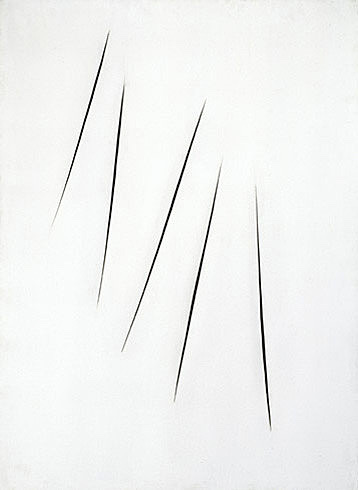
Lucio Fontana: The Man Who Opened Painting
Artist Spotlight · The Collection Editorial
“I make a hole in the canvas in order to leave behind me the old painting and the flat surface.”
Lucio Fontana, interview with Carla Lonzi, 1968
There is a moment, standing before one of Lucio Fontana's slashed canvases at the Museum of Modern Art in New York or the Tate Modern in London, when the world seems to hold its breath. The canvas is not merely cut. It is liberated. What appears at first glance to be an act of destruction reveals itself, slowly and then all at once, as one of the most generous gestures in the history of modern art: an invitation to look beyond the surface, past the plane, into infinite space itself.
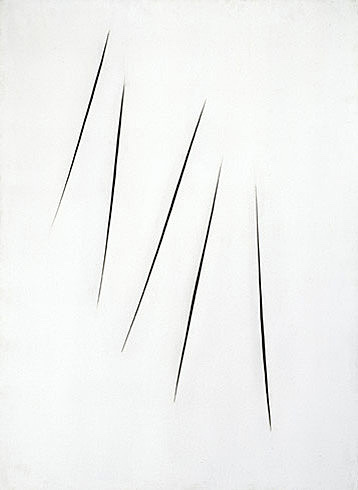
Lucio Fontana
Concetto spaziale, Attese, 1965
That sensation has not dimmed since Fontana first drew a blade across a canvas in 1958. If anything, the urgency of his vision grows stronger with each passing decade. Lucio Fontana was born in 1899 in Rosario, Argentina, to an Italian sculptor father, Luigi Fontana, whose own practice in figurative stone and bronze gave the young Lucio his first understanding of form, volume, and the physical resistance of materials. This dual inheritance, South American and Italian, proved generative throughout his life.
Fontana moved between Buenos Aires and Milan with a restlessness that was never mere geography but a genuine dialogue between two cultures, two temperaments, two ways of understanding what art could be. He studied formally at the Accademia di Brera in Milan in the late 1920s, training under the sculptor Adolfo Wildt, an experience that gave him formidable technical fluency even as it sharpened his desire to go elsewhere entirely. By the 1930s Fontana had established himself as a sculptor of genuine distinction, working in terracotta, ceramics, and bronze with an expressive confidence that drew admiring attention in Italy and Argentina alike. His ceramic works from this period, including the exuberant "Coccodrilli" of 1937, now registered with the Fondazione Lucio Fontana in Milan, reveal an artist who understood the pleasure of material and surface at a visceral level.
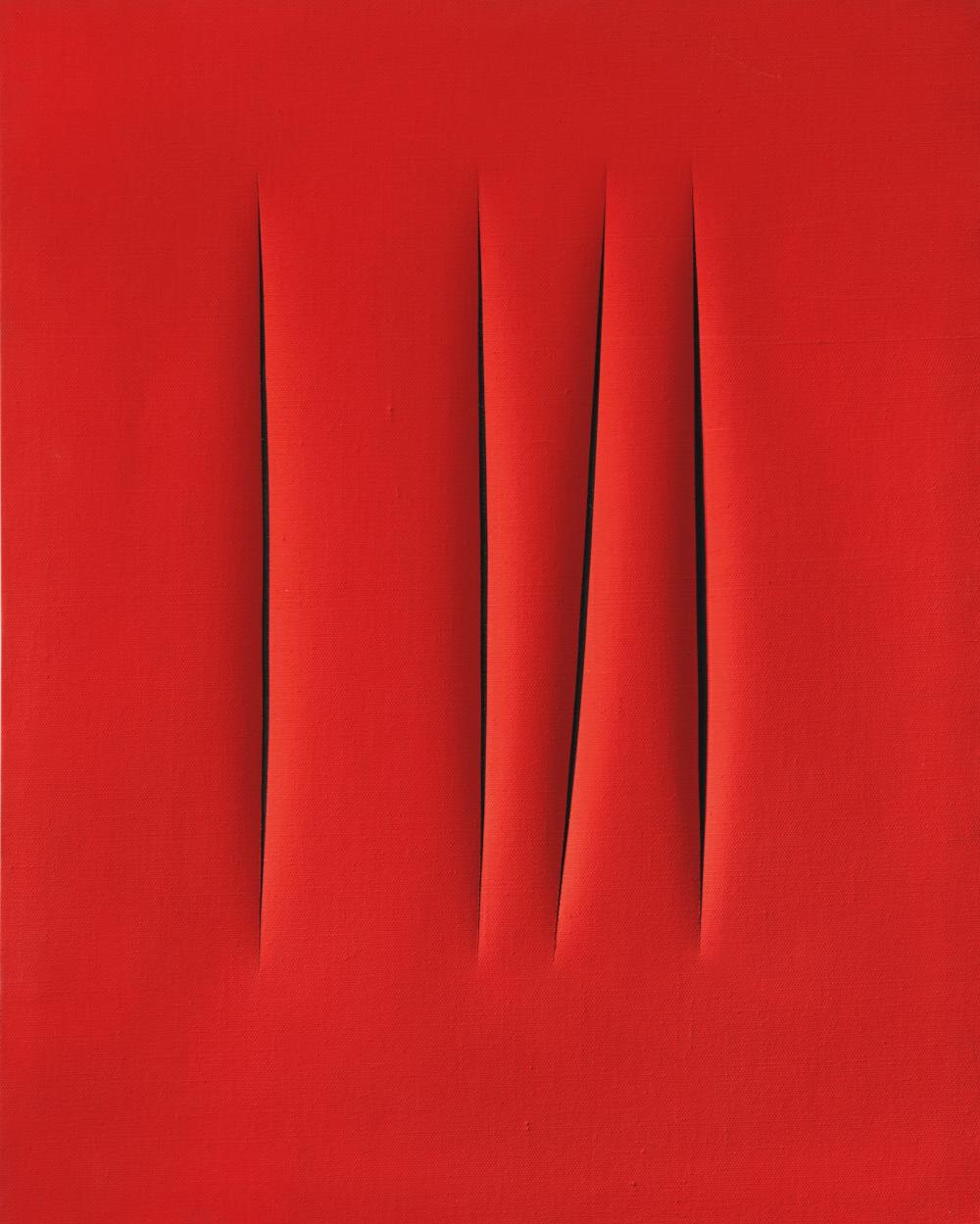
Lucio Fontana
Concetto spaziale, Attese, 1966
Yet even then, something in Fontana was straining against the boundaries of the object, against the contained and the categorical. The war years, which he spent largely in Argentina, gave him time and distance to think more radically. In 1946 he published the first Manifiesto Blanco in Buenos Aires, a document that announced his desire for an art of space, light, time, and movement. It was a manifesto that would take decades to fully inhabit.
“Space does not exist, it is just a mental exercise.”
Lucio Fontana
Fontana returned to Milan in 1947 and, with a group of collaborators, formalized the movement he called Spatialism, or Spazialismo. The early Spatial Environments he created, including a neon ceiling installation for the IX Triennale di Milano in 1951, were among the first works in the Western canon to treat the gallery itself as a medium, anticipating the installation art that would dominate discourse by the 1970s. But it was in 1958 that Fontana achieved his most radical and enduring breakthrough. The first "Tagli," or cuts, appeared that year.
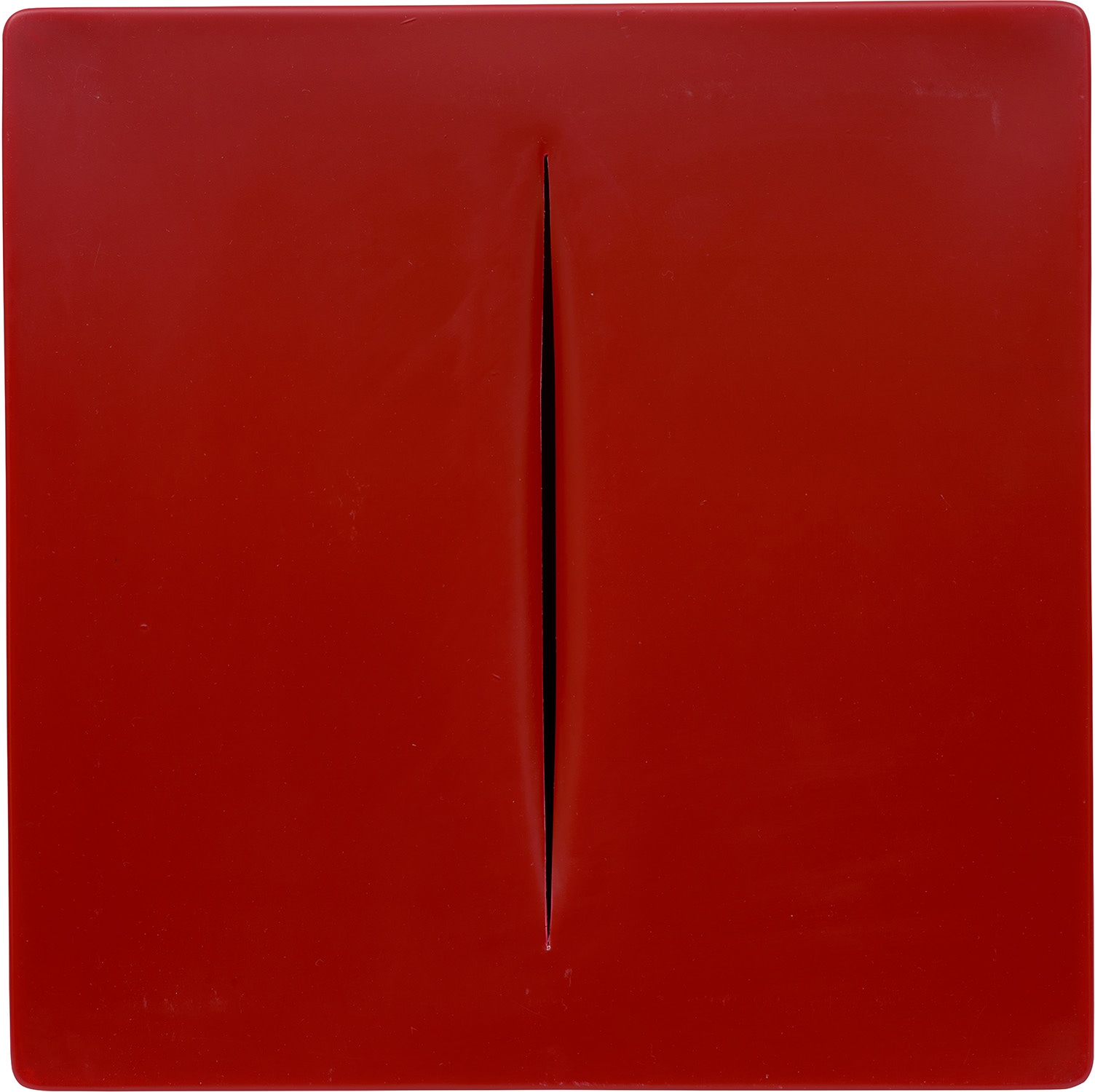
Lucio Fontana
Concetto Spaziale (Space Concept) (Red) (R. & R. M15)
Working on monochrome canvases prepared with a careful, almost devotional attention to texture and tone, Fontana drew a sharp blade through the surface in single, decisive gestures. The result was not violence but revelation. Behind the canvas, a thin backing of black gauze absorbed the eye and seemed to open onto genuine darkness, genuine depth. He titled these works "Concetto Spaziale, Attese": Spatial Concept, Waiting.
The title is everything. The cut is not a conclusion but an anticipation. The "Concetto Spaziale, Attese" works of the 1960s, including the extraordinary examples from 1965 and 1966 that represent some of the finest in Fontana's mature output, demonstrate the full range of his spatial thinking. Some carry a single long vertical cut; others hold three, five, or seven parallel incisions, each one made in a single pass without hesitation or revision.
Lucio Fontana
Concetto Spaziale, 1967
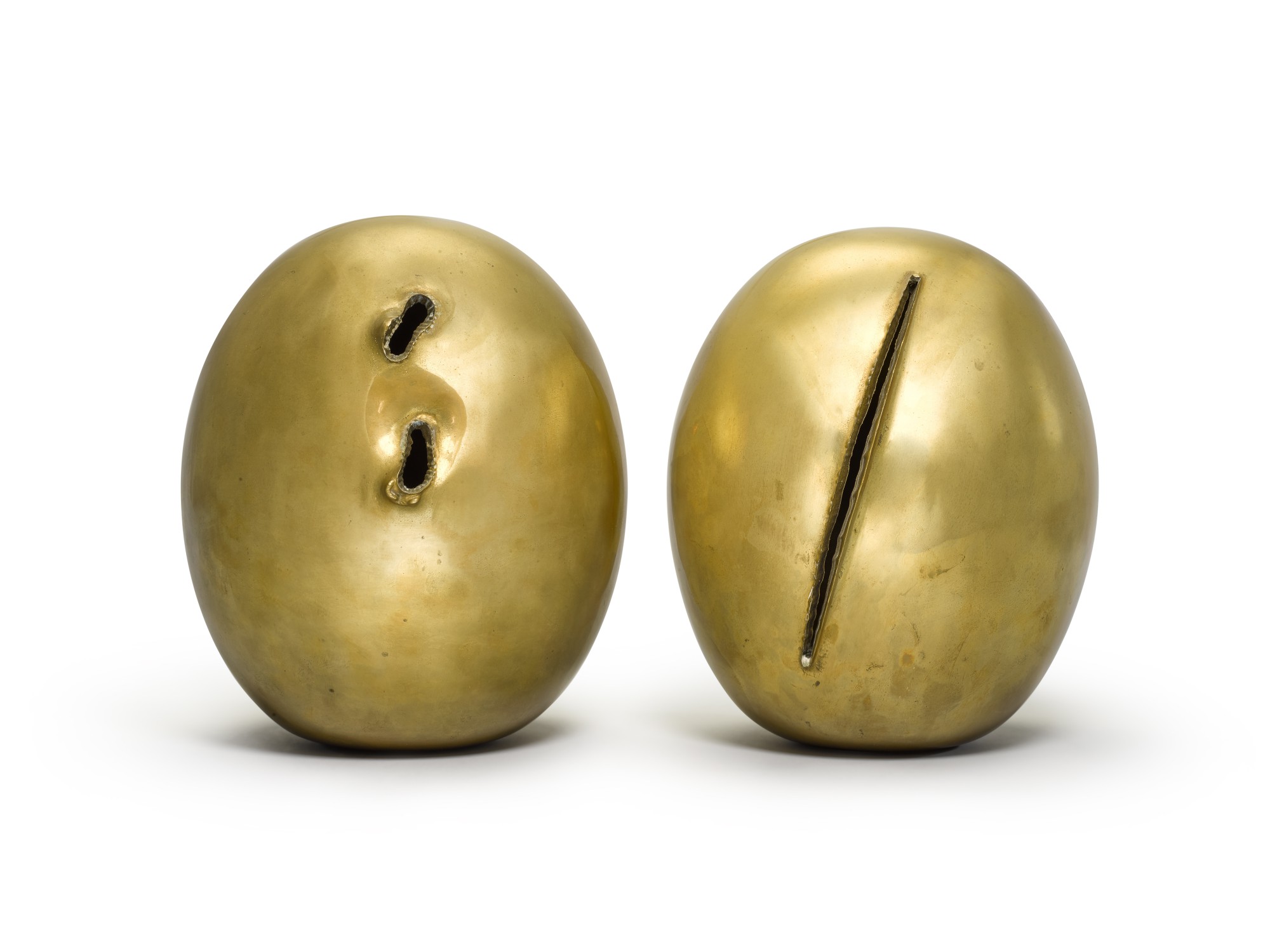
The monochromes range from luminous white to deep red to earthy bronze tones, and each color shifts the emotional register of the work entirely. His bronzes, such as the two part polished "Concetto Spaziale" of 1967 and the meditative "Concetto Spaziale, Natura" of 1959, bring the same spatial inquiry into three dimensions, where the puncture and the void become literal rather than illusory. Across every medium, the underlying question is identical: where does the artwork end and space begin? For collectors, Fontana occupies one of the most coveted and reliably significant positions in the postwar canon.
His works have appeared consistently across the major international auction houses, with the top "Tagli" canvases regularly achieving figures in the tens of millions at Christie's, Sotheby's, and Phillips. A pristine white or red "Attese" in excellent condition and with strong Fondazione provenance represents not only a sound long term acquisition but an object of profound visual intelligence that rewards sustained attention in any collection context. Collectors are advised to seek works with Fondazione Lucio Fontana certification, which guarantees authenticity and inclusion in the ongoing catalogue raisonné, a mark of institutional seriousness that underpins value. Works on paper, including his lithographs such as the incised purple "Concetto Spaziale" from the Corrente series, offer a compelling entry point that places collectors directly within his conceptual universe at a broader range of price points.
Fontana's position in art history is clarified enormously by understanding who surrounds him. He is a peer and in many ways a precursor to Yves Klein, whose own monochromes emerged in the late 1950s and share Fontana's appetite for the absolute. He anticipates the Minimalists, particularly Donald Judd and Dan Flavin, in his insistence that space itself is a sculptural medium. He is a spiritual neighbor to Alberto Burri, whose combusted and lacerated surfaces similarly transformed trauma and materiality into transcendence.
In the Latin American context, he connects to a broader tradition of geometric and kinetic experimentation that includes Julio Le Parc and Carlos Cruz Diez. Fontana, however, remains singular: no other artist of his generation achieved the same seamless unity between philosophical proposition and physical act. Lucio Fontana died in Comabbio, Italy, in September 1968, having lived just long enough to see his ideas enter the bloodstream of global contemporary practice. His legacy is not a closed chapter but an open question, one that artists and curators return to with fresh urgency in every generation.
In an era when the boundaries between digital and physical, between image and space, have never been more contested, Fontana's gesture of cutting through the surface feels less like history and more like instruction. To own a work by Fontana is to possess something genuinely alive: a thought that has not finished thinking.
Explore books about Lucio Fontana
Lucio Fontana
Enrico Crispolti
Lucio Fontana: Catalogue Raisonné
Enrico Crispolti
Lucio Fontana: The Spiritual Dimension
Pierre Restany
Fontana
Germano Celant
Lucio Fontana: White Paintings and Environments
Sarah Whitfield
Lucio Fontana: Concetti Spaziali
Giordana Mariani Canova
Lucio Fontana 1899-1968
Luciano Caramel