Kumi Sugaï
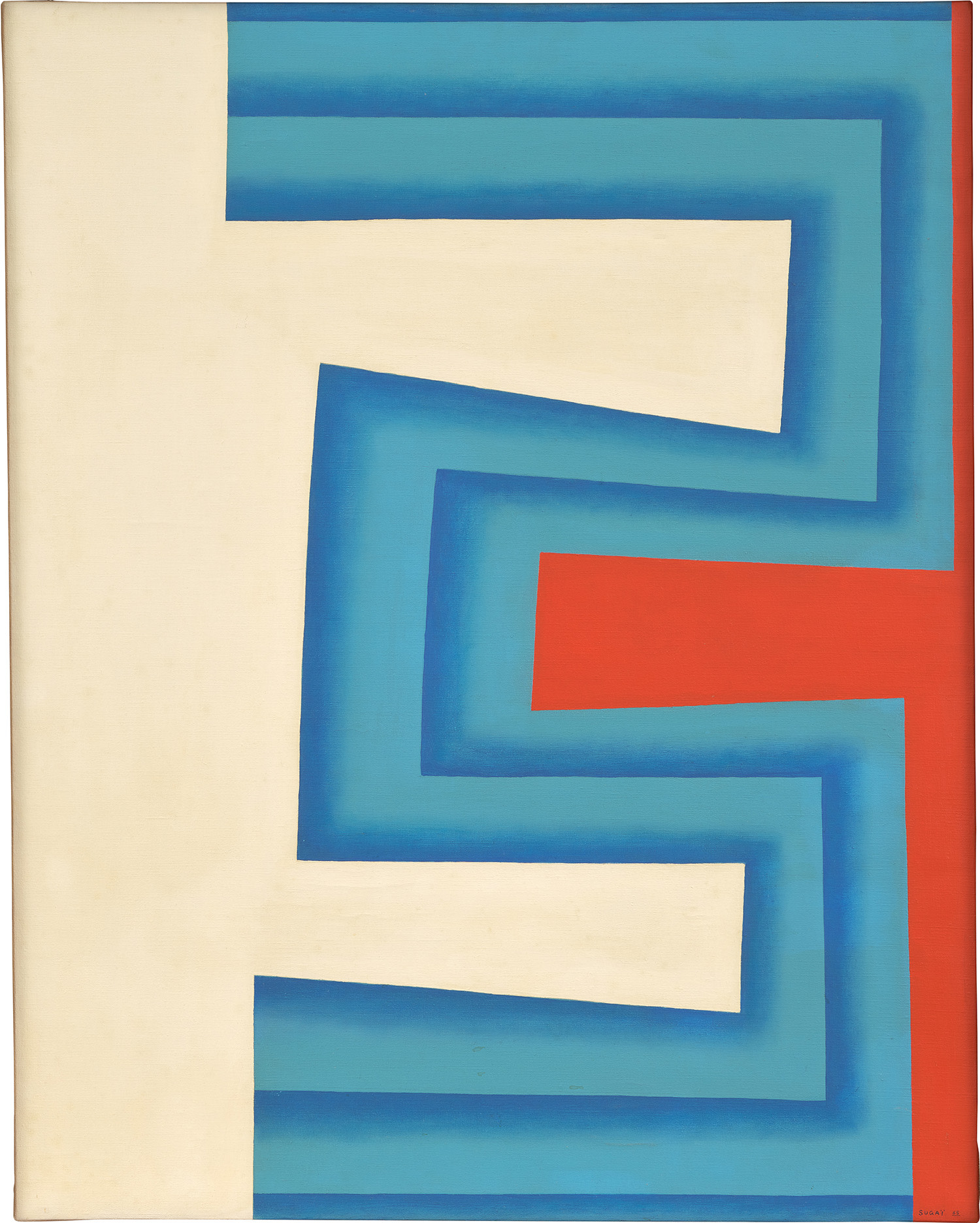
Kumi Sugaï: Where East Meets Parisian Light
Artist Spotlight · The Collection Editorial
There is a moment in the permanent collection of the Musée d'Art Moderne de la Ville de Paris when the room seems to shift register entirely. Among the postwar European canvases, a work by Kumi Sugaï asserts itself with a quiet, almost ceremonial authority. Its forms are bold and heraldic, its colors resonant as a struck bell. For a generation of European collectors who discovered Sugaï in the 1950s and 1960s, that quality of composed intensity was immediately recognizable as something new.
Kumi Sugaï
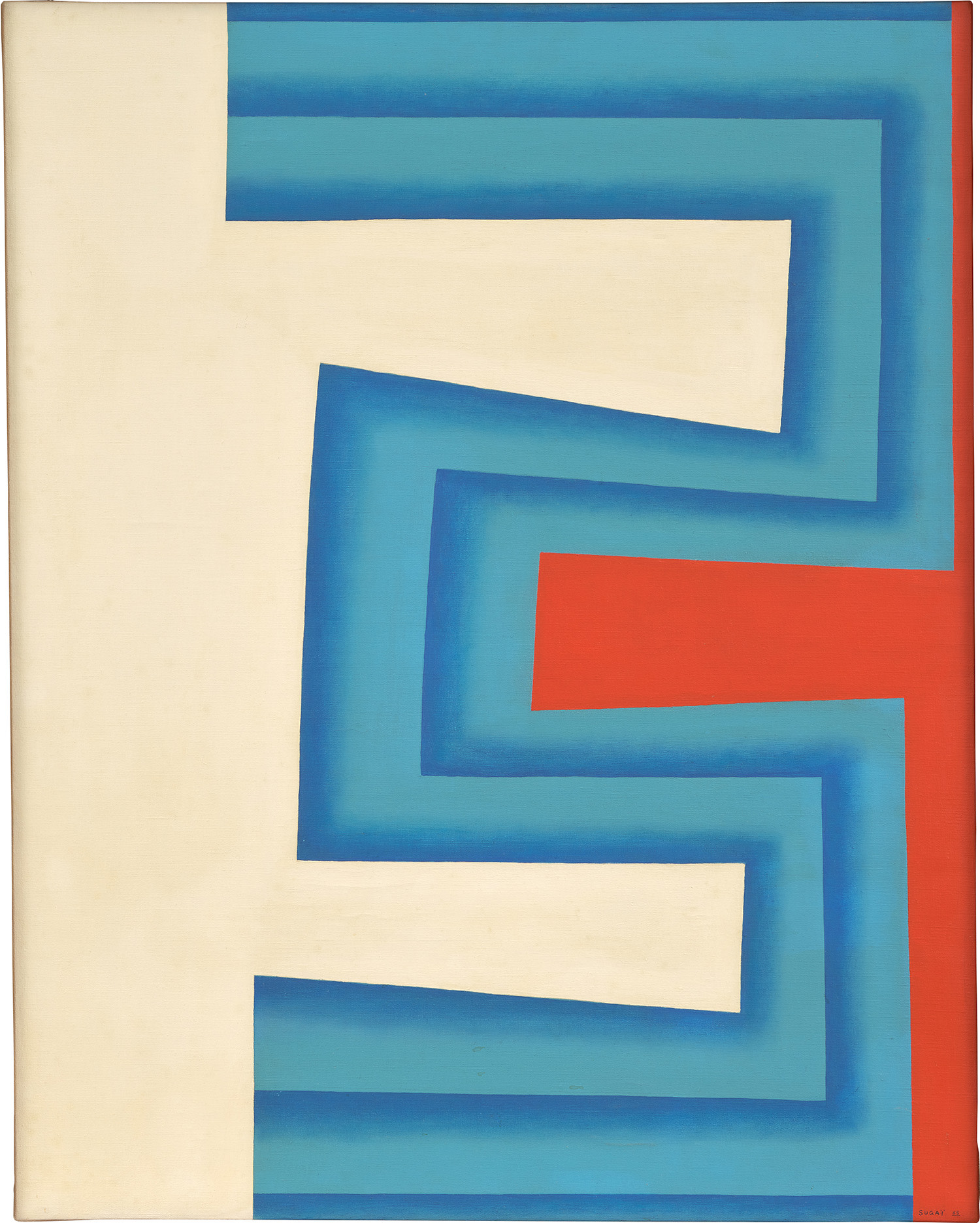
La Planète Mercuse No. 2, 1965
Today, as institutions and private collectors increasingly revisit the extraordinary cross cultural dialogues of postwar abstraction, Sugaï's reputation continues its steady, well deserved ascent. Kumi Sugaï was born in Kobe, Japan, in 1919, a port city whose cosmopolitan character perhaps seeded his lifelong appetite for dialogue between cultures. He trained at the Osaka School of Fine Arts, where he developed a rigorous grounding in graphic design and commercial art. That training would prove essential.
The economy of a logo, the precision of a sign, the way a single bold form can arrest the eye and carry meaning across language barriers: these instincts never left him, and they became the very bones of his mature painting. His early years in Japan were shaped by an awareness of both the Japanese calligraphic tradition and the modernist movements beginning to filter in from the West. In 1952, Sugaï made the journey that would define his career: he arrived in Paris, the undisputed capital of international art at the time. He settled on the Left Bank, immersing himself in the ferment of postwar French painting.
Kumi Sugaï
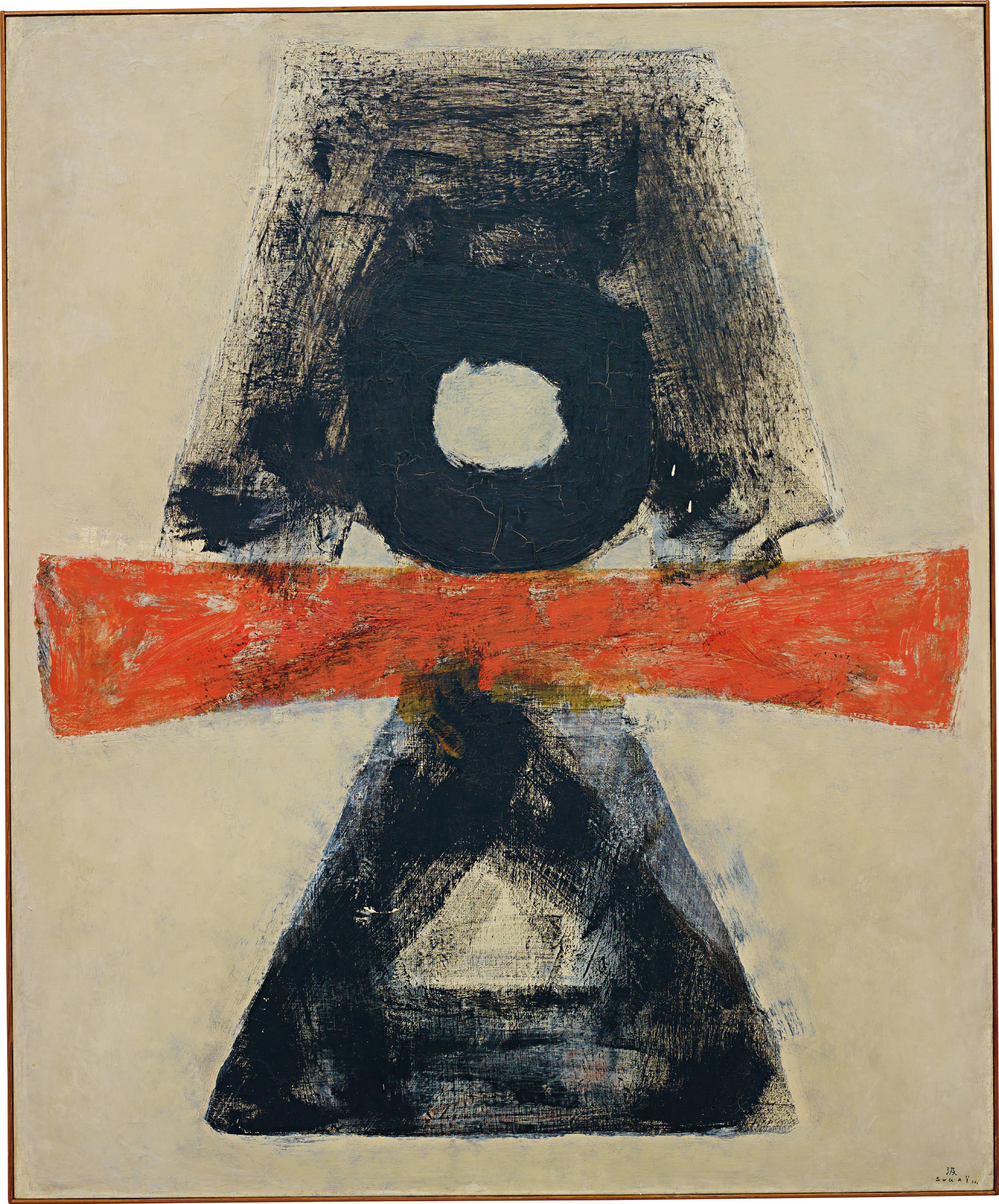
KAGURA (Sacred Music and Dance)
He studied the work of Fernand Léger, whose love of clean contour and bold primary form clearly resonated with Sugaï's own sensibilities. He encountered the École de Paris and its remarkable gathering of international artists, painters who had come from every corner of the world to test themselves against the city's exacting standards. Sugaï found his footing quickly. By 1954 he was exhibiting regularly, and by the end of the decade he had established himself as one of the most distinctive voices in European abstraction.
Sugaï's artistic development through the late 1950s and into the 1960s charts a painter finding, with increasing confidence, his singular territory. His early Paris canvases, such as the untitled oil on canvas of 1956 now available on The Collection, show a painter working through the gestural and symbolic registers of postwar abstraction while already reaching toward something more architecturally resolved. By 1957, works like Soyokazé reveal a vocabulary that was unmistakably his own: large, floating forms that recall both the pictographic energy of Japanese calligraphy and the graphic clarity of European concrete art. The palette is keyed high, colors held against one another with a jeweler's sense of tension.
Kumi Sugaï
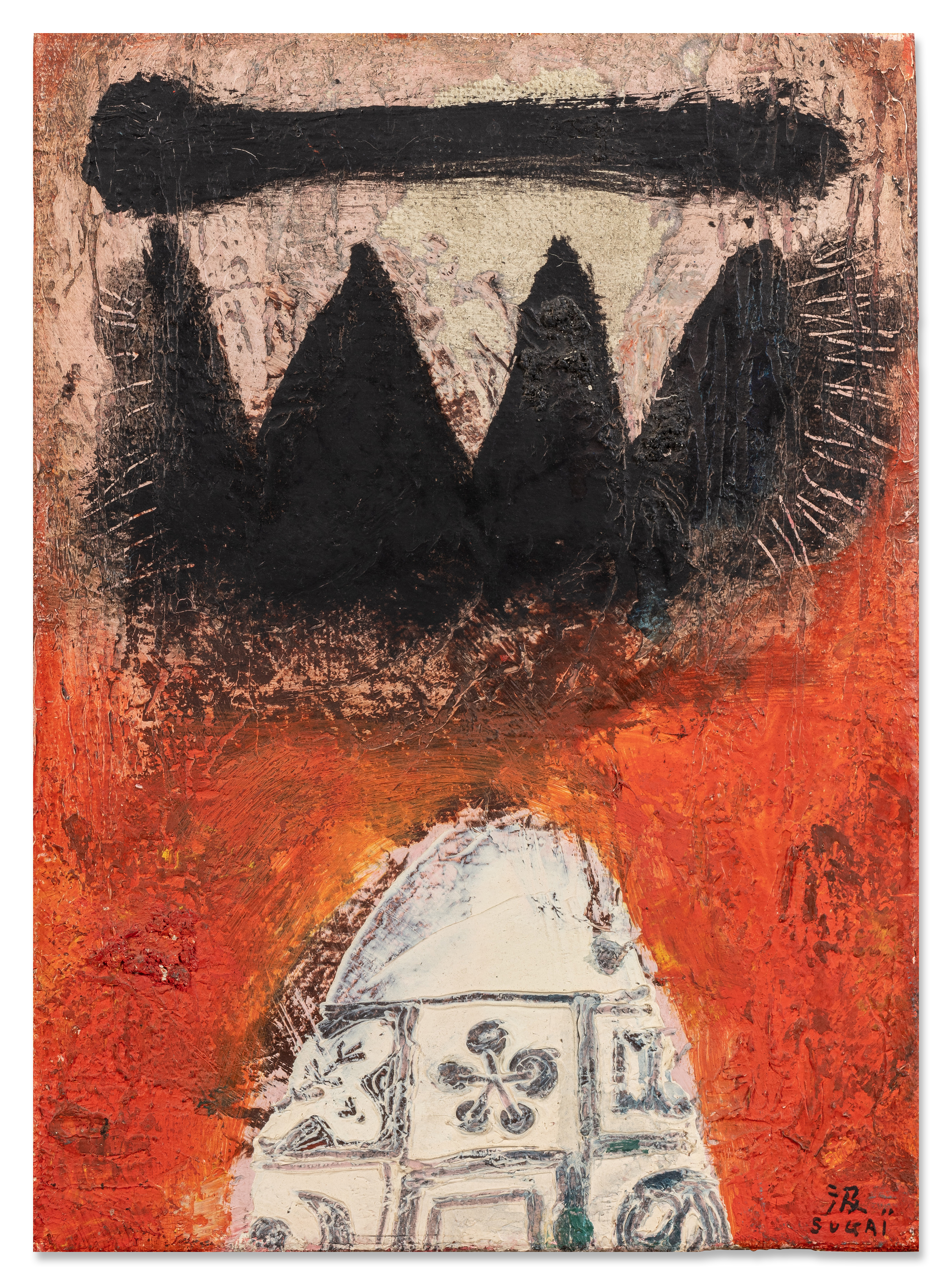
Diablotin
The forms seem to hover, weightless yet monumental. The works of the early 1960s represent perhaps the fullest flowering of his powers. Akatsuki, meaning Dawn, painted in 1960, is a canvas of extraordinary presence. A deep ground holds a composition of luminous, simplified forms that feel simultaneously ancient and completely modern: they carry the memory of ideograms, of heraldry, of the sun rising over water, without illustrating any of these things directly.
By the time of La Planète Mercuse No. 2 in 1965 and the radiant Petit Bleu of 1968, Sugaï had arrived at a cosmological imagery, forms that suggest planetary bodies, celestial signs, the geometry of forces larger than the human scale. These are paintings that operate on the nervous system as much as on the intellect. The work titled Mercure and the large canvas KAGURA, which takes its title from the ancient Japanese tradition of sacred music and dance offered to the Shinto gods, speak to the deep wellspring of Japanese cultural memory that Sugaï never abandoned, even as he painted in dialogue with the European present.
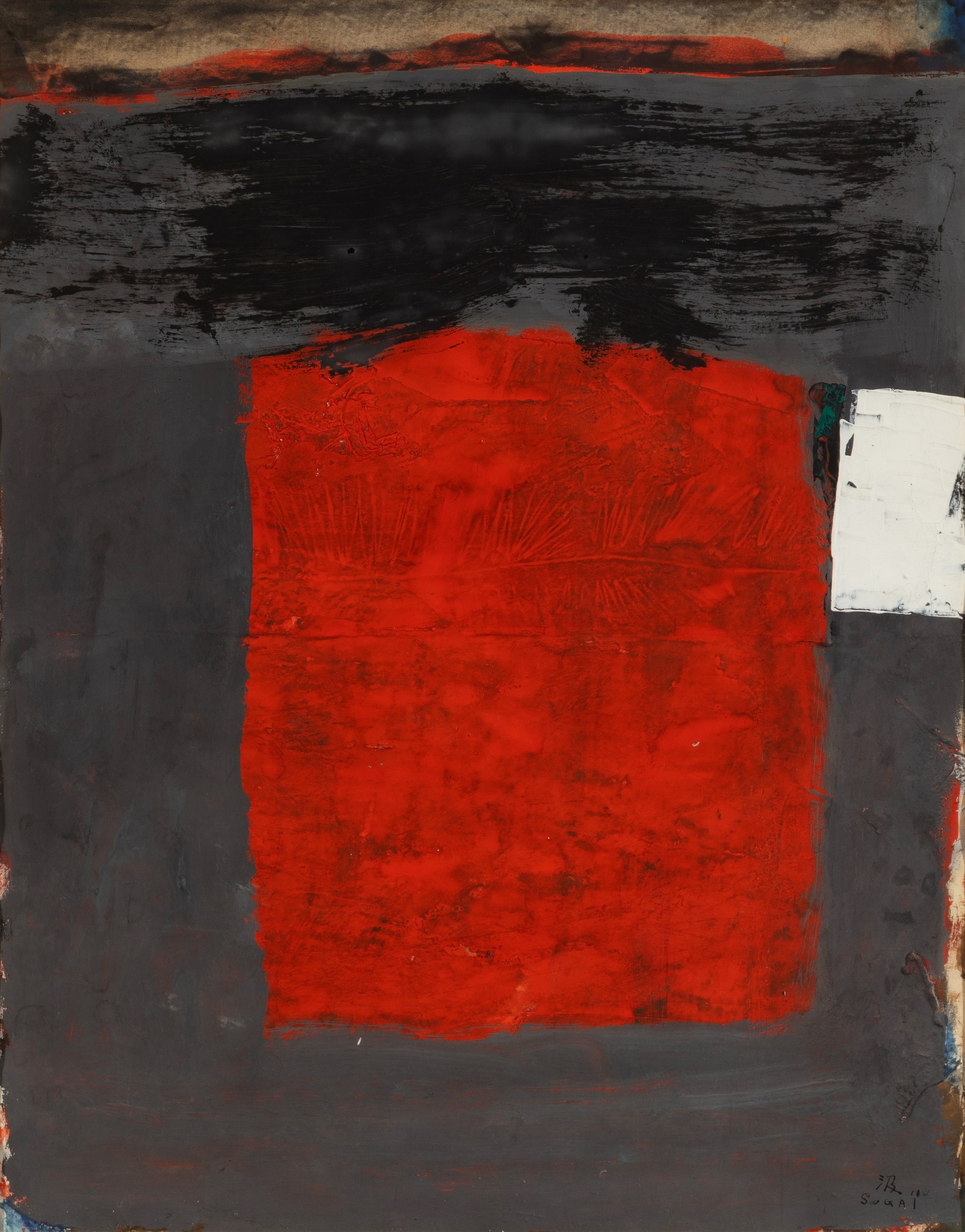
Kumi Sugaï
Composition Rouge
For collectors, Sugaï presents a genuinely compelling proposition. His work exists at a productive intersection: it satisfies the modernist collector's appetite for formal rigor and painterly quality while offering the kind of cultural depth and biographical distinctiveness that separates great collections from merely good ones. Auction records at houses including Christie's and Sotheby's have shown consistent interest in his major canvases, with oils on canvas from his peak period in the late 1950s through the late 1960s commanding the strongest attention. Works on paper, including gouaches such as Composition Rouge, offer an accessible entry point that nonetheless demonstrates the full intelligence of his pictorial thinking.
Collectors who have followed the sustained reappraisal of postwar international abstraction will recognize that Sugaï has been somewhat undervalued relative to his European contemporaries, a situation that the art market has been quietly correcting. To understand Sugaï fully, it helps to place him within a wider constellation of postwar artists navigating the space between Eastern and Western visual traditions. His work invites comparison with the Japanese Gutai group, though his approach is more coolly resolved than their emphasis on physical process. He shares certain formal ambitions with Hans Hartung and Pierre Soulages, fellow travelers in the world of Paris abstraction, though Sugaï's relationship to the sign and symbol sets him apart from both.
Closer perhaps in spirit is the graphic abstraction of Alexander Calder, whose sense of the joyful, freely floating form Sugaï echoes, or the heraldic clarity of Ellsworth Kelly's early European work. Sugaï belongs to no single school and is diminished by none of the labels that have been attached to him. Kumi Sugaï died in 1996, having spent the second half of his life between Paris and Nishinomiya in Japan, a journey that had come full circle. His legacy is that of an artist who found a way to carry the weight of two great visual traditions without being crushed by either, who made paintings of genuine beauty and formal authority that speak clearly across every border.
At a moment when the art world is rightly expanding its understanding of what postwar modernism looked like from multiple vantage points, Sugaï's work feels not only historically important but newly, urgently alive. To encounter one of his paintings is to understand, immediately and viscerally, what it means for an artist to find their true language.