Bernar Venet
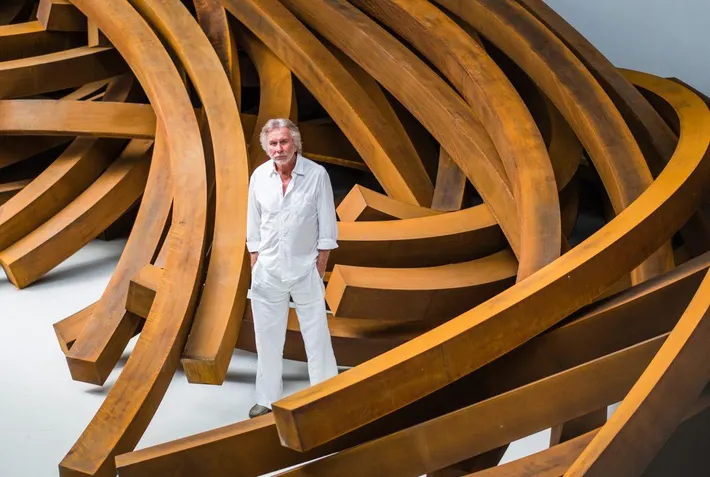
Bernar Venet Bends Steel Into Pure Feeling
Artist Spotlight · The Collection Editorial
“My work is not about expressing emotions. It is about demonstrating the existence of a system.”
Bernar Venet
In the summer of 2023, the grounds of the Palace of Versailles were transformed by the presence of monumental steel arcs rising from the immaculate French gardens, their rusted Cor Ten surfaces aging with quiet authority against the gilded baroque backdrop. Bernar Venet had arrived at one of the world's most prestigious venues for contemporary art, joining a lineage of artists including Jeff Koons and Takashi Murakami who have brought living practice into dialogue with royal history. The installation was not merely decorative spectacle. It was a statement about the endurance of ideas, about geometry as a language older and more universal than any court or crown.
Bernar Venet
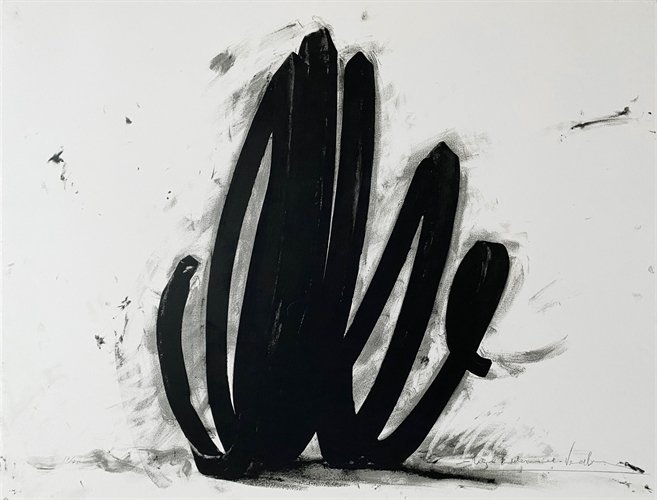
Ligne Indéterminée, 1990
Venet was born in 1941 in Château Arnoux Saint Auban, a small town tucked into the Alpes de Haute Provence in southern France, a landscape shaped by dramatic rock formations and the angular geometry of the natural world. Before he ever touched a welding torch or stretched a canvas, he worked as a stage designer for the Nice Opera, an experience that instilled in him a lifelong fluency in scale, space, and the relationship between form and the body of a viewer. That theatrical sensibility never fully left him. His sculptures, even at their most mathematically rigorous, retain an awareness of drama and presence.
In 1966, Venet made the move that would define his generation: he left France for New York City, arriving in a moment of extraordinary creative ferment. He became embedded in the conceptual art scene, forging friendships with figures such as Donald Judd, Carl Andre, and Sol LeWitt, artists who were collectively dismantling the conventions of painting and object making in favor of ideas, systems, and structures. Venet was drawn to this intellectual rigor, but he brought something distinctive to the conversation. Where many of his American peers favored cool industrial neutrality, Venet introduced mathematics not as metaphor but as subject matter in its own right, presenting actual scientific diagrams, equations, and statistical graphs as completed works of art.
Bernar Venet
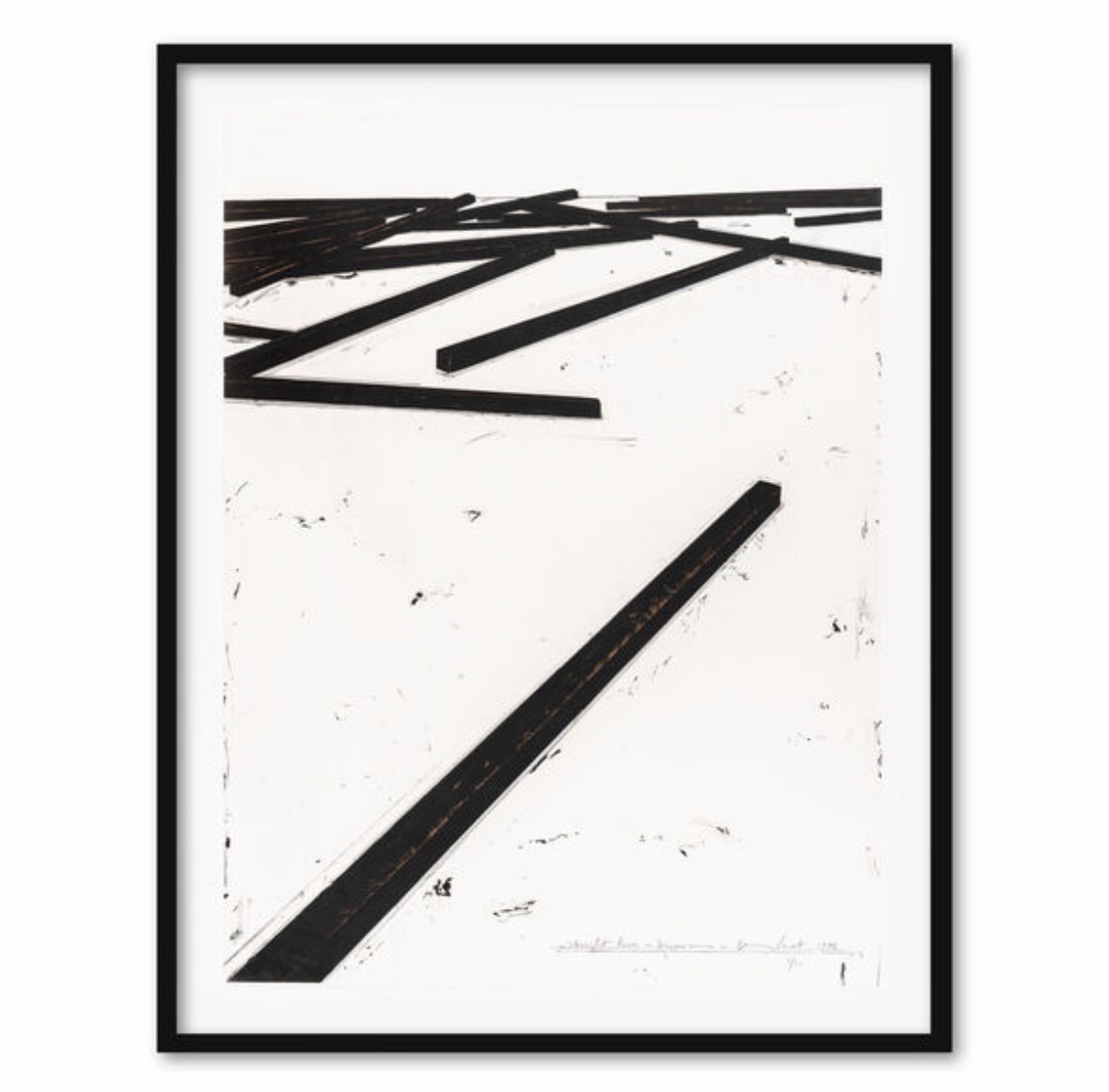
Straight Lines / Dispersion, 1997
His early work in the late 1960s was radically uncompromising. He exhibited blackboard diagrams of physics equations in gallery contexts, insisting that a mathematical formula was as complete a statement as any painted composition. He organized concerts of noise music and produced works in which the subject was indistinguishable from the documentation of a discipline entirely outside art history. This was conceptual art at its most philosophically committed, and it earned Venet a reputation as one of the movement's most serious and rigorous practitioners.
“The indeterminate line is a line that has no fixed beginning and no fixed end. It is free.”
Bernar Venet
He was included in landmark group exhibitions that helped define the era, and his work entered institutional collections in Europe and the United States during these foundational years. After a period of deliberate silence in the early 1970s during which he stepped back from making art entirely to question the premises of his own practice, Venet returned in the late 1970s with renewed intensity and a shift toward large scale sculpture. The arc became his signature form: a fragment of a circle, a line that curves through space without completing itself, suggesting both mathematical precision and existential openness. Works like his monumental arc series and the celebrated Indeterminate Lines brought together two seemingly opposite impulses.
Bernar Venet
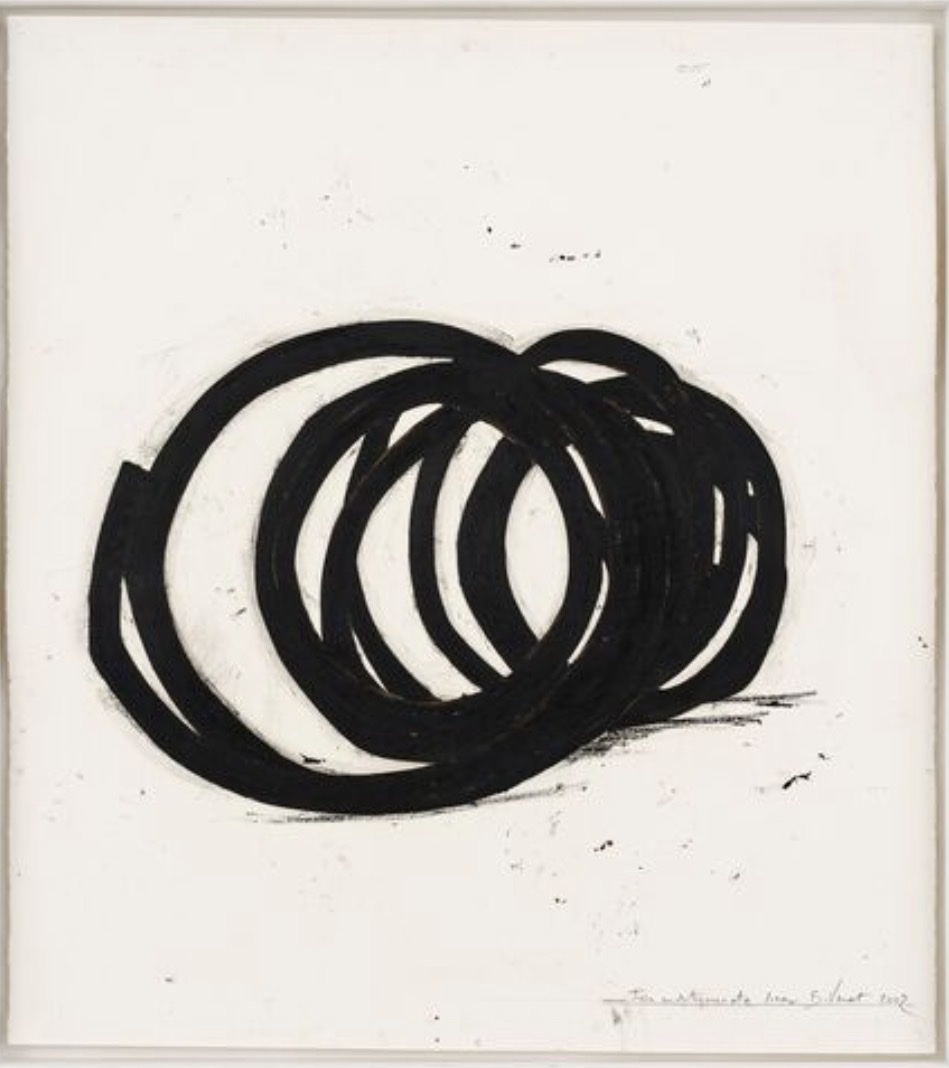
Two Indeterminate Lines, 2002
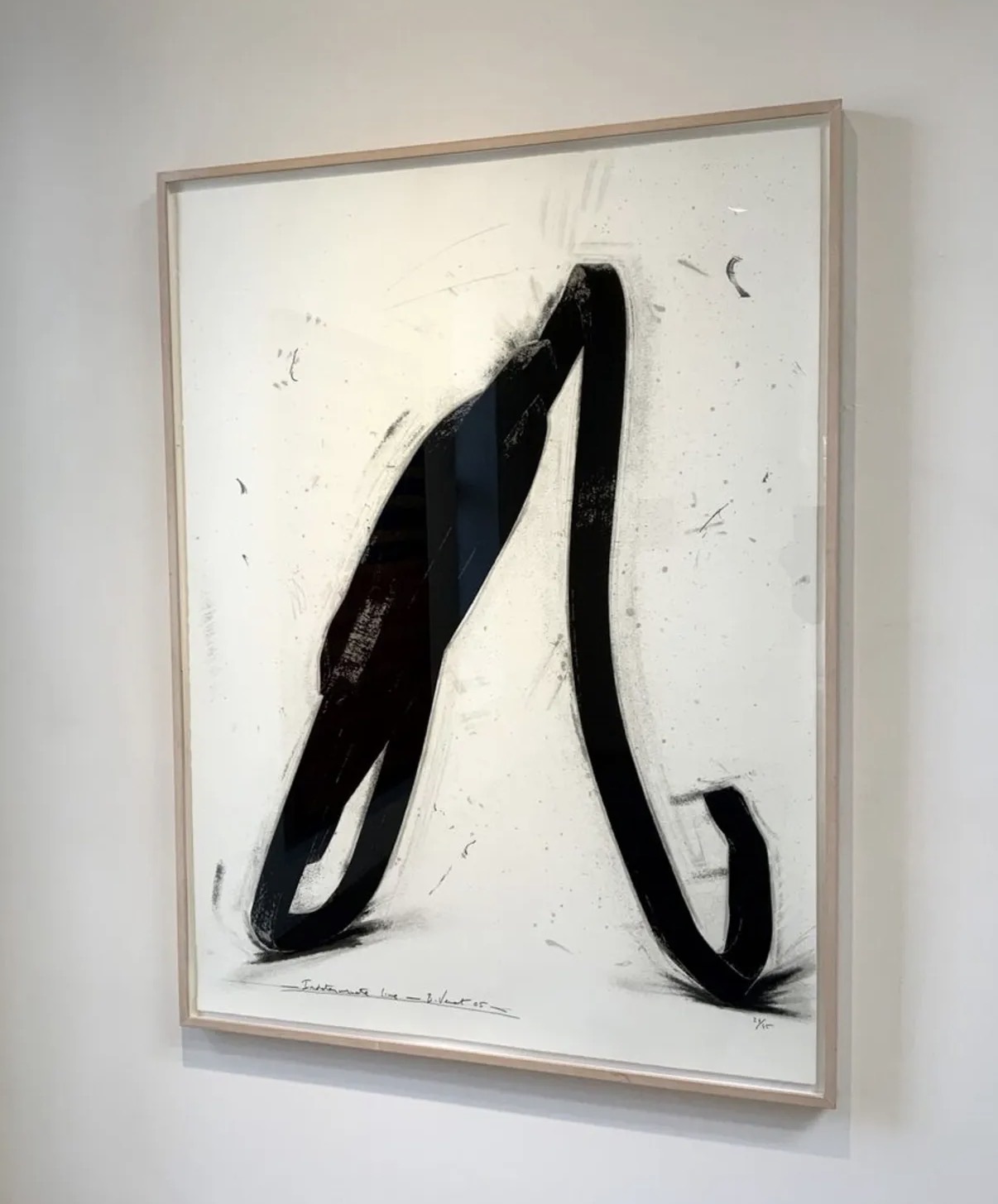
The arc is a defined geometric quantity, calculable and rational. The indeterminate line is its counterpart: a form that resists resolution, that twists and folds in ways that cannot be fully predicted. Together they articulate the central tension of Venet's entire project, the dialogue between order and entropy, between what can be measured and what exceeds measurement. The Indeterminate Lines in particular have become among the most recognized images in his body of work and represent an extraordinary range of media and scale.
From large oilstick works on paper that carry an almost gestural expressiveness, to the monumental Cor Ten steel sculptures that anchor public plazas and museum grounds worldwide, the series demonstrates Venet's ability to translate a single animating idea across radically different contexts without losing its conceptual integrity. Works such as Two Indeterminate Lines from 2002 and the large scale steel Indeterminate Line of 2022 show an artist still finding new dimensions within a vocabulary he has spent decades perfecting. His works on paper, including graphite and collage pieces such as Position of an Undetermined Line from 1981, reveal the intimacy and physical immediacy that underlies his most ambitious public statements. For collectors, Venet represents a particularly compelling proposition.
Bernar Venet
Indeterminate Line, 2005
He occupies a rare position as both a rigorous art historical figure with deep roots in conceptual and minimalist traditions and a living artist whose market has continued to strengthen with each major institutional endorsement. His prints and works on paper offer an accessible entry point into a practice that also commands significant sums for major sculptures at leading auction houses. The graphic works, including screenprints such as Ligne Indéterminée from 1990 and Straight Lines Dispersion from 1997, are beautifully resolved objects that carry the full weight of his thinking without requiring the real estate of a sculpture garden. Collectors who appreciate the intersection of intellectual ambition and formal beauty find in Venet a figure who satisfies both desires entirely.
Within the broader map of art history, Venet sits in productive relationship with artists including Richard Serra, whose monumental weathering steel works share a commitment to mass and gravity and the transformation of industrial material into existential experience. He connects also to the legacy of Sol LeWitt in his embrace of systems and mathematical structures, and to the French tradition of artists such as Yves Klein and Jean Tinguely who pushed against the boundaries of what art could claim as its subject. Yet Venet's synthesis is entirely his own, a practice rooted in southern French light and New York intellectual energy, in the opera house and the physics textbook, in the immovable weight of steel and the provisional freedom of an unresolved line. At more than eight decades of life and six decades of sustained artistic production, Bernar Venet stands as one of the defining figures of his generation and a vital, still evolving presence in contemporary art.
His recent works demonstrate no diminishment of ambition or formal invention. Public collections on every continent hold his sculptures. Museums from Paris to Seoul have devoted major retrospectives to his practice. And yet the work retains the quality that made it radical from the beginning: it insists on asking genuine questions about knowledge, form, and the limits of what art can hold.
To collect Venet is to participate in one of the great ongoing investigations of our time.
Explore books about Bernar Venet

Bernar Venet: A Retrospective
Museum of Modern Art

Bernar Venet: Sculptures and Drawings
Germano Celant

Bernar Venet: Lines, Angles, Curves
Pierre Restany
Bernar Venet: Selected Works 1961-2001
Various Authors
Bernar Venet: The Complete Works
Yannick Milland