Alexander Liberman
Alexander Liberman: A Life Beautifully Doubled
Artist Spotlight · The Collection Editorial
“I want to create a moment of freedom, a release from the weight of things.”
Alexander Liberman
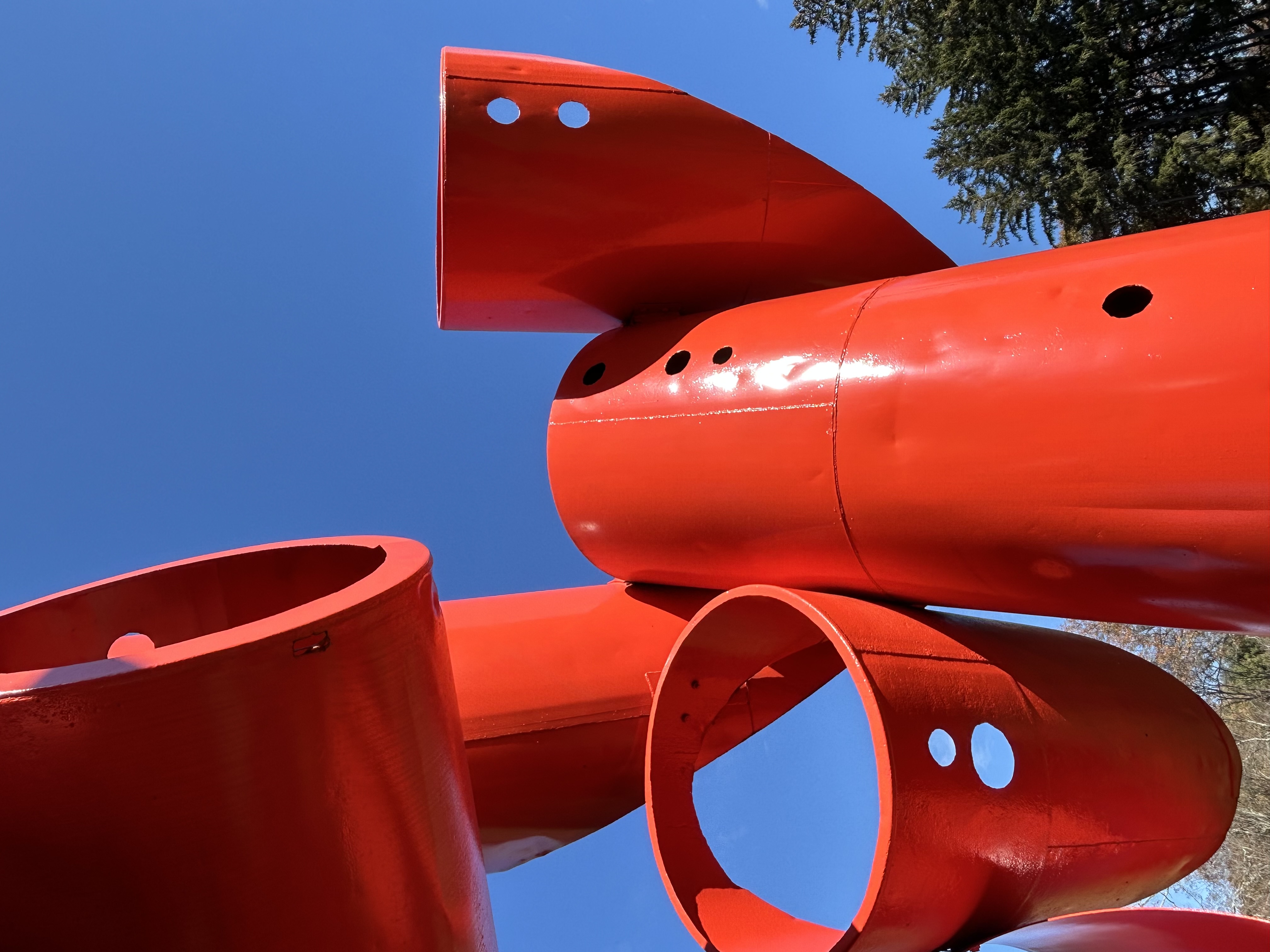
There is a particular kind of genius that refuses to be contained by a single discipline, and Alexander Liberman embodied this quality more fully than almost any figure of the twentieth century. When the Storm King Art Center in New York's Hudson Valley installed his monumental painted steel sculptures across its rolling landscape, visitors encountered something genuinely surprising: works of immense physical authority that somehow retained a quality of lightness, even joy. Those sculptures, their forms bold and their surfaces singing in red and orange and white, continue to draw devoted audiences today, offering a vivid reminder that Liberman was not merely an art world insider but a genuinely consequential artist whose vision reshaped how Americans understood both modernism and the spaces in which art could live. Alexander Liberman was born in Kiev in 1912, into a world that would soon be turned violently upside down.
Alexander Liberman
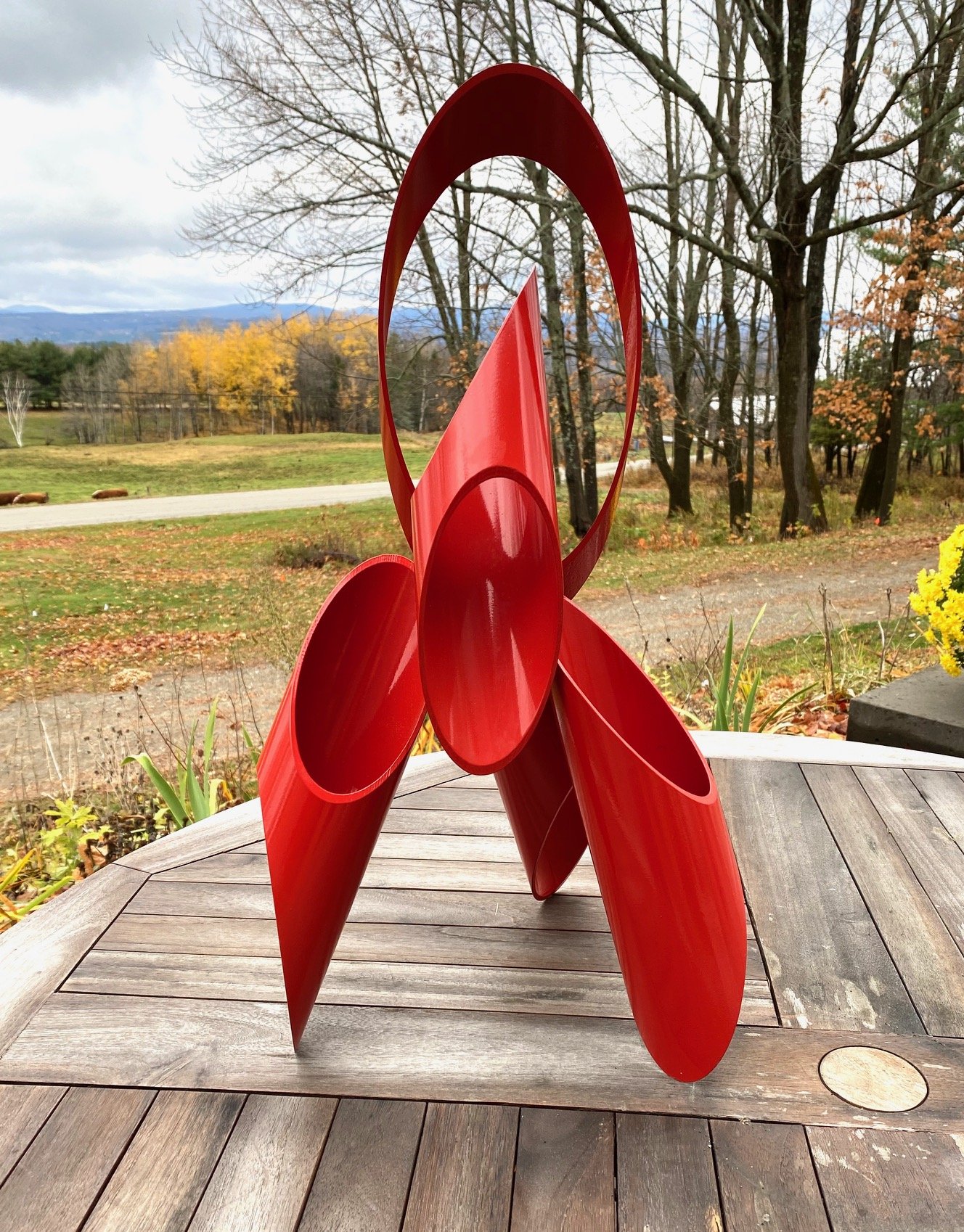
Untitled, 1987
His family fled the Russian Revolution, making their way westward through a Europe in upheaval, and it was in Paris that the young Liberman received the formation that would define everything that followed. He studied under the architect Auguste Perret, whose rigorous structural thinking left a permanent mark on how Liberman approached form, and he apprenticed with the legendary graphic designer Cassandre, whose bold geometric posters for French railways and ocean liners were among the most vital images of the age. Paris in the late 1920s and 1930s was alive with modernist experiment, and Liberman absorbed it all, from the Constructivists whose work he encountered in galleries and collections to the Surrealists whose influence permeated the city's cultural life. In 1941, with Europe consumed by war, Liberman emigrated to the United States, arriving in New York at a moment when the city was itself becoming the center of the art world.
He joined Condé Nast Publications almost immediately, and what began as a practical arrangement would evolve into one of the most storied editorial careers of the century. As art director and eventually editorial director, he shaped the visual identity of Vogue, Vanity Fair, and a constellation of other titles, working alongside photographers including Irving Penn and Richard Avedon and bringing a distinctly European modernist sensibility to American mass media. Yet even as he built this remarkable parallel career, he never abandoned his studio practice, insisting on the difficult and necessary doubling that defined his life. Liberman's artistic development moved through several distinct phases, each revealing a different dimension of his intelligence.
Alexander Liberman
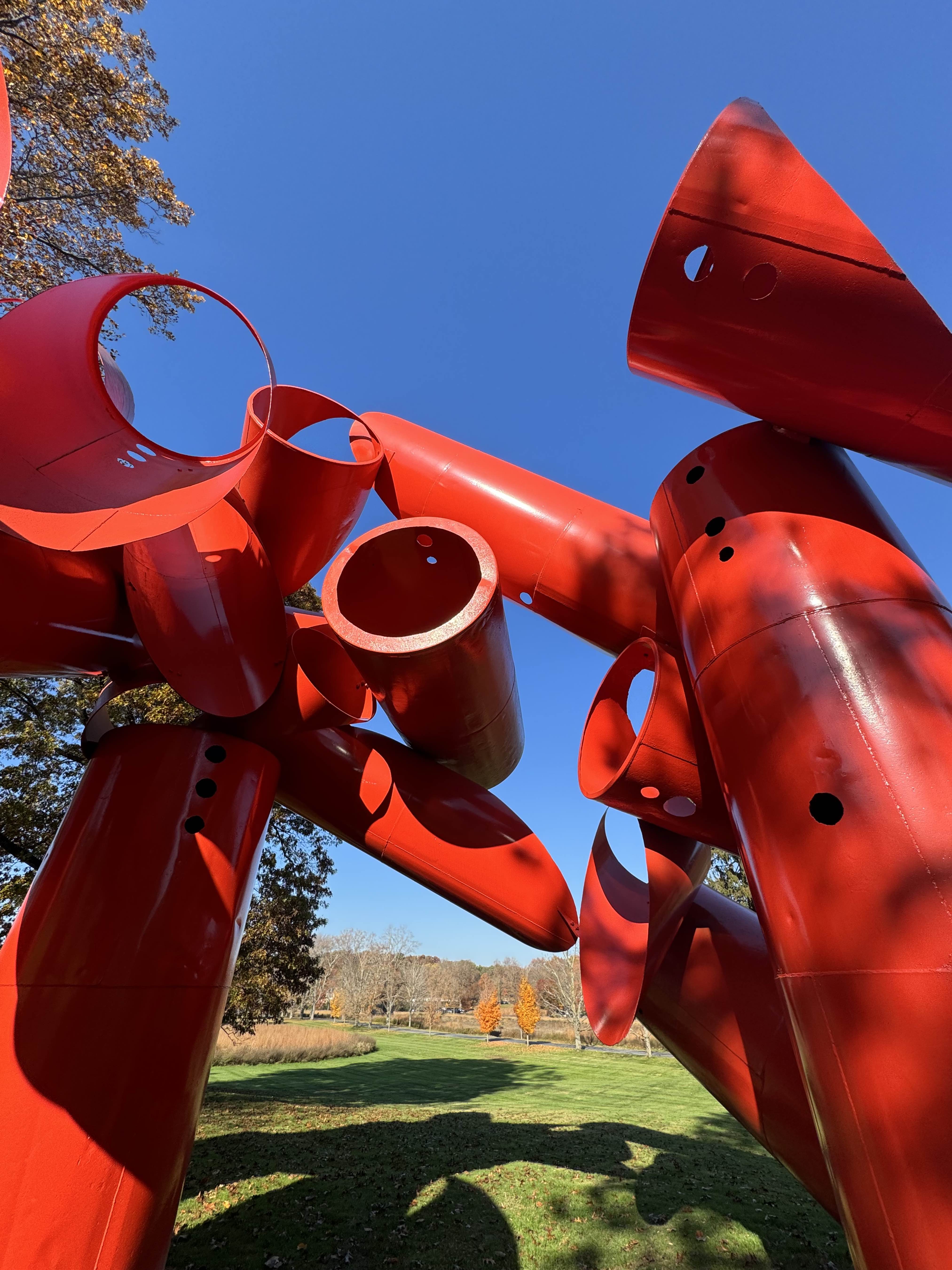
Adam, 1970
His early paintings engaged with pure geometry, with circles and arcs and fields of color that owed something to Constructivism but were already becoming something entirely personal. By the 1960s he had turned seriously to sculpture, working with industrial steel, welding and assembling salvaged cylinders and pipes and drums into structures of growing ambition. It was in this period that his voice as a sculptor fully emerged. He was drawn to the grammar of industrial fabrication not out of cool conceptual distance but out of genuine physical excitement, a love of mass and weight and the way painted surfaces could transform raw metal into something festive and alive.
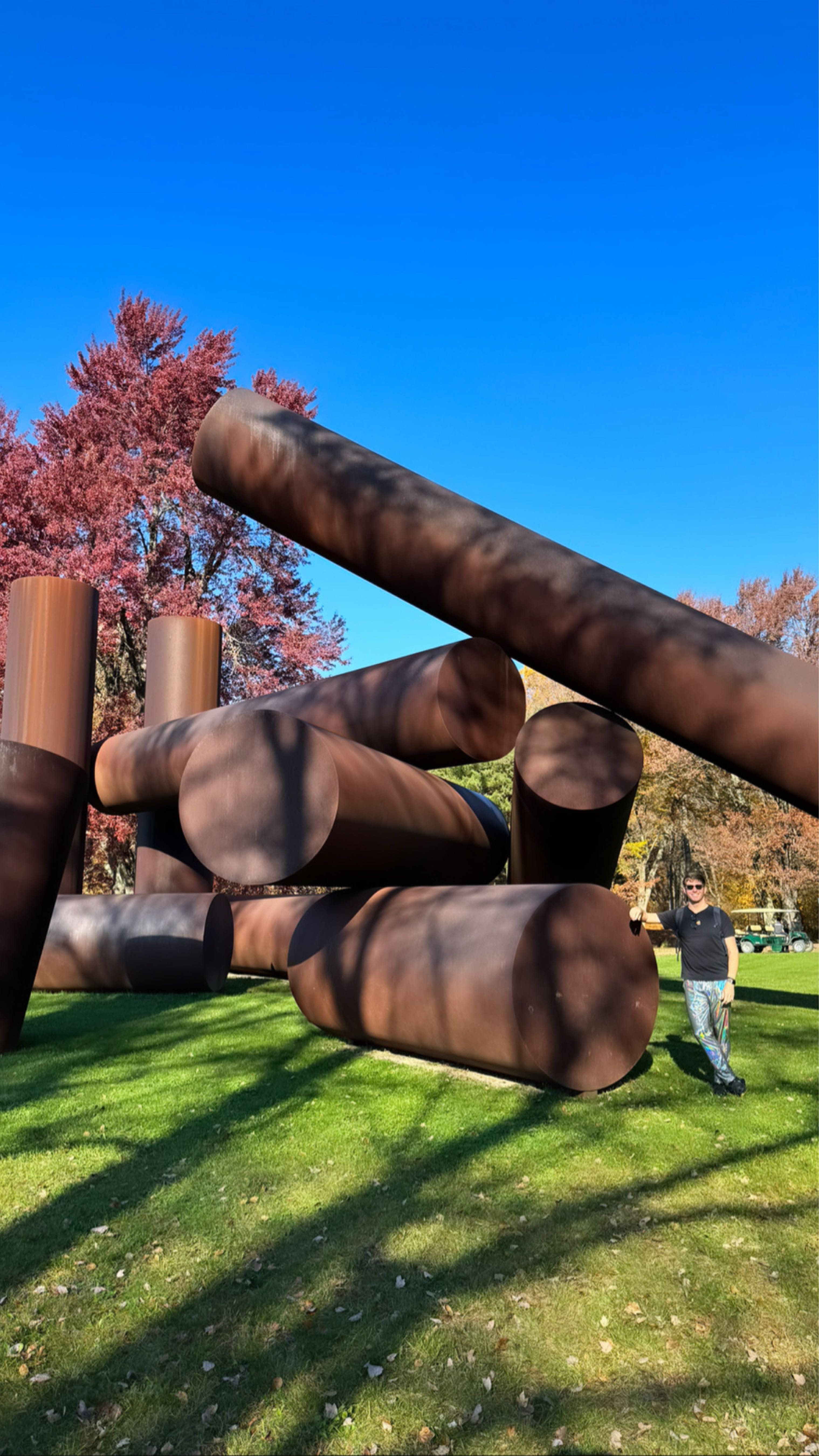
Among his most celebrated works are the large outdoor sculptures that defined his mature period, including pieces like Adam from 1970, a commanding painted steel composition that demonstrates his mastery of scale and his sensitivity to the relationship between sculpture and surrounding space. Adonai, also from 1970, similarly reveals his gift for creating works that feel both architecturally resolved and emotionally open. These are not cold objects but warm presences, their titles drawn from ancient and sacred language, suggesting that for all his embrace of industrial materials and abstract form, Liberman was reaching for something spiritual and enduring. His works in bronze, including Reach with its rich brown patina, show the same sensibility translated into a different material register, intimate and resonant.
Alexander Liberman
Adonai, 1970
For collectors, Liberman presents a genuinely compelling proposition. His career spans painting, sculpture, works on paper, and photography, offering multiple points of entry across a wide range of scales and price points. His painted steel sculptures, particularly those from the late 1960s and 1970s, represent the work for which he is most strongly identified by institutions and serious collectors, and works of this kind in good condition with clear provenance are prized acquisitions. His prints and works on paper, including etchings and aquatints executed with the same geometric confidence that animates his larger works, offer collectors an accessible introduction to his formal language.
Liberman's dual identity as an art world insider and a practicing artist gives his work an unusual historical texture, connecting it to the broader story of modernism's migration from Europe to America. Liberman's place in art history is best understood in relation to a generation of artists who embraced the possibilities of abstraction and industrial fabrication in the postwar period. His work shares sensibilities with figures such as Mark di Suvero, Anthony Caro, and John Chamberlain, artists who similarly transformed the possibilities of welded and assembled metal sculpture. At the same time, his engagement with pure geometric form and his roots in European Constructivism link him to a transatlantic conversation about modernism that stretched from Rodchenko and El Lissitzky through to the American Color Field painters who were his contemporaries in New York.
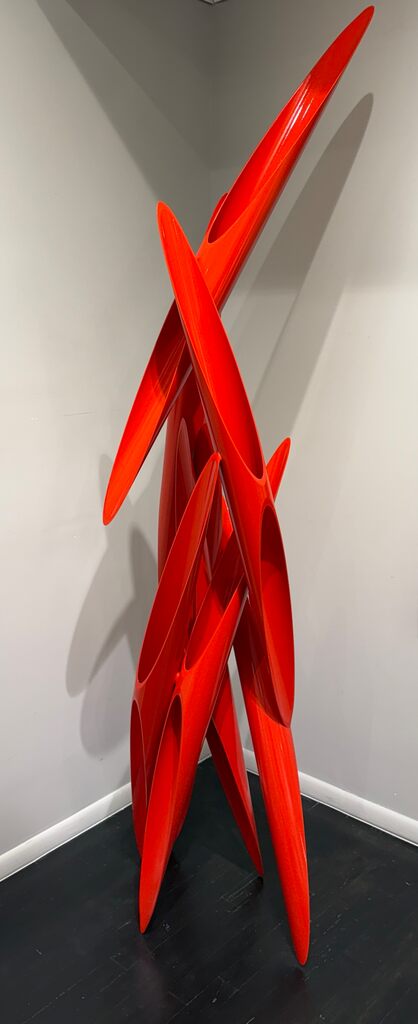
Alexander Liberman
Aim I, 1980
He is a bridge figure in the best sense, someone who carried the energies of one world into another and transformed them in transit. Alexander Liberman died in Miami in 1999, leaving behind a body of work that continues to reward attention and to grow in critical estimation. His sculptures stand in public spaces and museum collections across the United States, quiet monuments to the proposition that art can be simultaneously rigorous and joyful, intellectually serious and physically exhilarating. The story of his life, spanning Kiev and Paris and New York, revolution and reinvention and the long discipline of the studio, is one of the great narratives of twentieth century culture.
For collectors and admirers who encounter his work today, whether in person at Storm King or through the careful study of a painted steel maquette or a luminous geometric print, the experience is invariably the same: a sense of being in the presence of a genuinely original mind, one whose legacy belongs fully to our present moment.
Explore books about Alexander Liberman
Alexander Liberman: A Life
Jennifer Stockman

Alexander Liberman: An Artist in His Time
Michael Levey
Liberman: The Artist in His Studio
Alexander Liberman, Ingrid Ryberg
Alexander Liberman: Paintings and Drawings
Various
The Art of Alexander Liberman
Pierre Schneider