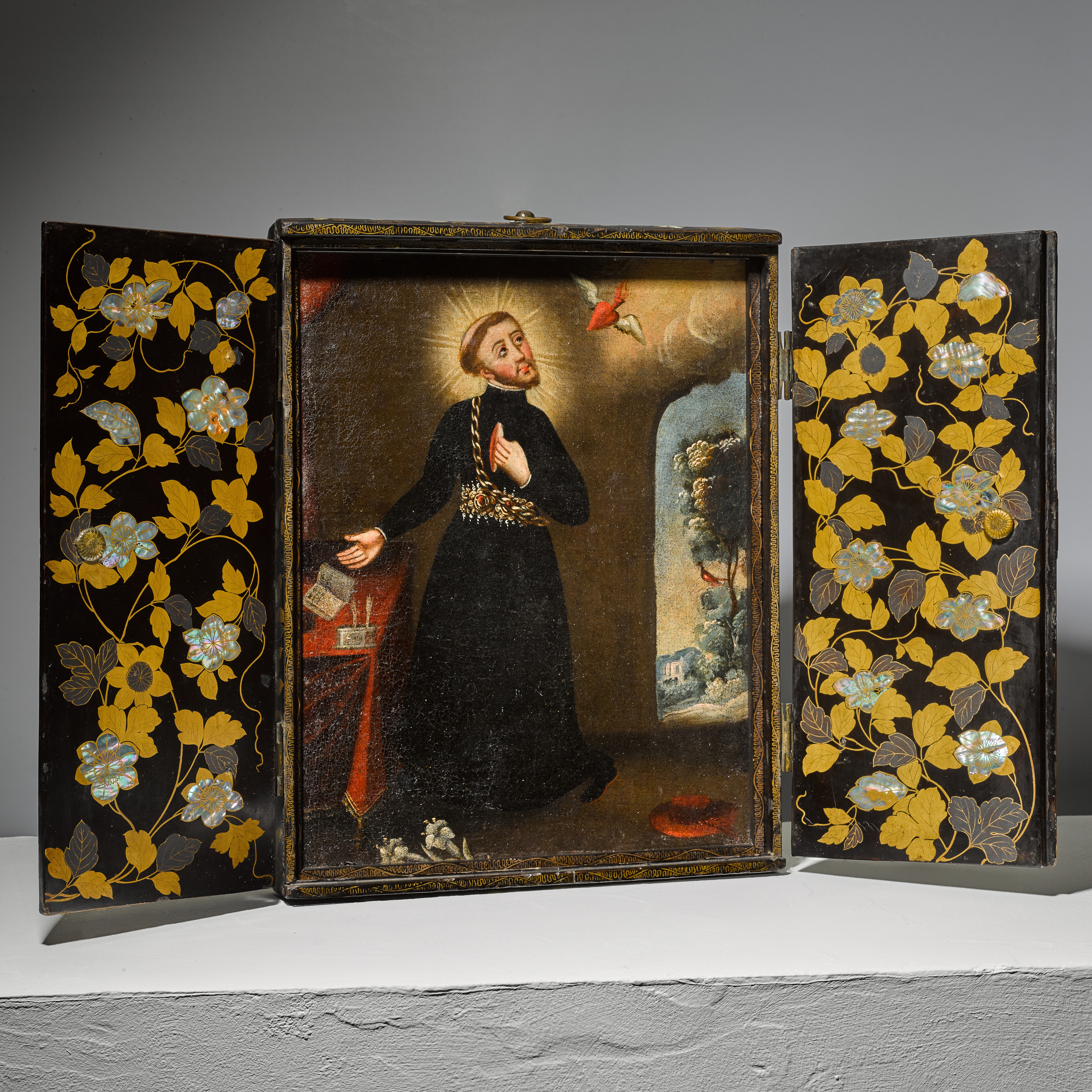
Momoyama period, late 16th - early 17th century
This Momoyama period shrine represents a remarkable fusion of Japanese and European artistic traditions, featuring elaborately decorated lacquered doors adorned with hiramaki-e, mother-of-pearl inlay, and metal fittings in the refined taste of the late 16th to early 17th century. The exterior displays naturalistic motifs of birds and flowering vines, while the interior reveals an oil painting of Saint Francis Xavier attributed to a European artist from the Spanish or Portuguese colonial school, dated to the 17th or 18th century. This unique object reflects the cultural and religious exchange that occurred following early European contact with Japan, combining Japanese decorative mastery with Christian iconography rendered in the Western medium of oil painting.
- Medium
- the two door shrine of typical rectangular form, the hinged doors mounted onto a shallow rectangular box, decorated in gold, silver and black hiramaki-e, and inlays of cut mother-of-pearl, the exterior of the doors with a small bird among clematis and grape vine, the frame with Nanban tendril and geometric design, metal fittings, latch and suspension ring, the doors opening to reveal a central canvas painted in oils by a European hand with St Francis Xavier gazing at the Sacred Heart, Spanish or Portuguese colonial school, 17th - 18th century, the interior of the doors with further flowers, foliage and vine
- Spotted At
- Auction House · Sotheby's
🔨 Auction Lot
Art of Japan
October 29, 2024
Estimate: $70,000 – $100,000
Lot 6








Start the Discussion
Request access to join the discussion