Join The Collection to save, track, and explore works like this.

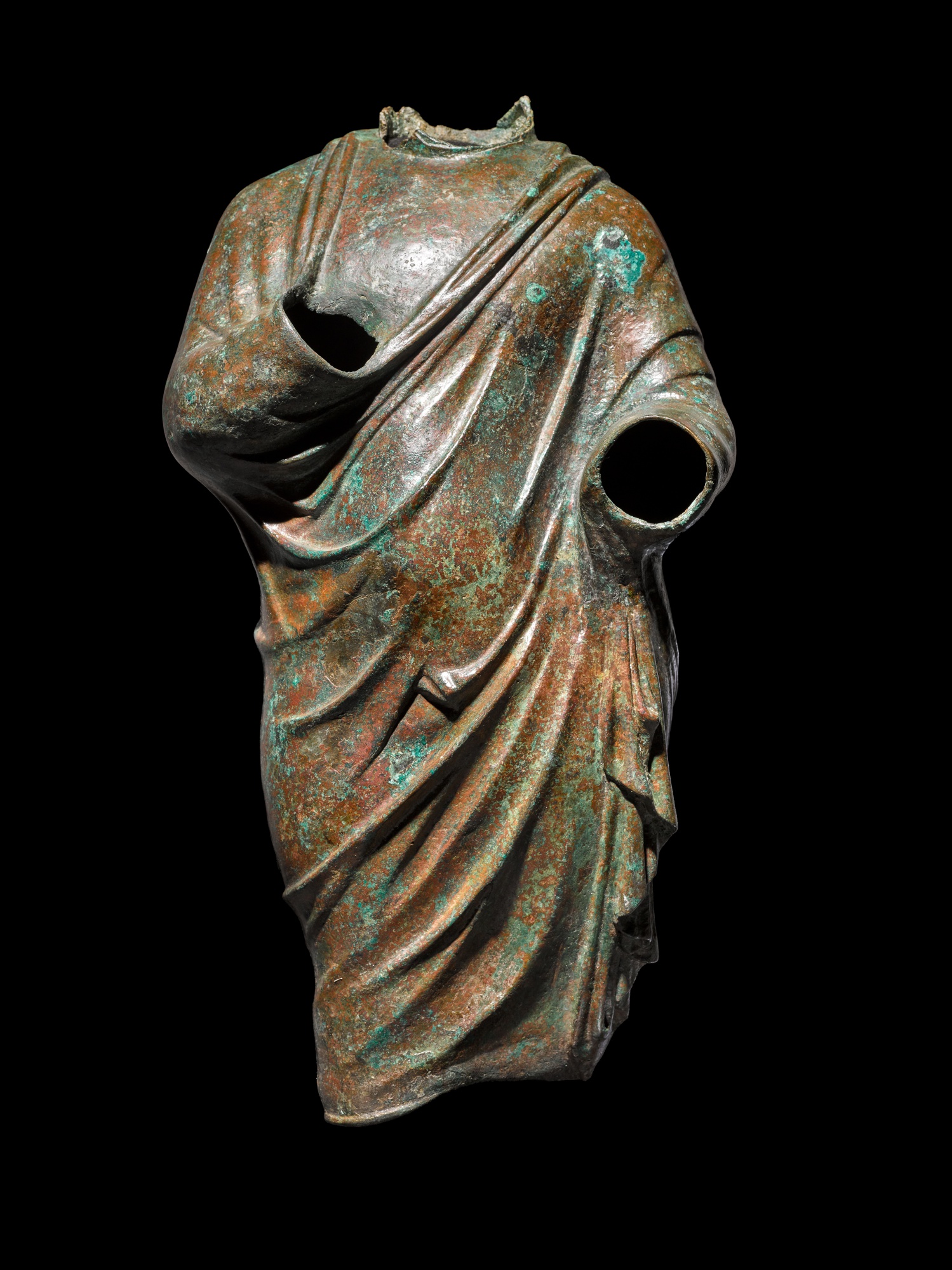
Unknown — A Bronze Torso of Harpokrates, late Hellenistic/early Roman, circa 1st Century B.C./1st Century A.D.
Unknown

A Bronze Torso of Harpokrates, late Hellenistic/early Roman, circa 1st Century B.C./1st Century A.D.

This bronze torso depicts Harpokrates, the Greco-Egyptian child deity associated with silence and the dawn, rendered in the refined naturalistic style characteristic of late Hellenistic and early Roman periods. The fragmentary sculpture demonstrates the technical mastery of ancient bronzeworkers in capturing the soft musculature and graceful proportions of a youthful figure. The work exemplifies the cultural synthesis of Greek artistic traditions with Egyptian religious iconography that flourished during this era of Mediterranean exchange.

🔨 Auction Lot

Ancient Sculpture and Works of Art

December 3, 2024

Estimate: $50,000$80,000

Lot 425

Start the Discussion

Request access to join the discussion

About this work

Unknown, A Bronze Torso of Harpokrates, late Hellenistic/early Roman, circa 1st Century B.C./1st Century A.D.

This bronze torso depicts Harpokrates, the Greco-Egyptian child deity associated with silence and the dawn, rendered in the refined naturalistic style characteristic of late Hellenistic and early Roman periods. The fragmentary sculpture demonstrates the technical mastery of ancient bronzeworkers in capturing the soft musculature and graceful proportions of a youthful figure. The work exemplifies the cultural synthesis of Greek artistic traditions with Egyptian religious iconography that flourished during this era of Mediterranean exchange.

Seen at
Sotheby's, New York, London, Hong Kong, Paris

Related themes

Serene, Bronze Sculpture, Unknown Artist, Ancient Mediterranean, Greco-Roman, Torso, Harpokrates, Hellenistic, Classical Mythology, 1st Century BC-AD

More works by Unknown

Collected by

Richard Caswell, Sebastián Naranjo, Jonah Handel, Musée d'Art Moderne de Paris, Ethan Elkins, Alex Capecelatro, Mihail Lari, Cleveland Museum of Art