Join The Collection to save, track, and explore works like this.

Tino Stefanoni — Memoria 3
Tino Stefanoni

Memoria 3

1975

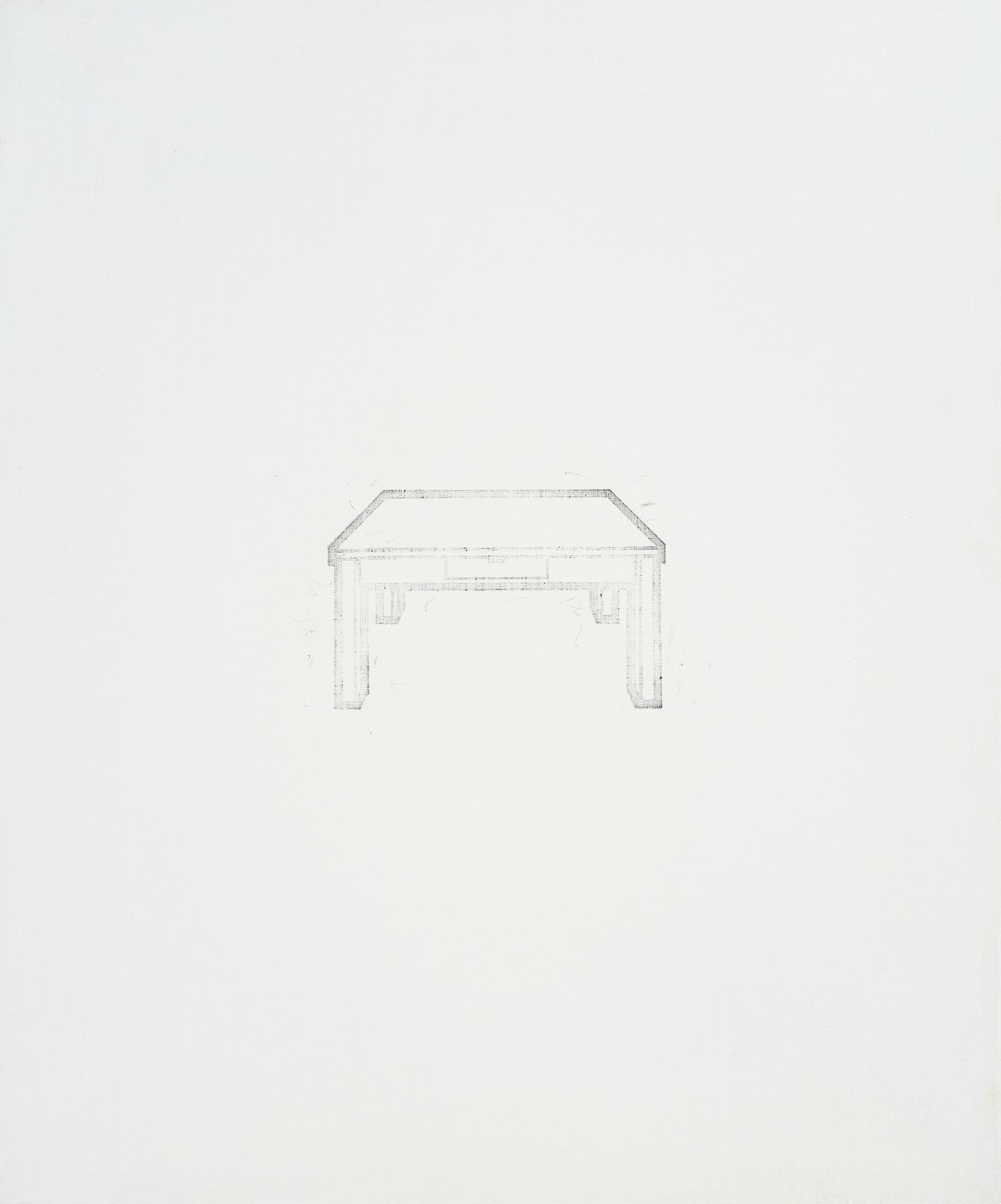
Rendered in the faintest tracery of carbon on linen white canvas, Memoria 3 presents a solitary table suspended against an expansive, luminous field. The table, depicted with the spare economy of a technical illustration or furniture catalogue diagram, hovers near the centre of the composition with an almost ghostly presence. Its forms are structural yet tentative, as though the object might dissolve entirely into the surrounding whiteness if observed too intently. The lines carry the characteristic quality of carbon paper transfer, slightly doubled and trembling, suggesting something copied, repeated, or imperfectly remembered rather than directly observed. Tino Stefanoni developed this body of work through the early and mid 1970s as part of a sustained investigation into the relationship between objects, representation, and duration. The choice of carbon paper as a medium is conceptually precise. Where conventional drawing fixes an image with intention, carbon transfer implies reproduction, the secondary impression of something already existing elsewhere. The table is not drawn so much as it is transmitted, arriving on the canvas at one remove from its origin, carrying the slight degradation and doubling that transmission always introduces. The title Memoria, used across this series, makes the epistemological stakes explicit. What is preserved in memory is never the thing itself but a copy of a copy, prone to fading, slippage, and quiet distortion. The scale of the work, 60 by 50 centimetres, is intimate and considered. The image occupies only a modest portion of the canvas, leaving vast areas of white to function not as emptiness but as active presence, as the atmosphere of forgetting or the silence in which recollection takes place. Stefanoni's decision to depict furniture, objects of domestic use and habit, deepens the melancholy of the series. Tables are sites of gathering, of daily life, of accumulated time. To represent one in such attenuated, half-erased terms is to engage directly with the pathos of ordinary things persisting beyond the moments they once anchored. Memoria 3 is a work of quiet conceptual rigour that rewards sustained attention, offering collectors a rare instance in which material process and thematic content are inseparable, each illuminating and intensifying the other.

Medium
Carbon paper on linen white canvas

🔨 Auction Lot

Martini Studio d'Arte: Modern And Contemporary Art

June 10, 2026

Estimate: €4,000 to €5,000

Lot 120

Start the Discussion

Request access to join the discussion

More by Tino Stefanoni

About this work

Tino Stefanoni, Memoria 3, 1975

Rendered in the faintest tracery of carbon on linen white canvas, Memoria 3 presents a solitary table suspended against an expansive, luminous field. The table, depicted with the spare economy of a technical illustration or furniture catalogue diagram, hovers near the centre of the composition with an almost ghostly presence. Its forms are structural yet tentative, as though the object might dissolve entirely into the surrounding whiteness if observed too intently. The lines carry the characteristic quality of carbon paper transfer, slightly doubled and trembling, suggesting something copied, repeated, or imperfectly remembered rather than directly observed. Tino Stefanoni developed this body of work through the early and mid 1970s as part of a sustained investigation into the relationship between objects, representation, and duration. The choice of carbon paper as a medium is conceptually precise. Where conventional drawing fixes an image with intention, carbon transfer implies reproduction, the secondary impression of something already existing elsewhere. The table is not drawn so much as it is transmitted, arriving on the canvas at one remove from its origin, carrying the slight degradation and doubling that transmission always introduces. The title Memoria, used across this series, makes the epistemological stakes explicit. What is preserved in memory is never the thing itself but a copy of a copy, prone to fading, slippage, and quiet distortion. The scale of the work, 60 by 50 centimetres, is intimate and considered. The image occupies only a modest portion of the canvas, leaving vast areas of white to function not as emptiness but as active presence, as the atmosphere of forgetting or the silence in which recollection takes place. Stefanoni's decision to depict furniture, objects of domestic use and habit, deepens the melancholy of the series. Tables are sites of gathering, of daily life, of accumulated time. To represent one in such attenuated, half-erased terms is to engage directly with the pathos of ordinary things persisting beyond the moments they once anchored. Memoria 3 is a work of quiet conceptual rigour that rewards sustained attention, offering collectors a rare instance in which material process and thematic content are inseparable, each illuminating and intensifying the other.

Medium
Carbon paper on linen white canvas
Year
1975
Seen at
Martini Studio d'Arte

Related themes

Furniture Subject, Carbon On Canvas, Conceptual Drawing, Minimalist, Male Artist, White And Grey, Conceptual Art, Domestic Objects, Italian Artist, Sparse Composition, Neutral Palette, Everyday Objects, Object Studies, Monochromatic, Intimate Scale, Memory And Time, Erasure And Absence, Works on Canvas, Still Life, Postwar European, Reproduction And Copy

More works by Tino Stefanoni