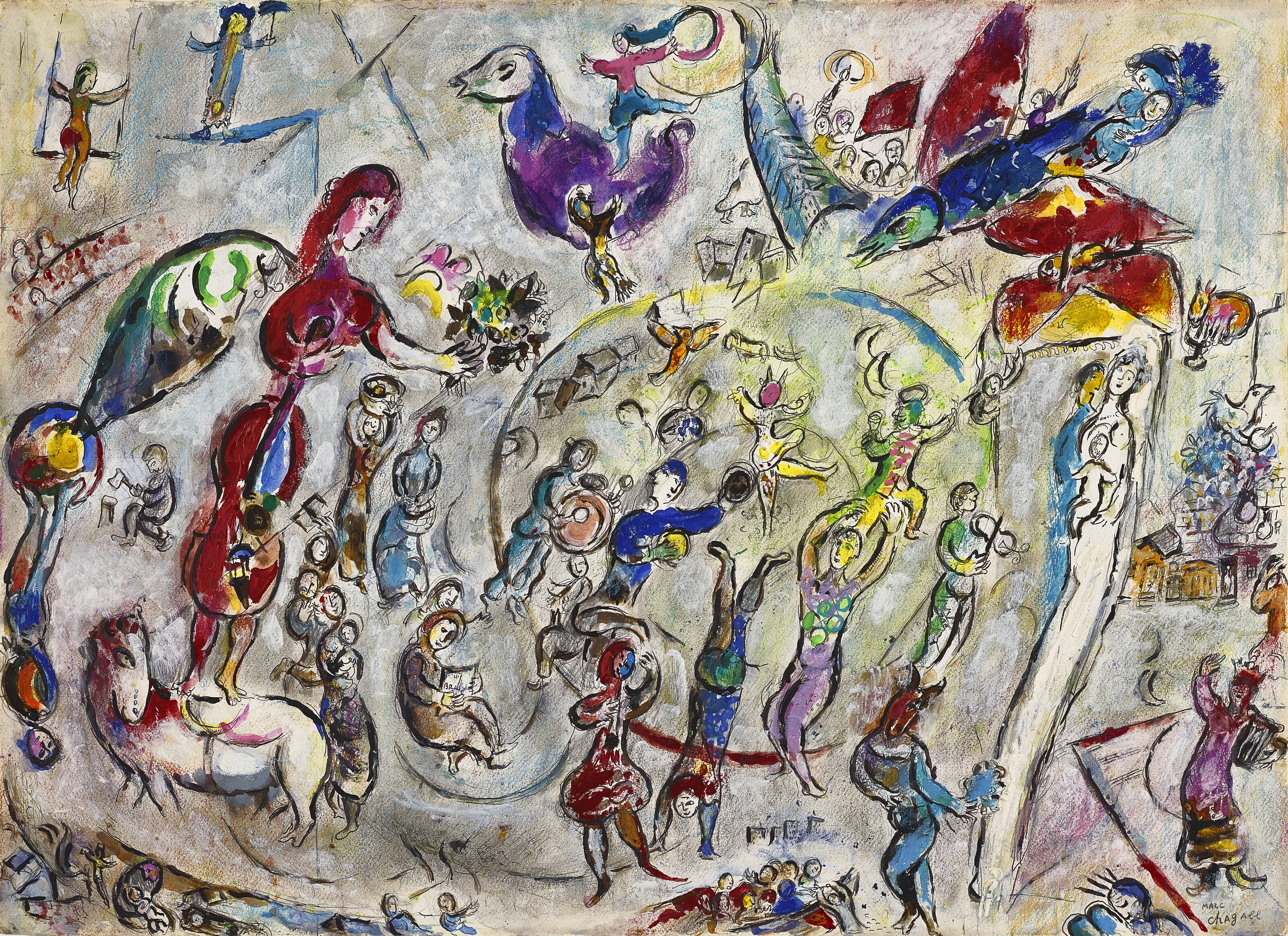
Esquisse pour “La vie”
"Esquisse pour 'La vie'" is a preparatory sketch by Marc Chagall for his larger composition exploring themes of love, passion, and human existence. The work exemplifies Chagall's characteristic blend of Cubist fragmentation and dreamlike imagery, with floating figures and symbolic elements rendered in his distinctive expressive style. As a study piece, it reveals the artist's process of developing the composition's emotional and formal elements before executing the final painting.
- Spotted At
- Auction House · Christie's
Notes
EXHIBITED Tokyo, Mitsukoshi, Ltd., Marc Chagall Exhibition: Eternal Love, July –September 2006, pp.32–33, no. 10 (illustrated). FURTHER DETAILS The Comité Marc Chagall has confirmed the authenticity of this work. Conditions of sale Brought to you by Ziwei Yi AVP, Specialist, Head of 20th Century Day Sale 20th/21st Century Art, Asia Pacific ZIWEIYI@CHRISTIES.COM +852 297 86732 LOT ESSAY Filled with a rich array of bright colours, fantastical figures, and vibrant energy, Marc Chagall’s 1964 Esquisse pour “La vie” bursts with the swirling, dreamlike symbolism that defines his mature vision of existence as a joyous yet poignant spectacle. A hidden gem once held in the artist’s personal collection, this remarkable work has been cherished in a single private collection for the past twenty years, now appearing at auction for the first time. Created as a preparatory study for his monumental oil painting La Vie (Life)—a grand 296 × 406 cm canvas commissioned by his friends and dealers Marguerite and Aimé Maeght, now housed at the Fondation Maeght in Saint-Paul-de-Vence— Esquisse pour “La vie” distills the essence of the larger work into an intimate yet expansive composition. 76 years old in 1964, Marc Chagall inevitably reflected on his life while composing this work, assembling a rich tapestry of recurring images that had defined his career to create a visual self-portrait of his artistic oeuvre. A bride and groom, reminiscent of The Flying Fish (1948), drift upward like wisps of smoke, while glimpses of political upheaval appear in the upper right, echoing The Revolution (1937). The blue fish near the top right corner recalls imagery from La Poisson Volant (1956), while the two nearby blue figures evoke the dreamlike atmosphere of Paysage bleu (Blue Landscape) (1949). Central to this composition is Chagall’s enduring fascination with the circus, a motif that recurs profoundly from the 1920s through the 1970s. Rooted in vivid childhood memories of traveling circuses that visited his hometown in Russia, these spectacles filled the young artist with wonder and awe. What began as nostalgic recollection evolved into a rich metaphor for the human condition—joyful yet tragic, where the clowns’ painted smiles and the acrobats’ gravity-defying feats mask underlying fragility, suffering, and vulnerability. Chagall identified deeply with the performers, viewing them as alter egos for the artist himself: outsiders who transcend earthly constraints through sheer imagination, much like the floating figures, vibrant colors, and dream-like harmonies that define his signature style. By weaving circus elements together with lovers, rural animals, and biblical allusions, Chagall masterfully bridged the profane and the sacred, transforming personal nostalgia into a universal poetry that speaks to themes of joy, loss, and transcendence. This metaphorical depth vividly embodies the “circus of life”. Laughter and drama intermingle in these scenes, reflecting the chaotic and unpredictable nature of existence. The ups and downs, joys and sorrows, dramatic highs and serene moments, all unfold within his colorful, swirling compositions. What appears at first glance as a purely joyful tableau often carries a melancholic undertone, flowing dream-like across the canvas as if capturing the ephemeral essence of life itself. In this way, Chagall presents “life” condensed into a single painting, symbolizing its brevity and fickleness: life is nothing more than this fleeting, illusory performance. Among the most richly detailed and imaginatively charged of Chagall’s works on paper, Esquisse pour “La vie” weaves together motifs central to Chagall’s artistic journey into a sweeping, poetic composition that intertwines lived experiences and dreams. Family memories, migrations, love, all enveloped in his characteristic floating, ethereal world. Rather than a straightforward retrospective, the work offers a profound meditation on the circus-like spectacle of existence—ephemeral, colorful, tragic, and transcendent. READ MORE
🔨 Auction Lot
20th Century Day Sale
March 28, 2026
Estimate: $4,800,000 – $6,800,000
Sold: $6,858,000
Lot 108
Spotted works by Marc Chagall
Start the Discussion
Request access to join the discussion