Join The Collection to save, track, and explore works like this.

Léon Augustin Lhermitte — Les Laveuses
Léon Augustin Lhermitte

Les Laveuses

1905

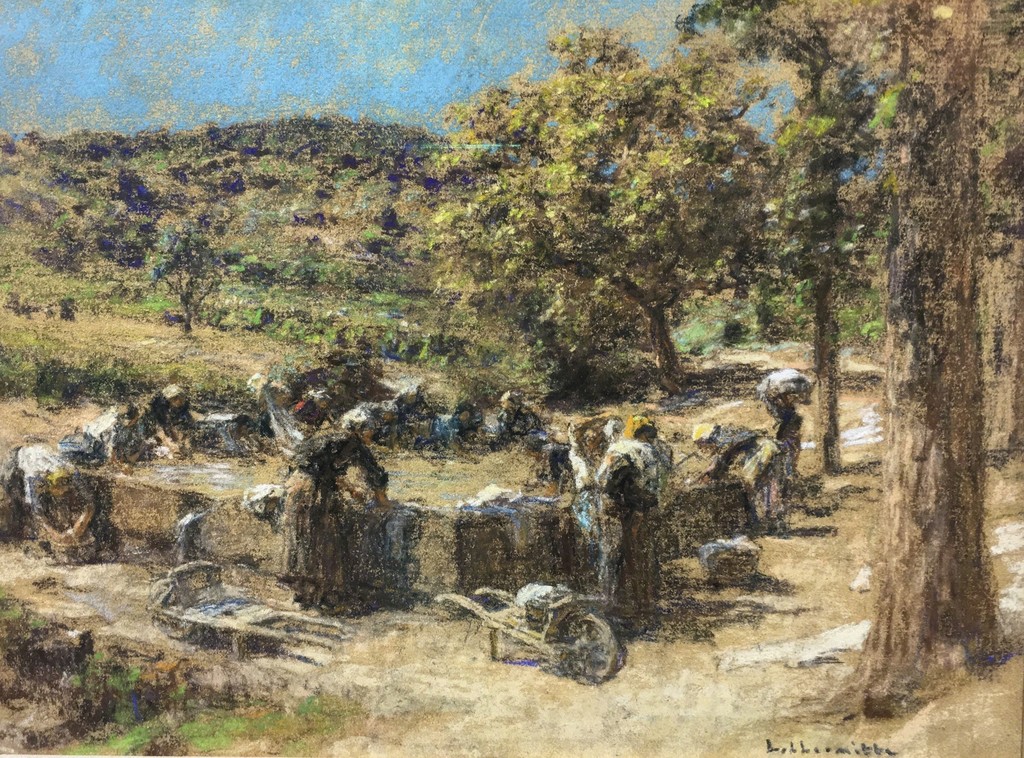
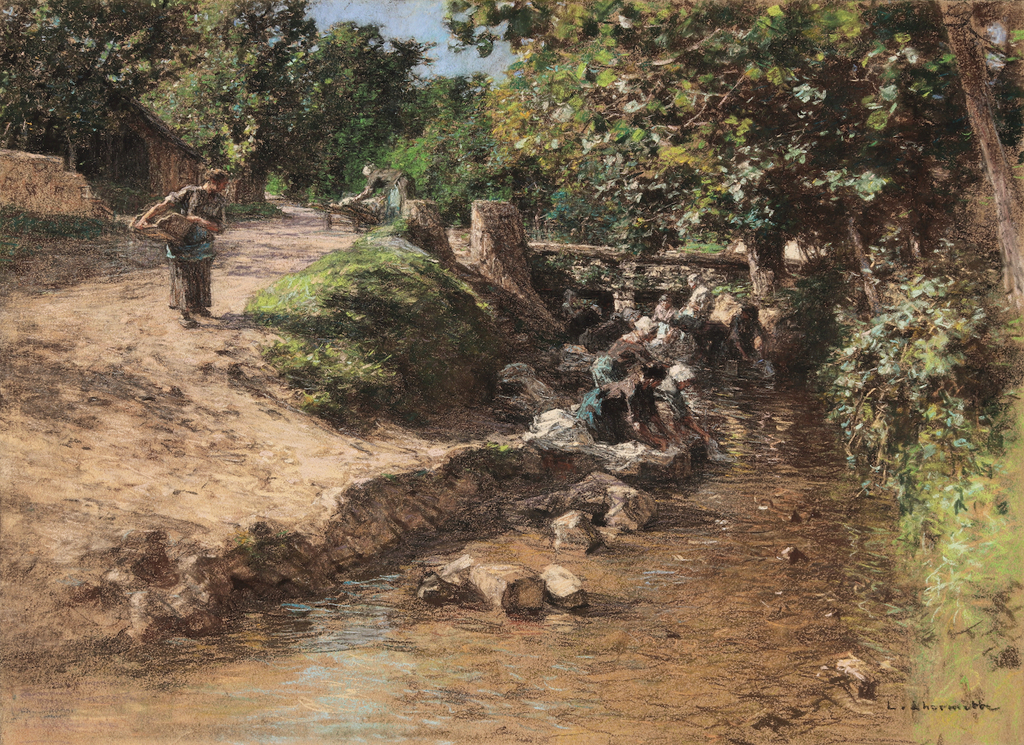
Les Laveuses, a pastel of 1905, presents a scene of washerwomen at their labour with the quiet authority that defined Léon Augustin Lhermitte's mature practice. Working at a modest 49.5 by 67.9 centimetres, Lhermitte compresses an entire social world into an intimate format, rendering the texture of wet fabric, the cool light on water, and the physical effort of the figures with the meticulous naturalism for which he was celebrated across France and beyond. The medium of pastel is handled here not as a vehicle for prettiness but as a precise observational instrument, each stroke contributing to a surface of remarkable tonal depth and tactile specificity. Lhermitte's credentials place this work within a distinguished lineage. Born in 1844 in Mont-Saint-Père in the Aisne, he trained in Paris under Lecoq de Boisbaudran, whose method of drawing from memory allowed his students to absorb a scene fully before committing it to the surface, a discipline shared by figures including James McNeill Whistler and Auguste Rodin. This technique gave Lhermitte's rural subjects an observed authenticity rather than a posed quality, and it is what separates him from mere genre painters of his era. Vincent van Gogh admired him openly, and Edgar Degas extended a personal invitation to join the Impressionist exhibitions, an invitation Lhermitte declined, remaining committed to his own rigorously naturalistic course. By 1905 Lhermitte was at the height of his international reputation, his work circulating through major dealers in Britain, North America, and France. Les Laveuses exemplifies the synthesis that made him so influential, taking a subject rooted in the academic tradition of rural labour and animating it with the progressive sensibility of pastel as a primary rather than preparatory medium. Signed by the artist and offered framed through Gladwell and Patterson, this is a work that rewards close attention, carrying within its modest dimensions both the documentary precision of a lifetime spent watching rural France and the formal conviction of an artist who understood exactly what pastel, at its most serious, could achieve.

Medium
Pastel
Overall
Framed
Signed
Yes

Start the Discussion

Request access to join the discussion

Spotted works by Léon Augustin Lhermitte
About this work

Léon Augustin Lhermitte, Les Laveuses, 1905

Les Laveuses, a pastel of 1905, presents a scene of washerwomen at their labour with the quiet authority that defined Léon Augustin Lhermitte's mature practice. Working at a modest 49.5 by 67.9 centimetres, Lhermitte compresses an entire social world into an intimate format, rendering the texture of wet fabric, the cool light on water, and the physical effort of the figures with the meticulous naturalism for which he was celebrated across France and beyond. The medium of pastel is handled here not as a vehicle for prettiness but as a precise observational instrument, each stroke contributing to a surface of remarkable tonal depth and tactile specificity. Lhermitte's credentials place this work within a distinguished lineage. Born in 1844 in Mont-Saint-Père in the Aisne, he trained in Paris under Lecoq de Boisbaudran, whose method of drawing from memory allowed his students to absorb a scene fully before committing it to the surface, a discipline shared by figures including James McNeill Whistler and Auguste Rodin. This technique gave Lhermitte's rural subjects an observed authenticity rather than a posed quality, and it is what separates him from mere genre painters of his era. Vincent van Gogh admired him openly, and Edgar Degas extended a personal invitation to join the Impressionist exhibitions, an invitation Lhermitte declined, remaining committed to his own rigorously naturalistic course. By 1905 Lhermitte was at the height of his international reputation, his work circulating through major dealers in Britain, North America, and France. Les Laveuses exemplifies the synthesis that made him so influential, taking a subject rooted in the academic tradition of rural labour and animating it with the progressive sensibility of pastel as a primary rather than preparatory medium. Signed by the artist and offered framed through Gladwell and Patterson, this is a work that rewards close attention, carrying within its modest dimensions both the documentary precision of a lifetime spent watching rural France and the formal conviction of an artist who understood exactly what pastel, at its most serious, could achieve.

Medium
Pastel
Dimensions
overall: 49.5 x 67.9 cm • framed: 71.1 x 88.9 cm
Year
1905
Signed
Hand-signed by the artist
Seen at
Gladwell & Patterson

More works by Léon Augustin Lhermitte

Collected by

Cleveland Museum of Art