Le Pho (1907–2001)
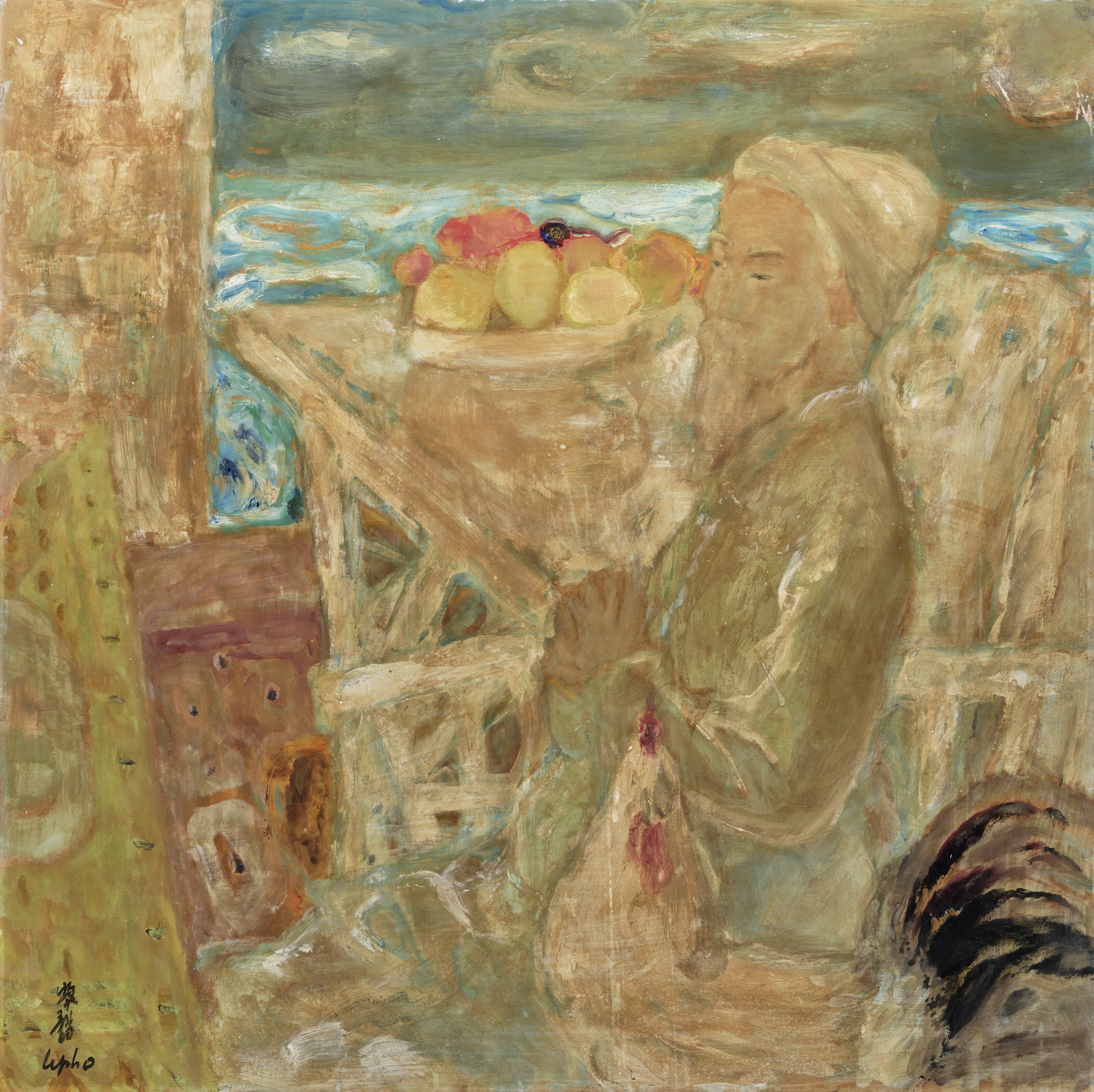
Le philosophe (The Philosopher)
"Le Philosophe" exemplifies Le Pho's distinctive synthesis of Vietnamese and French artistic traditions, depicting a contemplative figure rendered in soft, muted tones with delicate brushwork. The composition reflects the artist's characteristic elegance and refinement, employing a restrained palette and graceful line work that conveys quiet introspection. This work is representative of Le Pho's mature period, when he successfully merged Eastern aesthetic sensibilities with Western modernist techniques to create a uniquely personal visual language.
- Signed
- Yes
- Spotted At
- Auction House · Christie's
Notes
LITERATURE Wally Findlay Galleries International (ed.), le-pho by Waldemar George, 1970 (illustrated, np). EXHIBITED Paris, Galerie Romanet, Le Pho, peintures sur soie, April 1961 Paris, Christie's, The Phoenix Glue and the Broken Silk Thread - Important Vietnamese Artworks from the Melchior Dejouany Collection, 8 June - 13 June 2024 FURTHER DETAILS LE PHO, "THE PHILOSOPHER", 1956, OR THE ARTIST'S IMPERTURBABILITY In 1956, Le Pho (1907–2001), who still exhibits at Galerie Romanet—the gallery has brilliantly promoted his work since 1942—began to escape the gloom of the post-war period, which saw a sharp decline in the art market. Fewer exhibitions, fewer connoisseurs as the country rebuilt, and a shift in the market towards the United States. Since the end of the war, he had exhibited at the Galerie Roux-Hentschel in 1945, then at the Galerie Art Français in 1946, both in Paris, then in Brussels at the Galerie Van Loo in 1948. But sales dwindled, and from 1950 to 1954 he was Artistic Advisor to the Vietnamese Embassy in Paris, decorating some of the capital’s Vietnamese apartments, including that of Prince Buu Loc. After the end of the war, his style evolved: Fewer clean, ink-black lines and identifiable gouache tones. The painter still paints on silk, but the medium becomes mixed. With Le Pho, you always have to be on the lookout for allusion. Here, the auspicious format (88 x 88 cm) speaks for themselves. The encounter with Henri Matisse in 1943 continues to bear fruit: The palette remains clear. Bonnard’s spirit still permeates the work. Le philosophe is unique in the painter’s oeuvre. There’s nothing else to it. Is it a crystallization of the preceding difficult years? Seated in profile, our Asian philosopher with a thick moustache and long beard, wearing traditional headgear, features well defined, hands clasped, appears to pay homage to what could be the ancestral altar. A bowl of fruit sits on a table, within a nha ruong opening onto a bright garden signified by a very pure blue. The table is askew, everything is in imbalance in a chromatic dilution-confusion throughout the entire work. Alone, rooted in tradition, oblivious to the changes of time, the philosopher stands unperturbed, possibly allusory to Le Pho himself ? Jean-François Hubert Senior Expert, Art of Vietnam Conditions of sale Brought to you by Ziwei Yi AVP, Specialist, Head of 20th Century Day Sale 20th/21st Century Art, Asia Pacific ZIWEIYI@CHRISTIES.COM +852 297 86732
🔨 Auction Lot
20th Century Day Sale
March 28, 2026
Estimate: $700,000 – $1,000,000
Sold: $2,159,000
Lot 126
Start the Discussion
Request access to join the discussion