Join The Collection to save, track, and explore works like this.

Kenturah Davis — Sidemark
Kenturah Davis

Sidemark

2025

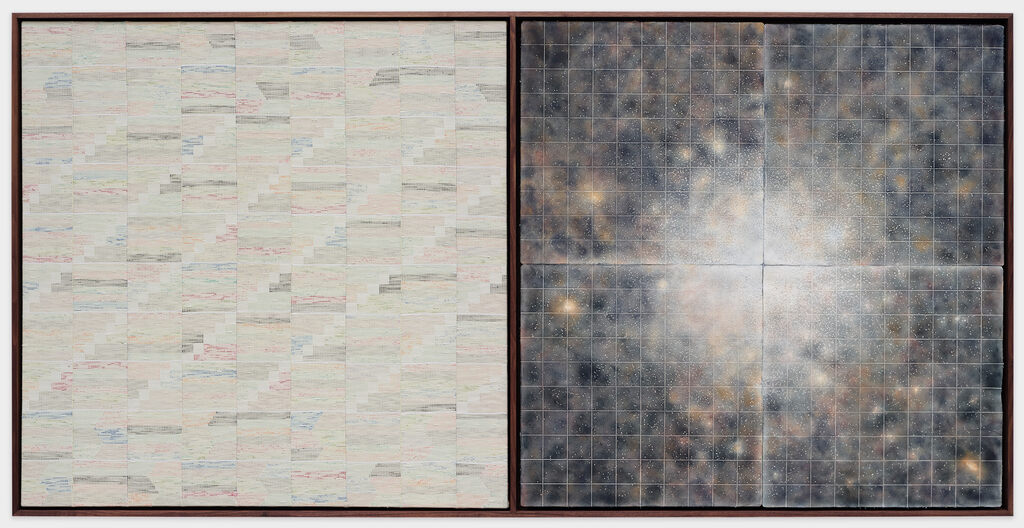
Sidemark presents one of Kenturah Davis's most formally ambitious works to date, pairing an ancient Japanese textile tradition with a cosmological field of light and pigment to arrive at something that hovers at the threshold between portraiture and abstraction. The left panel houses a hand-woven cloth whose geometric patterning draws on a Kente weaving tradition known as "stairs," a form Davis encountered during time spent in Ghana. Yet the fabrication method is shifu, a centuries-old Japanese practice in which paper is first written upon, then processed into thread and woven into cloth. The result is a surface of muted, layered tones in which the original text has been rendered wholly illegible, encoded into the material body of the work itself. What reads as quiet color is, in fact, language that has undergone radical transformation, its meaning distributed across every fiber of the weave. The opposing panel turns outward toward the cosmic scale. Across four joined sheets of hand-debossed Igarashi kozo paper, a dense celestial field unfolds: individual stars pressed directly into the sheet's surface, then built up through successive applications of dry natural pigment and oil paint rubbings that give the composition its remarkable luminous depth. Clusters of white gold concentrate near the center of the field, radiating outward into a tonally complex darkness that rewards sustained looking. The debossing technique means each star has a physical presence within the paper, so light falls differently across the surface depending on the viewer's position, making the work genuinely responsive to its environment. Taken together, the two panels form a kind of diptych portrait, one that refuses easy legibility as a conceptual stance. Davis has spoken about how every person carries within them the accumulated, invisible record of a lifetime, and how that encoding resists any attempt at quick comprehension or summary. Sidemark extends that thinking into material terms, presenting surfaces whose embedded information is real but irretrievable, demanding that the viewer sit with complexity rather than resolve it. Framed in walnut and signed by the artist, the work arrives as one of the most significant pieces Davis has produced, uniting her longstanding interest in text, cartography, and the body into a single unified statement of exceptional scale.

Medium
Oil and natural pigment on hand-debossed Igarashi kozo with shifu weaving (cotton warp, paper thread weft) in walnut frame
Overall
Framed
Signed
Yes
Location
Stephen Friedman Gallery, London

Start the Discussion

Request access to join the discussion

About this work

Kenturah Davis, Sidemark, 2025

Sidemark presents one of Kenturah Davis's most formally ambitious works to date, pairing an ancient Japanese textile tradition with a cosmological field of light and pigment to arrive at something that hovers at the threshold between portraiture and abstraction. The left panel houses a hand-woven cloth whose geometric patterning draws on a Kente weaving tradition known as "stairs," a form Davis encountered during time spent in Ghana. Yet the fabrication method is shifu, a centuries-old Japanese practice in which paper is first written upon, then processed into thread and woven into cloth. The result is a surface of muted, layered tones in which the original text has been rendered wholly illegible, encoded into the material body of the work itself. What reads as quiet color is, in fact, language that has undergone radical transformation, its meaning distributed across every fiber of the weave. The opposing panel turns outward toward the cosmic scale. Across four joined sheets of hand-debossed Igarashi kozo paper, a dense celestial field unfolds: individual stars pressed directly into the sheet's surface, then built up through successive applications of dry natural pigment and oil paint rubbings that give the composition its remarkable luminous depth. Clusters of white gold concentrate near the center of the field, radiating outward into a tonally complex darkness that rewards sustained looking. The debossing technique means each star has a physical presence within the paper, so light falls differently across the surface depending on the viewer's position, making the work genuinely responsive to its environment. Taken together, the two panels form a kind of diptych portrait, one that refuses easy legibility as a conceptual stance. Davis has spoken about how every person carries within them the accumulated, invisible record of a lifetime, and how that encoding resists any attempt at quick comprehension or summary. Sidemark extends that thinking into material terms, presenting surfaces whose embedded information is real but irretrievable, demanding that the viewer sit with complexity rather than resolve it. Framed in walnut and signed by the artist, the work arrives as one of the most significant pieces Davis has produced, uniting her longstanding interest in text, cartography, and the body into a single unified statement of exceptional scale.

Medium
Oil and natural pigment on hand-debossed Igarashi kozo with shifu weaving (cotton warp, paper thread weft) in walnut frame
Dimensions
overall: 106.7 x 208.3 x 10.2 cm • framed: 106.7 x 208.3 x 10.2 cm
Year
2025
Signed
Hand-signed by the artist
Seen at
Stephen Friedman Gallery, London

Related themes

Mohn Art Collective

More works by Kenturah Davis