Join The Collection to save, track, and explore works like this.

Art Institute of Chicago

Spotted

Islamic — Four Tiles with a Figural Scene

Islamic

Four Tiles with a Figural Scene

1601

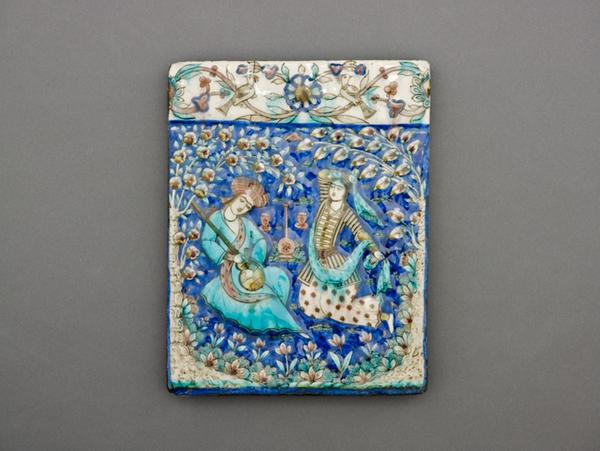
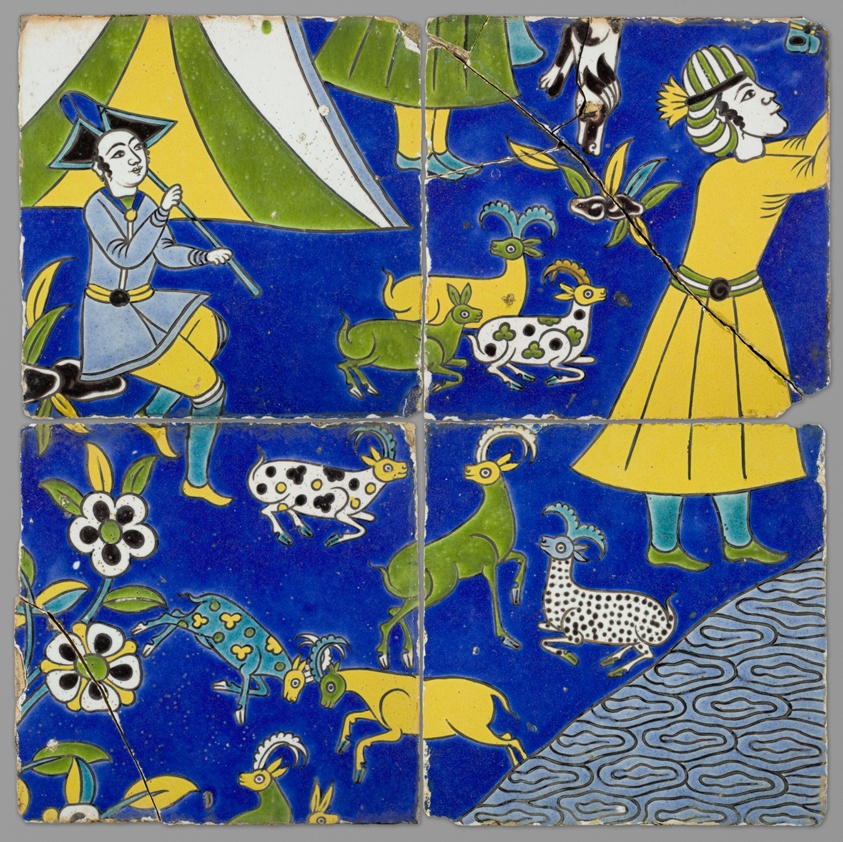
The practice of decorating tiles with bright colors outlined in black was known as cuerda seca, which translates as “dry cord” from Spanish. Cuerda seca developed in the Islamic lands of Spain, Iran, and Central Asia at the end of the 14th century and remained popular in these regions for several centuries. The black line between colors allowed for carefully distinguished forms that otherwise might have been muddles during the firing process.These tiles are a section of a larger scene depicting the life of the epic Persian hero Bahram Gur. Here, gazelles festively play along the bank of a river as young man plays the flute and another presumably bridles a horse, of which only the nose is visible. Similar figures appear in different sets of tiles, evidence of the use of pattern books or stock images for similar scenes. The tales of Bahram Gur were popular subjects for both smaller decorative objects and long epic books, such as the lavishly decorated Khamsa of Nizami, a 16th-century manuscript created for the Mughal Emperor Akbar.

Medium
Fritware with polychrom overglaze decoration
Dimensions

Start the Discussion

Request access to join the discussion

Spotted works by Islamic

About this work

Islamic, Four Tiles with a Figural Scene, 1601

The practice of decorating tiles with bright colors outlined in black was known as cuerda seca, which translates as “dry cord” from Spanish. Cuerda seca developed in the Islamic lands of Spain, Iran, and Central Asia at the end of the 14th century and remained popular in these regions for several centuries. The black line between colors allowed for carefully distinguished forms that otherwise might have been muddles during the firing process.These tiles are a section of a larger scene depicting the life of the epic Persian hero Bahram Gur. Here, gazelles festively play along the bank of a river as young man plays the flute and another presumably bridles a horse, of which only the nose is visible. Similar figures appear in different sets of tiles, evidence of the use of pattern books or stock images for similar scenes. The tales of Bahram Gur were popular subjects for both smaller decorative objects and long epic books, such as the lavishly decorated Khamsa of Nizami, a 16th-century manuscript created for the Mughal Emperor Akbar.

Medium
Fritware with polychrom overglaze decoration
Dimensions
24.2 x 2.2 cm
Year
1601
Seen at
Art Institute of Chicago, Chicago, IL

Related themes

Small Scale, Unique Work

More works by Islamic

Collected by

Art Institute of Chicago