Hippolyte Bayard
circa 1855
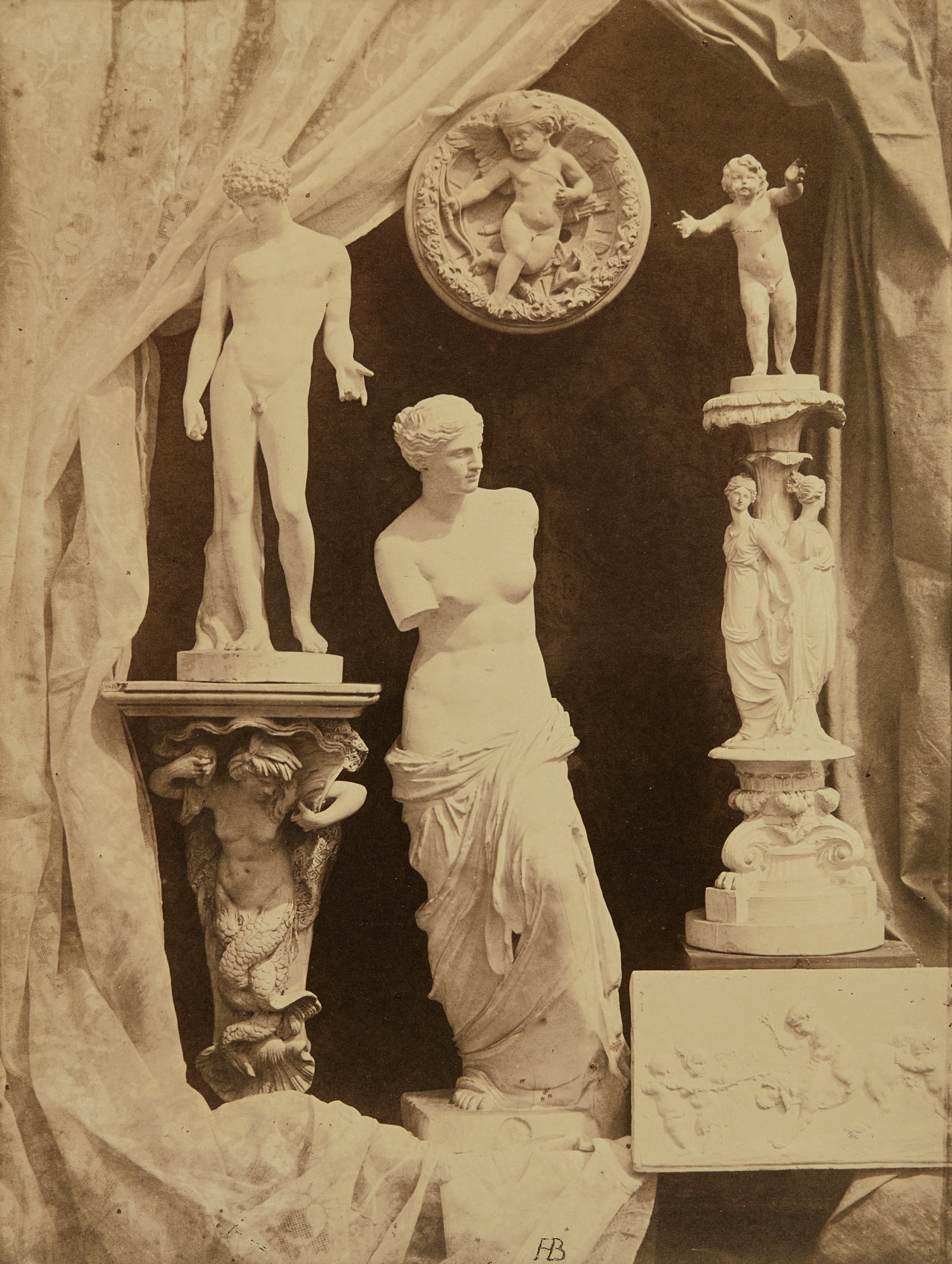
Hippolyte Bayard's circa 1855 photograph exemplifies his pioneering work in early photography, created from a glass-plate negative that captures exceptional detail and three-dimensional space. This study depicts plaster statuary from a series of classical sculpture tableaus, where the bright reflective surfaces and immobility of the casts made them ideal subjects for Bayard's carefully composed photographic investigations.
- Medium
- Hippolyte Bayard was one of the earliest practitioners of the art of photography, and his experiments with the medium were contemporaneous with those of William Henry Fox Talbot and Louis-Jacques-Mandé Daguerre. One of Bayard’s first innovations was a technique that yielded a direct positive on paper. He went on to make daguerreotypes and paper-negatives and positives, and was an early convert to the glass-plate negative. The print offered here was made from a glass-plate negative and makes full use of glass’s ability to convey detail and three-dimensional space. This study is one of a series of tableaus Bayard made of plaster statuary. Plaster casts of classical sculpture, with their bright reflective surfaces, complete immobility, and art-historical resonance, made ideal subjects for his carefully constructed compositions.
- Spotted At
- Auction House · Phillips
🔨 Auction Lot
The Odyssey of Collecting: Photographs from Joy of Giving Something Foundation
October 3, 2017
Spotted works by Hippolyte Bayard
Start the Discussion
Request access to join the discussion