Join The Collection to save, track, and explore works like this.

Cleveland Museum of Art

Spotted

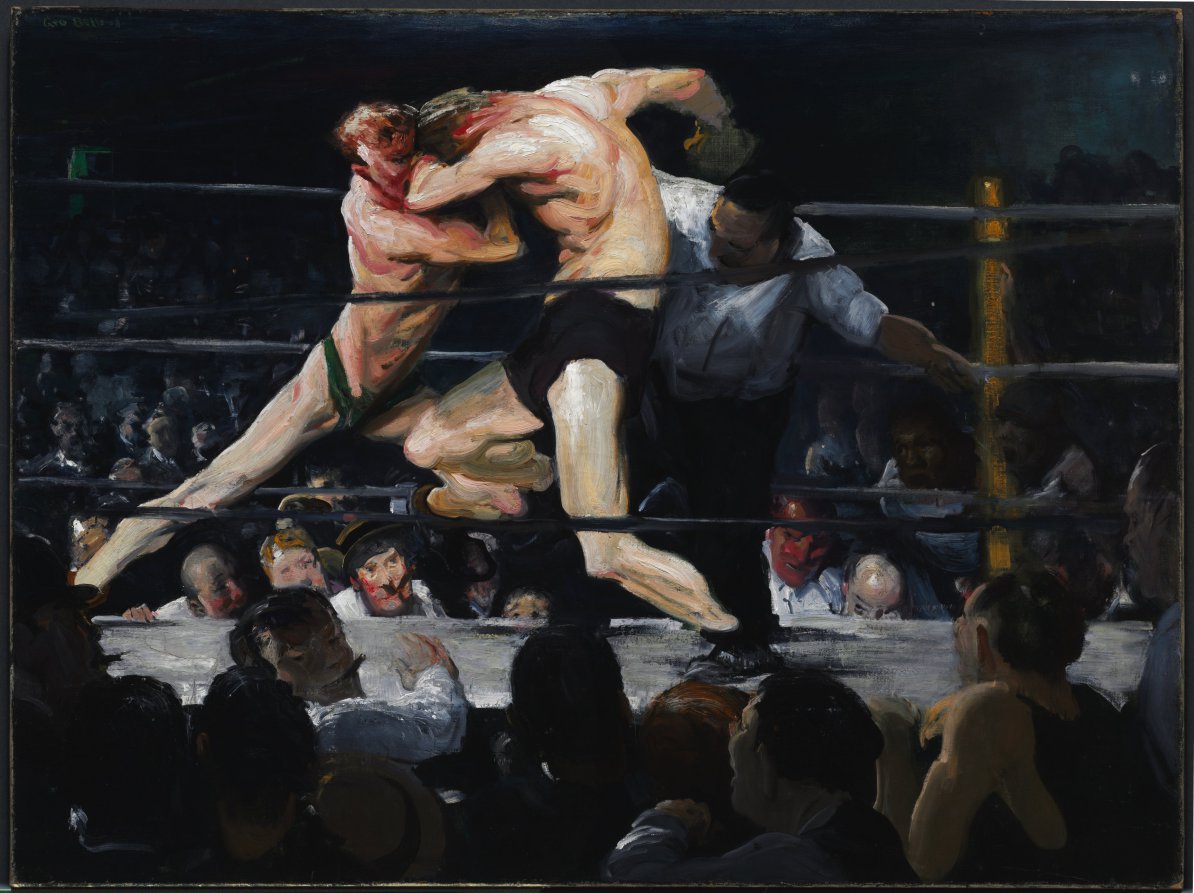
George Bellows — Stag at Sharkey's
George Bellows

Stag at Sharkey's

1909

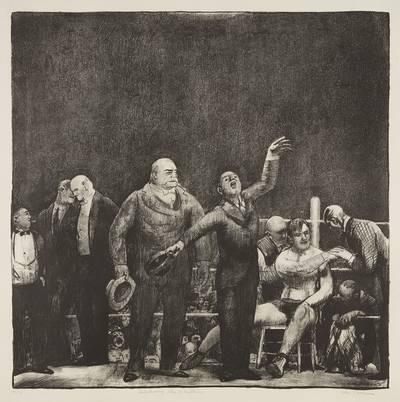
Bellows was no stranger to Sharkey’s Athletic Club, a raucous saloon with a backroom boxing ring, located near his studio. Founded by Tom “Sailor” Sharkey, an ex-fighter who had also served in the US Navy, the club attracted men seeking to watch or participate in matches. Because public boxing was illegal in New York at the time, a private event had to be arranged in order for a bout to take place. Participation was usually limited to members of a particular club, but whenever an outsider competed, he was given temporary membership and known as a “stag.” Although boxing had its share of detractors who considered it uncouth at best or barbaric at worst, its proponents—among them President Theodore Roosevelt—regarded it a healthy manifestation of manliness. Around the time Bellows painted Stag at Sharkey’s, boxing was moving from a predominantly working-class enterprise to one with greater genteel appeal. For some contemporaries, boxing was a powerful analogy for the notion that only the strongest and fittest would flourish in modern society.

Medium
oil on canvas

Start the Discussion

Request access to join the discussion

Spotted works by George Bellows

About this work

George Bellows, Stag at Sharkey's, 1909

Bellows was no stranger to Sharkey’s Athletic Club, a raucous saloon with a backroom boxing ring, located near his studio. Founded by Tom “Sailor” Sharkey, an ex-fighter who had also served in the US Navy, the club attracted men seeking to watch or participate in matches. Because public boxing was illegal in New York at the time, a private event had to be arranged in order for a bout to take place. Participation was usually limited to members of a particular club, but whenever an outsider competed, he was given temporary membership and known as a “stag.” Although boxing had its share of detractors who considered it uncouth at best or barbaric at worst, its proponents—among them President Theodore Roosevelt—regarded it a healthy manifestation of manliness. Around the time Bellows painted Stag at Sharkey’s, boxing was moving from a predominantly working-class enterprise to one with greater genteel appeal. For some contemporaries, boxing was a powerful analogy for the notion that only the strongest and fittest would flourish in modern society.

Medium
oil on canvas
Year
1909
Seen at
Cleveland Museum of Art, Cleveland, OH

Related themes

Dark Palette, Early 20th Century, Urban Working-Class Life, Boxing, American Realism, Modern, Unique Work, Painting, Oil on Canvas, Figure Composition

More works by George Bellows

Collected by

Cleveland Museum of Art