Join The Collection to save, track, and explore works like this.

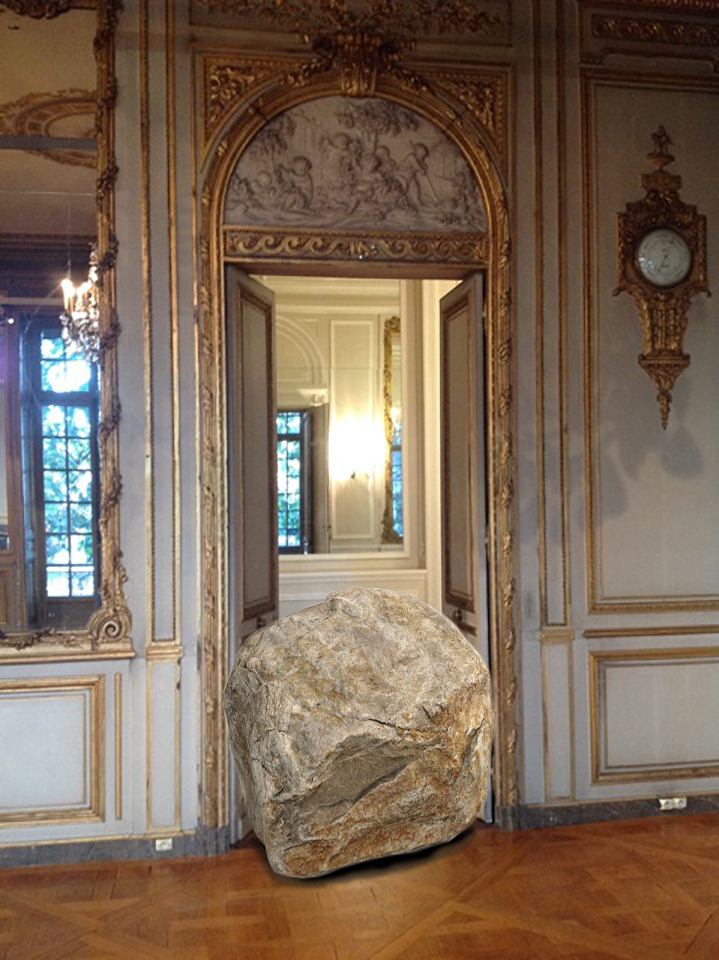
Daniel Joseph Martinez — The Burial of the Dead, 1844: Karl Marx and Friedrich Engels first meet at the Café de la Régence in Paris, become lifelong friends, begin work on The Communist Manifesto
Daniel Joseph Martinez

The Burial of the Dead, 1844: Karl Marx and Friedrich Engels first meet at the Café de la Régence in Paris, become lifelong friends, begin work on The Communist Manifesto

2016

A boulder wedged immovably into a doorway functions here as both physical obstruction and philosophical proposition. Daniel Joseph Martinez presents an object of geological time and brute material presence at the threshold of passage, transforming an architectural opening into a site of confrontation. The work belongs to Martinez's ongoing engagement with historical rupture, radical thought, and the body's negotiation of power, and its title layers meaning with characteristic density, braiding T.S. Eliot's wasteland liturgy with a speculative reconstruction of the 1844 Paris encounter between Karl Marx and Friedrich Engels, the fateful meeting that would eventually produce one of history's most consequential political texts. The conjunction of these references is not decorative but structural, insisting that burial, obstruction, and germination are all aspects of the same condition. The variable dimensions of the work are essential to its meaning, as each installation requires a boulder scaled to its specific architectural context, making the piece simultaneously site-responsive and categorically resistant to neutral display. No viewer can move through this doorway unchanged, or at all. The signature and material authenticity of the work coexist with an object the earth itself produced long before any artistic intention was applied to it, and this tension between authorship and found geological fact charges the piece with a productive irony that runs throughout Martinez's practice. Where most sculpture occupies space, this one refuses to share it. For collectors prepared to engage with conceptual work that carries genuine physical and institutional stakes, this is a rare acquisition. Martinez has been a defining voice in socially critical American art since the 1980s, and this piece, currently installed at the Mona Bismarck American Center, distills his concerns with history, ideology, and bodily experience into a single irreducible gesture.

Medium
Boulder blocking doorway
Signed
Yes

Start the Discussion

Request access to join the discussion

About this work

Daniel Joseph Martinez, The Burial of the Dead, 1844: Karl Marx and Friedrich Engels first meet at the Café de la Régence in Paris, become lifelong friends, begin work on The Communist Manifesto, 2016

A boulder wedged immovably into a doorway functions here as both physical obstruction and philosophical proposition. Daniel Joseph Martinez presents an object of geological time and brute material presence at the threshold of passage, transforming an architectural opening into a site of confrontation. The work belongs to Martinez's ongoing engagement with historical rupture, radical thought, and the body's negotiation of power, and its title layers meaning with characteristic density, braiding T.S. Eliot's wasteland liturgy with a speculative reconstruction of the 1844 Paris encounter between Karl Marx and Friedrich Engels, the fateful meeting that would eventually produce one of history's most consequential political texts. The conjunction of these references is not decorative but structural, insisting that burial, obstruction, and germination are all aspects of the same condition. The variable dimensions of the work are essential to its meaning, as each installation requires a boulder scaled to its specific architectural context, making the piece simultaneously site-responsive and categorically resistant to neutral display. No viewer can move through this doorway unchanged, or at all. The signature and material authenticity of the work coexist with an object the earth itself produced long before any artistic intention was applied to it, and this tension between authorship and found geological fact charges the piece with a productive irony that runs throughout Martinez's practice. Where most sculpture occupies space, this one refuses to share it. For collectors prepared to engage with conceptual work that carries genuine physical and institutional stakes, this is a rare acquisition. Martinez has been a defining voice in socially critical American art since the 1980s, and this piece, currently installed at the Mona Bismarck American Center, distills his concerns with history, ideology, and bodily experience into a single irreducible gesture.

Medium
Boulder blocking doorway
Year
2016
Signed
Hand-signed by the artist
Seen at
Mona Bismarck American Center

Related themes

Mohn Art Collective

More works by Daniel Joseph Martinez