Join The Collection to save, track, and explore works like this.

Hippolyte Bayard — circa 1855
Hippolyte Bayard

circa 1855

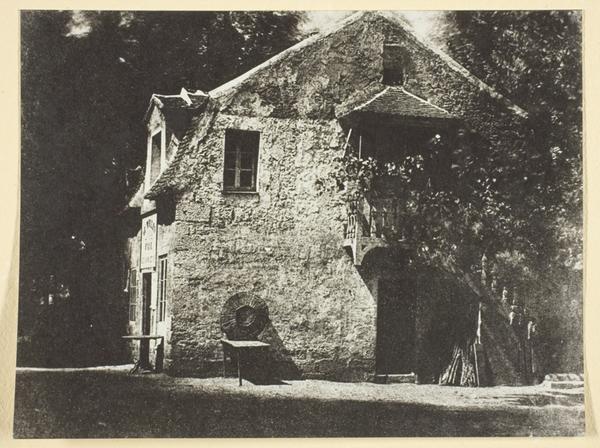
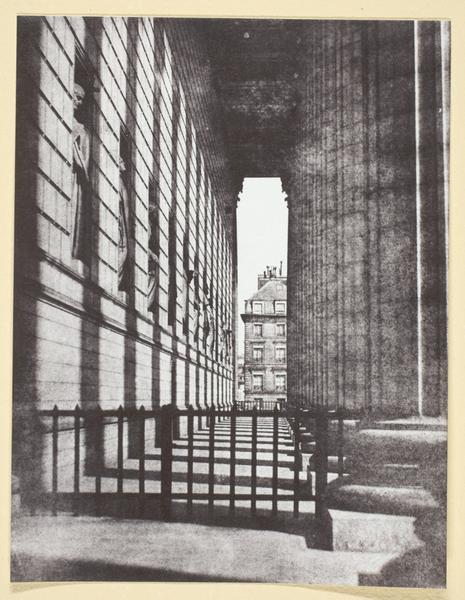
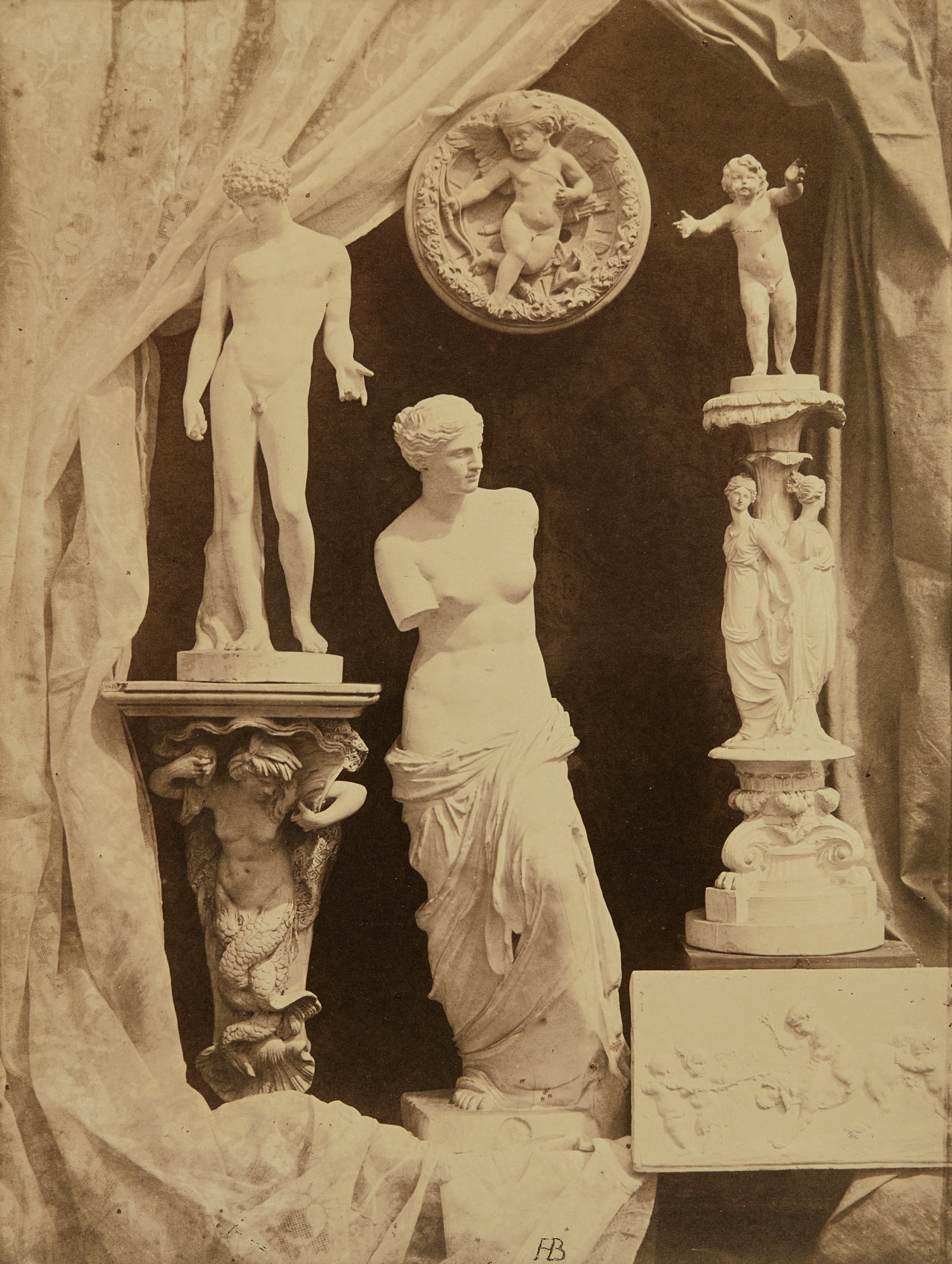
Hippolyte Bayard's circa 1855 photograph exemplifies his pioneering work in early photography, created from a glass-plate negative that captures exceptional detail and three-dimensional space. This study depicts plaster statuary from a series of classical sculpture tableaus, where the bright reflective surfaces and immobility of the casts made them ideal subjects for Bayard's carefully composed photographic investigations.

Medium
Hippolyte Bayard was one of the earliest practitioners of the art of photography, and his experiments with the medium were contemporaneous with those of William Henry Fox Talbot and Louis-Jacques-Mandé Daguerre. One of Bayard’s first innovations was a technique that yielded a direct positive on paper. He went on to make daguerreotypes and paper-negatives and positives, and was an early convert to the glass-plate negative. The print offered here was made from a glass-plate negative and makes full use of glass’s ability to convey detail and three-dimensional space. This study is one of a series of tableaus Bayard made of plaster statuary. Plaster casts of classical sculpture, with their bright reflective surfaces, complete immobility, and art-historical resonance, made ideal subjects for his carefully constructed compositions.

🔨 Auction Lot

The Odyssey of Collecting: Photographs from Joy of Giving Something Foundation

October 3, 2017
Start the Discussion

Request access to join the discussion

About this work

Hippolyte Bayard, circa 1855

Hippolyte Bayard's circa 1855 photograph exemplifies his pioneering work in early photography, created from a glass-plate negative that captures exceptional detail and three-dimensional space. This study depicts plaster statuary from a series of classical sculpture tableaus, where the bright reflective surfaces and immobility of the casts made them ideal subjects for Bayard's carefully composed photographic investigations.

Medium
Hippolyte Bayard was one of the earliest practitioners of the art of photography, and his experiments with the medium were contemporaneous with those of William Henry Fox Talbot and Louis-Jacques-Mandé Daguerre. One of Bayard’s first innovations was a technique that yielded a direct positive on paper. He went on to make daguerreotypes and paper-negatives and positives, and was an early convert to the glass-plate negative. The print offered here was made from a glass-plate negative and makes full use of glass’s ability to convey detail and three-dimensional space. This study is one of a series of tableaus Bayard made of plaster statuary. Plaster casts of classical sculpture, with their bright reflective surfaces, complete immobility, and art-historical resonance, made ideal subjects for his carefully constructed compositions.
Seen at
Phillips, New York, London, Hong Kong

Related themes

Monochrome, Photography, French, Classical Sculpture, Serene, Documentary, 19th Century, Photograph, Gelatin Silver Print, Still Life

More works by Hippolyte Bayard

Collected by

Art Institute of Chicago, Cleveland Museum of Art