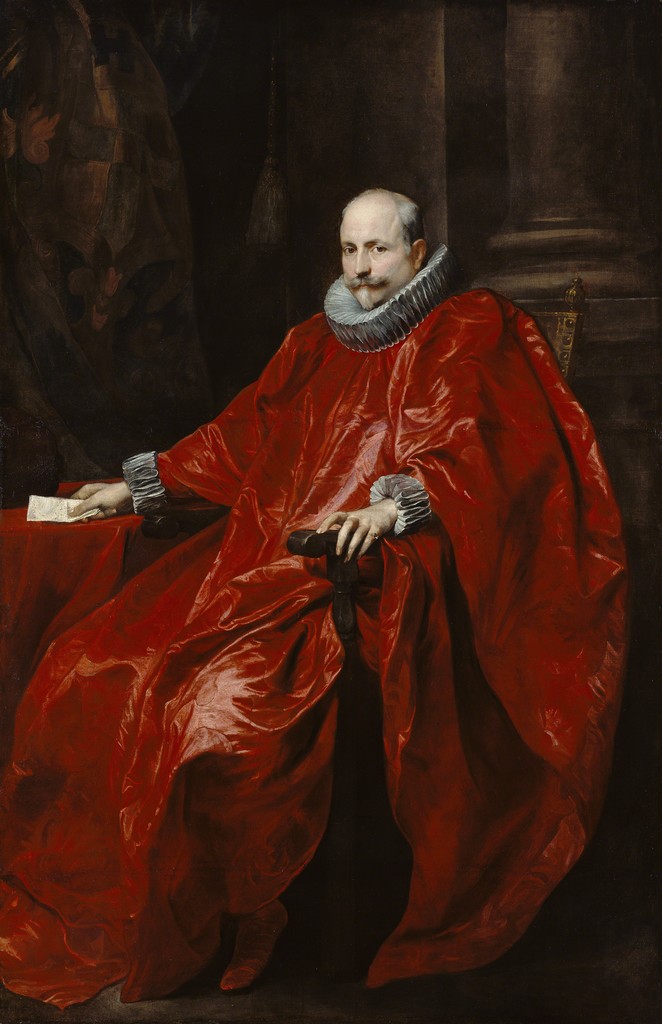
Portrait of Agostino Pallavicini
1621
Painted in Genoa in 1621, this monumental portrait of Agostino Pallavicini stands as one of the defining achievements of Anthony van Dyck's first Italian sojourn, a period that fundamentally shaped the trajectory of European portraiture. Measuring over two meters in height, the canvas presents the Genoese ambassador to the Holy See with an authority that is at once theatrical and psychologically acute. Pallavicini is rendered in sumptuous scarlet robes, the fabric handled with a painterly virtuosity that would become synonymous with van Dyck's mature style, the drapery cascading with an almost sculptural weight while simultaneously conveying the softness of the finest silk. The ambassador's bearing is commanding yet restrained, the slight turn of the head and the measured gaze communicating a statecraft refined over decades of diplomatic service. Van Dyck was in his early twenties when he completed this work, yet the portrait reveals a confidence in compositional ambition that places it squarely within the grand tradition of Titian and Veronese, painters whom the young Flemish master studied intensively during his Italian years. The architecture framing the figure, with its sweeping curtain and columnar backdrop, borrows the vocabulary of High Renaissance portraiture while inflecting it with a new immediacy and warmth. The treatment of Pallavicini's face is particularly remarkable, the skin tones built up in thin, luminous glazes that capture the particular quality of Mediterranean light and lend the sitter an air of lived experience rather than idealized grandeur. This is not merely representation but an act of social elevation, a function van Dyck would go on to perform for the courts of Europe with unrivaled distinction. Now held in the permanent collection of the J. Paul Getty Museum, the portrait is recognized as a cornerstone of van Dyck's early career and a pivotal document in the history of aristocratic portraiture. For collectors and scholars alike, the work illustrates how completely van Dyck had absorbed and then surpassed his Italian sources by the time he was barely into his third decade, producing a likeness that remains as commanding today as it was in the gilded halls of Genoese nobility four centuries ago.
- Medium
- Oil on canvas
- Signed
- Yes
- Location
- J. Paul Getty Museum, Los Angeles, United States
Spotted works by Anthony van Dyck
Start the Discussion
Request access to join the discussion