Join The Collection to save, track, and explore works like this.

Art Institute of Chicago

Spotted

William Morris — "Swan House" Carpet
William Morris

"Swan House" Carpet

1883

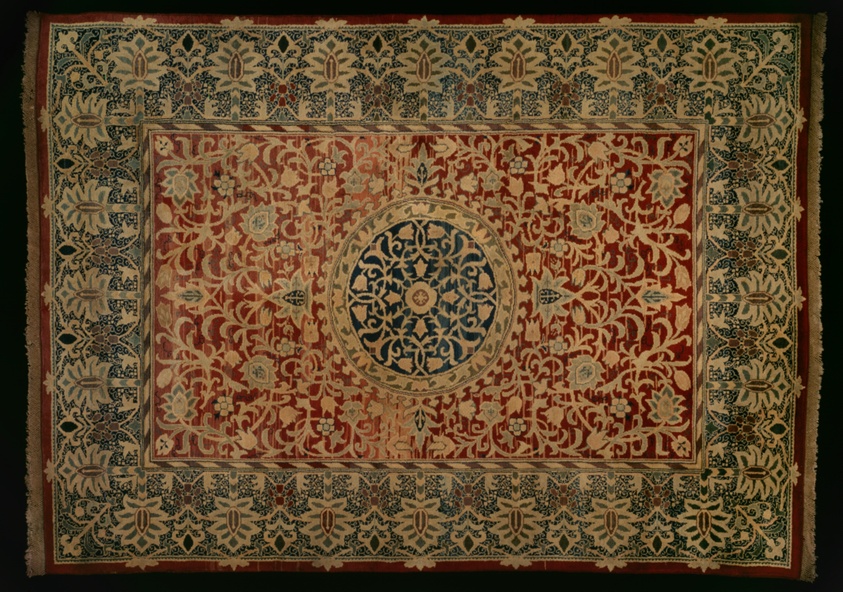
This carpet was among the original furnishings of the John J. Glessner House on Prairie Avenue in Chicago, which was designed by the architect Henry Hobson Richardson (1838–1886) and completed in 1887. The carpet was located in the hall of the house and was one of the many furnishing textiles designed by Morris and other eminent Arts and Crafts textile designers and manufacturers of the period. The design and craftsmanship of decorative objects were of the utmost importance to Morris. His dedicated interest in understanding, practicing, and mastering textile-manufacturing techniques, coupled with his belief in the benefits of beauty in everyday life, made him and his firm among the most celebrated in British history. In the 1870s Morris began designing hand-knotted and machine-made carpets. He had long been interested in historical carpets, and many could be found in his personal collection. Here Morris looked to Turkish and Persian rugs for inspiration, utilizing a layout with a central medallion set in a field of interlacing stylized flowers and foliage framed by a border of continuous palmettes.

Medium
Cotton and wool, plain weave with supplementary wrapping wefts forming "Ghiordes knots" cut pile
Dimensions

Start the Discussion

Request access to join the discussion

About this work

William Morris, "Swan House" Carpet, 1883

This carpet was among the original furnishings of the John J. Glessner House on Prairie Avenue in Chicago, which was designed by the architect Henry Hobson Richardson (1838–1886) and completed in 1887. The carpet was located in the hall of the house and was one of the many furnishing textiles designed by Morris and other eminent Arts and Crafts textile designers and manufacturers of the period. The design and craftsmanship of decorative objects were of the utmost importance to Morris. His dedicated interest in understanding, practicing, and mastering textile-manufacturing techniques, coupled with his belief in the benefits of beauty in everyday life, made him and his firm among the most celebrated in British history. In the 1870s Morris began designing hand-knotted and machine-made carpets. He had long been interested in historical carpets, and many could be found in his personal collection. Here Morris looked to Turkish and Persian rugs for inspiration, utilizing a layout with a central medallion set in a field of interlacing stylized flowers and foliage framed by a border of continuous palmettes.

Medium
Cotton and wool, plain weave with supplementary wrapping wefts forming "Ghiordes knots" cut pile
Dimensions
472.3 x 333.4 cm
Year
1883
Seen at
Art Institute of Chicago, Chicago, IL

Related themes

Modern, Unique Work, Large Scale

More works by William Morris

Collected by

Art Institute of Chicago, Cleveland Museum of Art