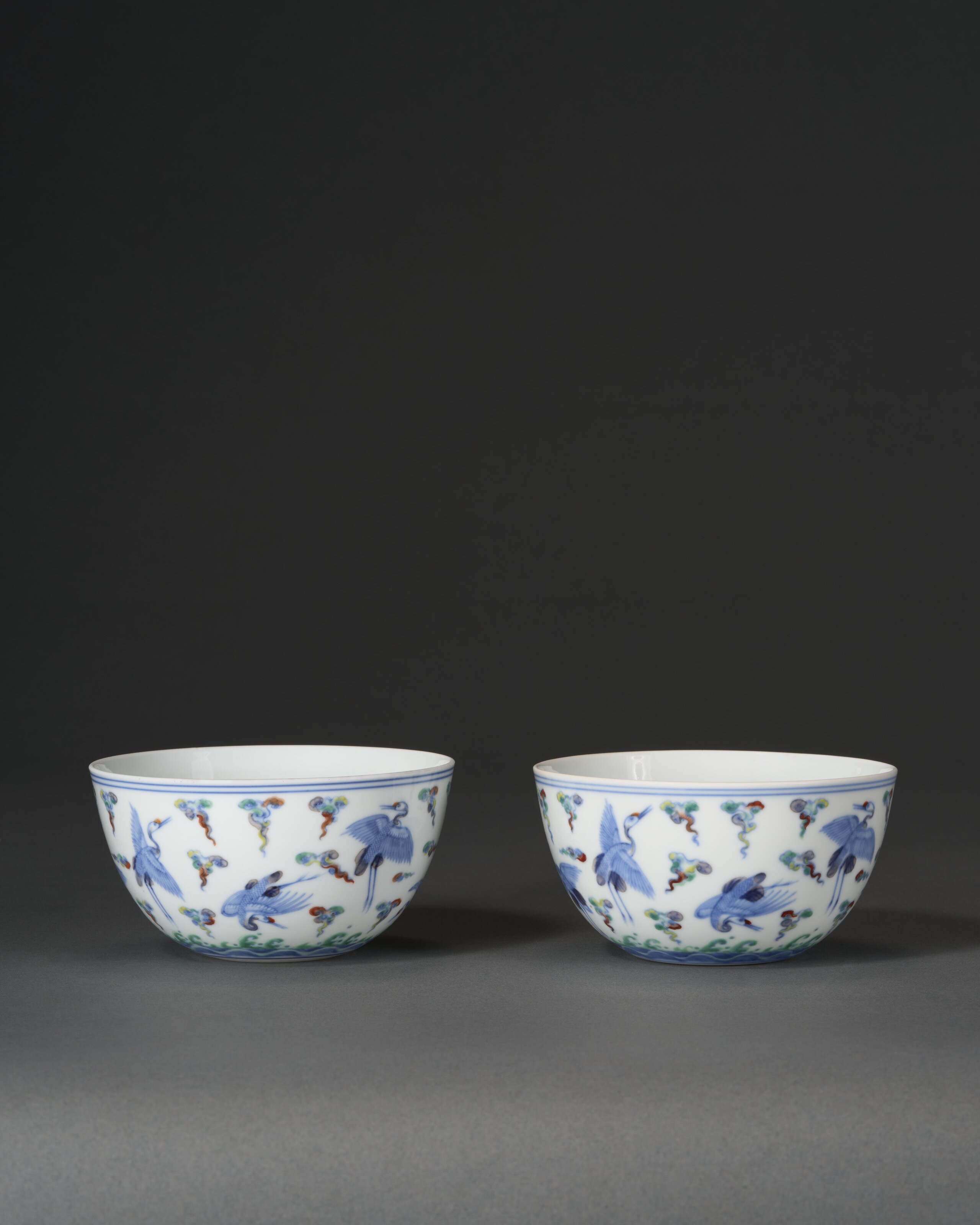
A Very Rare Pair Of Doucai 'crane' Bowls
YONGZHENG SIX-CHARACTER MARKS IN UNDERGLAZE BLUE WITHIN DOUBLE CIRCLES AND OF THE PERIOD (1723-1735)
This exceptional pair of doucai bowls from the Yongzheng period (1723–1735) exemplifies the refined aesthetic and technical mastery of early Qing imperial porcelain production. The bowls feature the characteristic underglaze blue six-character reign marks within double circles, a hallmark of authentic pieces from this era, while the doucai technique demonstrates the skilled coordination of underglaze blue outlines with overglaze enameled colors. The crane motif, symbolizing longevity and auspiciousness in Chinese culture, reflects both the decorative sophistication and cultural significance inherent in imperial porcelain of the Yongzheng reign.
- Spotted At
- Auction House · Christie's
Notes
LITERATURE Chang Foundation, Selected Chinese Ceramics from Han to Qing Dynasties, Taipei, 1990, p. 306-307, no. 134. Conditions of sale Brought to you by Rufus Chen (陳嘉安) Head of Sale, AVP, Specialist Check the condition report or get in touch for additional information about this ASIANARTNY@CHRISTIES.COM +1 212 636 2180 VIEW CONDITION REPORT LOT ESSAY The motif of cranes flying amidst ruyi-form clouds is rife with symbols of longevity and strong Daoist associations. This motif is rarely found on Yongzheng-period ceramics, but could be representative of the emperor’s antiquarianism and interest in ceramics and motifs from earlier dynasties. The design was particularly favored in the mid-Ming period during the Jiajing period, as the Jiajing Emperor had a keen interest in Daoism, which regarded the crane as a symbol of longevity, immortality, and wisdom. The motif of a crane flying towards the sun may also represent the wish for a recipient to rise to a high office (See J. Harrison-Hall, Ming Ceramics, London, 2001, p. 255). An example of a Jiajing-marked dish decorated with cranes and clouds is illustrated in Mayuyama: Seventy Years, vol. 1, Tokyo, 1976, p. 284, no. 851. Another Jiajing-period bowl decorated on the interior in blue and white with a crane amidst ruyi-form clouds is illustrated by J. Harrison-Hall, Catalogue of Late Yuan and Early Ming Porcelains in the British Museum, London, 2001, p. 245, no. 9:65. A related pair of Yongzheng-marked bowls in blue and white decorated with cranes in flight sold at Sotheby’s Hong Kong, 3 April 2019, lot 3634.
🔨 Auction Lot
Important Chinese Art
March 26, 2026
Estimate: $100,000 – $150,000
Sold: $698,500
Lot 653
Start the Discussion
Request access to join the discussion