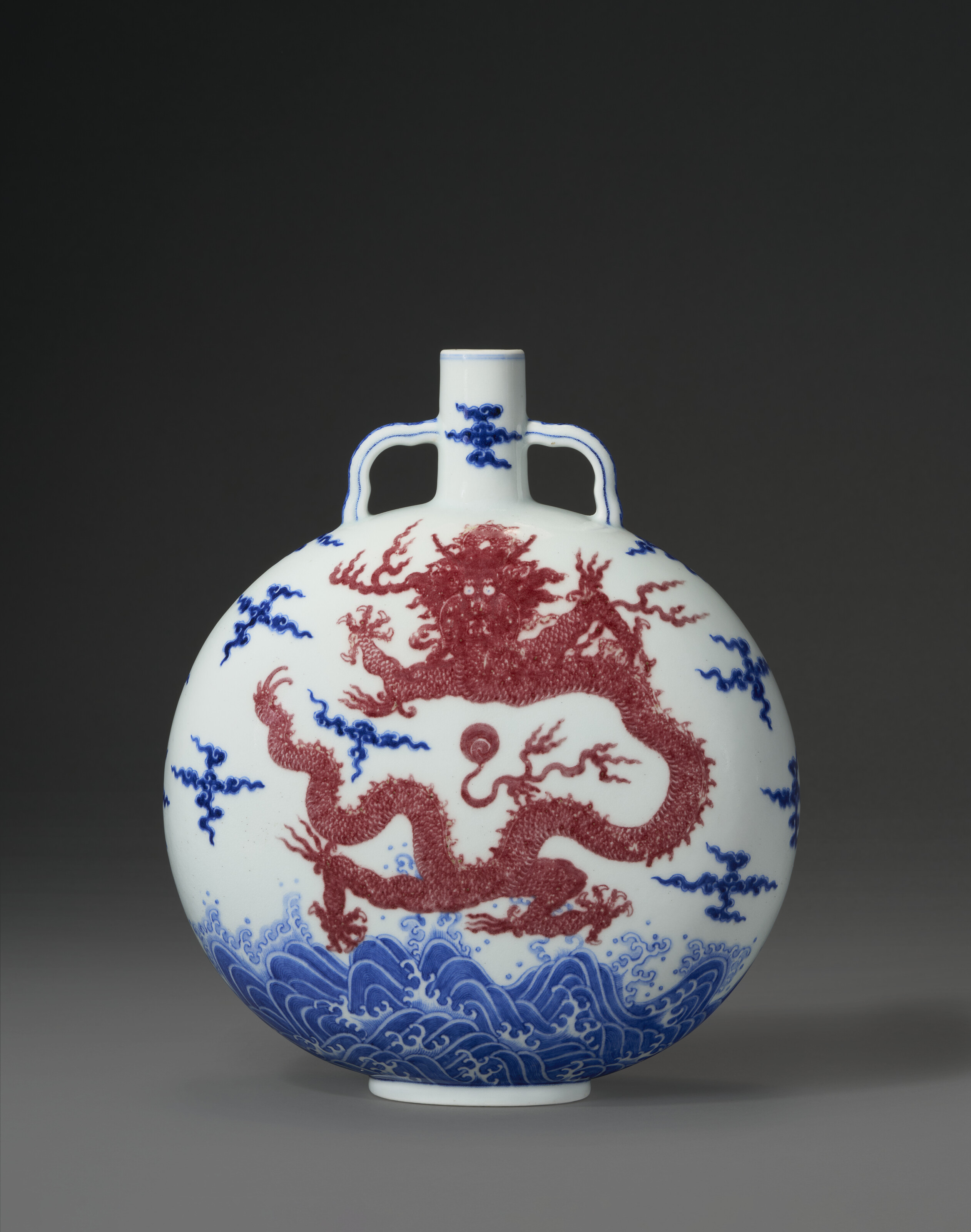
A Superb Underglaze-blue And Copper-red-decorated 'dragon' Moon Flask
QIANLONG SEAL MARK IN UNDERGLAZE BLUE AND OF THE PERIOD (1736-1795)
This exceptional moon flask exemplifies the technical mastery of Qianlong period porcelain, combining underglaze blue decoration with the notoriously difficult copper red technique to depict an auspicious dragon motif. The flattened spherical form, characteristic of moon flasks, served both ceremonial and decorative purposes in the imperial court during the eighteenth century. The presence of an authentic Qianlong seal mark confirms this piece's imperial provenance and represents a significant achievement in Chinese ceramic craftsmanship.
- Spotted At
- Auction House · Christie's
Notes
LOT ESSAY This superb moon flask is a rare example of a large imperial Qianlong vessel decorated with underglaze copper-red dragons amid richly painted underglaze‑blue waves and clouds, demonstrating the superb technical control achieved at the imperial kilns at this time. A closely related moon flask of comparable design and size (31 cm.) is in the Qing court collection, and illustrated in The Complete Collection of Treasures of the Palace Museum—36--Blue and White Porcelain with Underglazed Red (III), Hong Kong, 2000, p. 233, no. 213. Further examples include one illustrated in Soame Jenyns, Later Chinese Porcelain: The Ch’ing Dynasty, 1971, pl. XCIV, fig. 1, and another from the Walters Collection illustrated in Bushell, Oriental Ceramic Art, New York, 1981, fig. 17. The decoration ultimately derives from early Ming porcelains combining iron‑red dragons with underglaze blue decoration. As early as the Yongle reign (1402–24), a small number of imperial wares were decorated with red dragons against blue grounds, including a Yongle stem bowl excavated at the imperial kilns in 1999 and published in The Porcelain of Imperial Kiln in Ming and Qing Dynasties, Beijing, 2016, pp. 178–9, no. 75. Although iron‑red was also used on Hongwu and Yongle porcelains, its combination with cobalt blue became more widespread during the Xuande reign. A small group of Xuande bowls features iron‑red dragons above blue waves. Examples include one excavated at Jingdezhen (ibid., p. 118, no. 42); one in the National Palace Museum, Taipei (Catalogue of the Special Exhibition of Selected Hsuan‑te Porcelains, 1998, pp. 164–5, no. 55) and one in the Percival David Collection (acc. no. PDF A778). The dragon’s vigorous, forward‑facing stance on the present moon flask also recalls Xuande prototypes. A closely related composition appears on a stem bowl in the Percival David Collection, where a copper‑red dragon rises from blue waves with all four limbs extended (Rosemary Scott, Imperial Taste, 1989, p. 63, no. 33). While both Xuande and Qianlong dragons share this looping-neck posture, Xuande examples typically show the head in three‑quarter view, whereas Qianlong versions, such as the current moon flask, render it face-forward for greater visual impact. READ MORE
🔨 Auction Lot
Important Chinese Art
March 26, 2026
Estimate: $200,000 – $400,000
Sold: $736,600
Lot 660
Start the Discussion
Request access to join the discussion