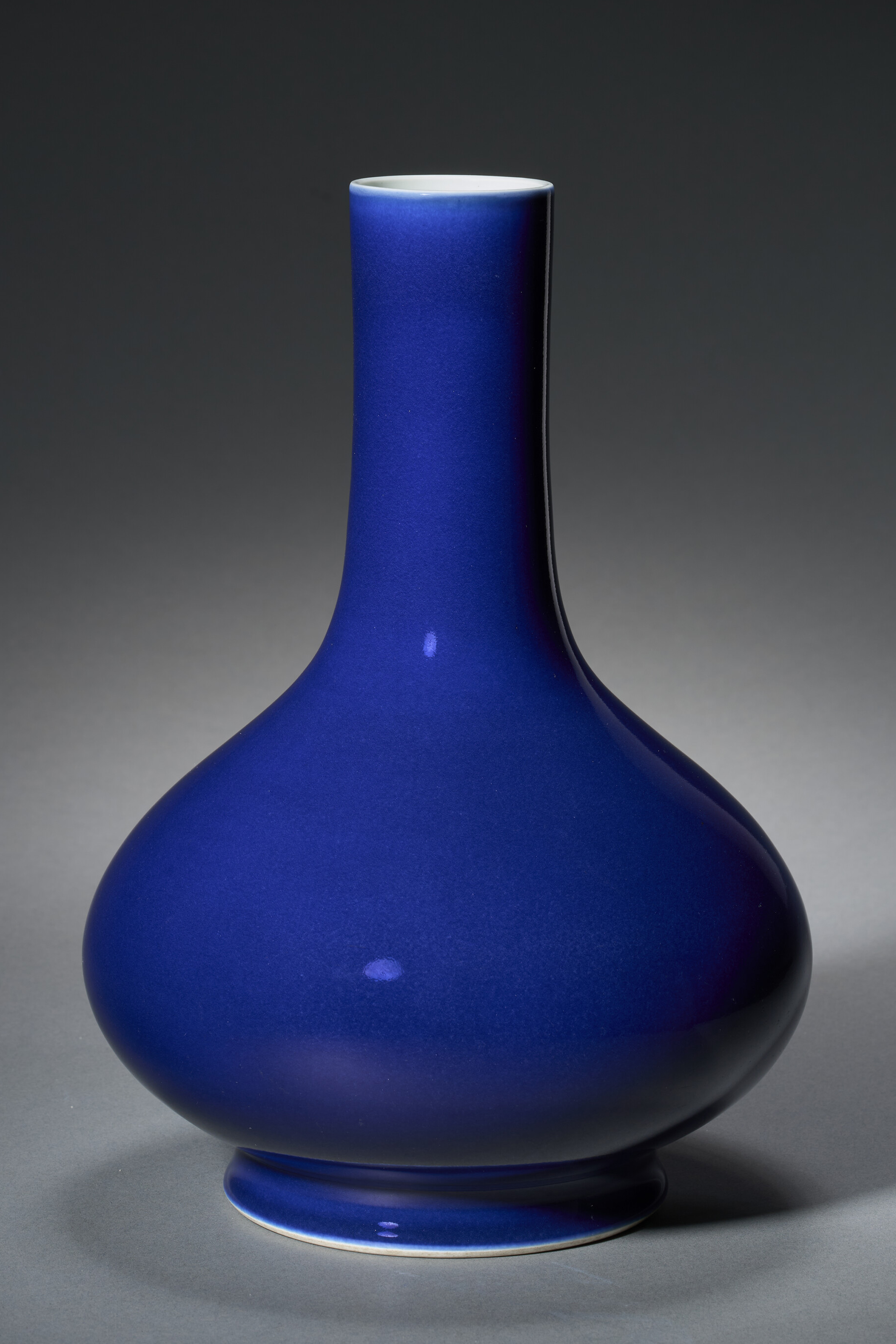
A Rare Sacrificial-blue-glazed Long-necked Vase
QIANLONG SEAL MARK IN UNDERGLAZE BLUE AND OF THE PERIOD (1736-1795)
This sacrificial blue vase from the Qianlong period (1736 1795) demonstrates the technical mastery of Chinese imperial porcelain production during the Qing dynasty's height. The long slender neck and elegant form exemplify the refined aesthetic preferences of the 18th century, while the rare sacrificial blue glaze indicates its likely use in court ritual ceremonies. The underglaze blue Qianlong seal mark confirms its imperial manufacture and authenticity as a period piece from one of China's most artistically accomplished reigns.
- Spotted At
- Auction House · Christie's
Notes
LOT ESSAY The deep cobalt-blue glaze on the present vase is known in Chinese as jilan (霽藍), often translated in English as “sacrificial blue.” Fired at a high temperature with cobalt oxide as the principal colorant, this monochrome became increasingly popular in the Ming and Qing dynasties. Its courtly name derives from the use of blue-glazed vessels in rituals at the Altar of Heaven. In 1369, the Hongwu emperor issued an edict stipulating that vessels for the imperial altars were henceforth to be made in porcelain, with each altar associated with a prescribed color: blue for Heaven, red for the Sun, yellow for Earth, and white for the Moon. Archival records suggest the Qianlong emperor’s favor for the sacrificial blue glaze; Archives of the Qing Palace Workshop records that on the twenty-eighth day of the eleventh month of thirteenth year of Qianlong (1748), the superintendent Tang Ying submitted “superior-color sample” vases and jars, among which “a pair of jiqing (霽青 sacrificial blue) tianqiu zun” was selected by imperial command for retention, while the remaining items were dispatched to other appropriate offices. Vases of this shape, with a subtly compressed body and a tall, slender neck, were produced in the Qianlong reign in a variety of monochrome glazes. Large scale, blue-glazed versions such as the present example, however, are exceedingly rare. A comparable blue-glazed example of smaller proportions (26 cm. high) was sold at Christie’s London, 12 May 2009, lot 164. By contrast, related Qianlong vases of comparable height are more often found in other monochrome glazes; two tea-dust-glazed vases in the National Palace Museum, Taipei (collection nos.中瓷000443N000000000 and 中瓷000446N000000000), for example, measure 35.2 and 35.5 cm., respectively. The underglaze-blue seal mark on the base is also noteworthy. Set within a rectangular reserve, the nian 年 character is finished with a single terminal vertical stroke, a feature often associated with early Qianlong manufacture. Comparable marks may be noted on a smaller sacrificial-blue-glazed bottle vase (23.5 cm. high) sold at Christie’s New York, 24 March 2011, lot 1740, and on a Ru-type glazed gu-shaped vase formerly in the J. M. Hu Collection, sold at Imperial Qing Monochromes from the J. M. Hu Collection; Christie’s Hong Kong, 29 November 2017, lot 2854. READ MORE
🔨 Auction Lot
Important Chinese Art
March 26, 2026
Estimate: $80,000 – $120,000
Sold: $152,400
Lot 662
Start the Discussion
Request access to join the discussion