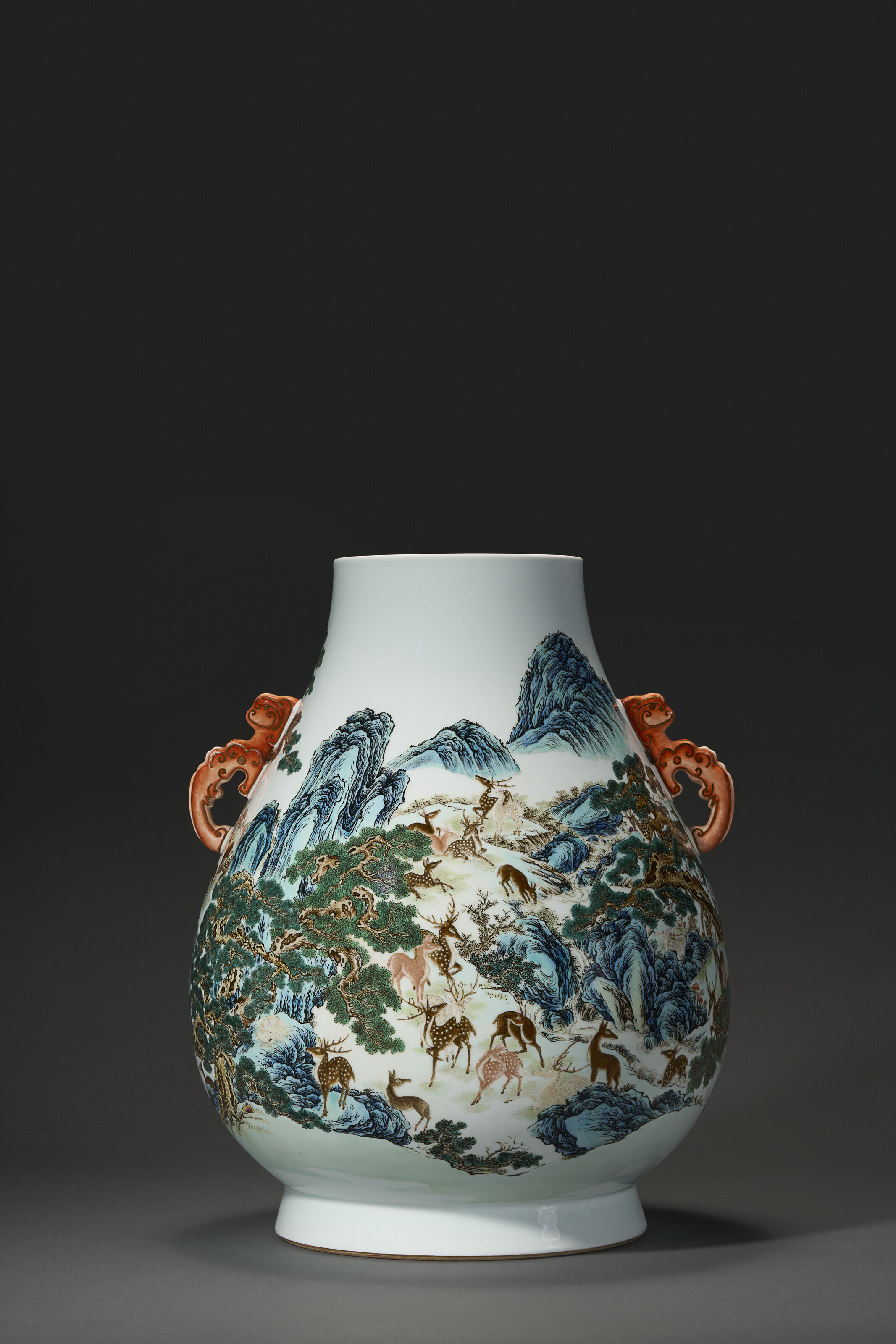
A Magnificent Famille Rose 'hundred Deer' Hu -form Vase
QIANLONG SEAL MARK IN UNDERGLAZE BLUE AND OF THE PERIOD (1736-1795)
This famille rose porcelain vase, dating to the Qianlong period (1736 to 1795), exemplifies the refined aesthetic and technical mastery of Chinese imperial ceramics. The hu form references an ancient bronze vessel shape, while the hundred deer decoration showcases the famille rose technique's brilliant enamels and the period's fascination with auspicious animal imagery. The underglaze blue Qianlong seal mark indicates the vase was produced during the emperor's reign, confirming its authenticity and imperial workshop origin.
- Spotted At
- Auction House · Christie's
Notes
LITERATURE Bruce Museum, Flora and Fauna: Themes and Symbols in the Decorative Arts of China, Greenwich, Connecticut (brochure). EXHIBITED Greenwich, Connecticut, Bruce Museum, Flora and Fauna: Themes and Symbols in the Decorative Arts of China, 23 June-9 September 2007. Conditions of sale Brought to you by Rufus Chen (陳嘉安) Head of Sale, AVP, Specialist Check the condition report or get in touch for additional information about this ASIANARTNY@CHRISTIES.COM +1 212 636 2180 VIEW CONDITION REPORT LOT ESSAY The 'hundred deer' motif was very popular as the landscape depicted contains important symbolic references. The subject of deer has a long history in Chinese art as it refers to the rebus where the Chinese word for 'deer' is a homophone for 'emolument' or 'civil service salary'; the 'hundred deer' therefore represent the ultimate success, a career in government service in Imperial China. The deer is also associated with Daoism and the Star God of Longevity, Shoulao, while the inclusion of peaches and lingzhi fungus in the decoration is further symbolic of longevity. As such, the subject matter on the present vase alludes to a multitude of auspicious connotations. The picturesque scenes of deer in a rocky, tree-strewn landscape were probably intended to represent deer in the imperial gardens and hunting parks. Indeed, one of the reasons for the popularity of deer in Chinese art is associated with a favorite imperial pastime - the creation of gardens and hunting parks, which were frequently stocked with deer. The Manchu Qing dynasty were proud of their heritage and encouraged equestrian and hunting skills. The Qianlong Emperor revived the tradition of the annual Autumn Hunt, and the Summer Palace at Chengde was largely a hunting park kept stocked with game, particularly deer. Deer and deer hunts were favorite themes in Qing dynasty court painting, as exemplified by a hanging scroll by one of the most revered Jesuits who served the Qing imperial court, Giuseppe Castiglione (1688-1768); sold at Christie's Hong Kong, 30 May 2005, lot 1207. Examples of hu-shaped vases with this exquisite design are in various museum and private collections. One in the Palace Museum, Beijing, is illustrated in The Complete Collection of Treasures of the Palace Museum – 39 – Porcelains with Cloisonné Enamel Decoration and Famille Rose Decoration, Hong Kong, 1999, pp. 98-9, no. 85; a pair is in the Shanghai Museum, illustrated in Selected Ceramics from the Collection of Mr. and Mrs. J.M. Hu, Shanghai, 1989, pl. 67; a single vase, also in the Shanghai Museum, is illustrated in Chugoku Toji Zenshu, vol. 21, Kyoto, 1981, pl. 103; and in the Hong Kong Museum of Art, included in the exhibition catalogue, The Wonders of the Potter's Palette, Hong Kong, 1984, p. 119, no. 71. Compare, also, two other similar vases, the first from the British Rail Pension Fund sold at Sotheby's Hong Kong, 16 May 1989, lot 89; and the other, from the collection of a medical doctor who worked in the German embassy in Beijing during the early 20th century, sold at Christie's Paris, 14 December 2011, lot 170. READ MORE
🔨 Auction Lot
Important Chinese Art
March 26, 2026
Estimate: $800,000 – $1,200,000
Sold: $1,143,000
Lot 632
Start the Discussion
Request access to join the discussion