Join The Collection to save, track, and explore works like this.

Art Institute of Chicago

Spotted

Cornelius Kierstede — Two-Handled Covered Cup
Cornelius Kierstede

Two-Handled Covered Cup

1698

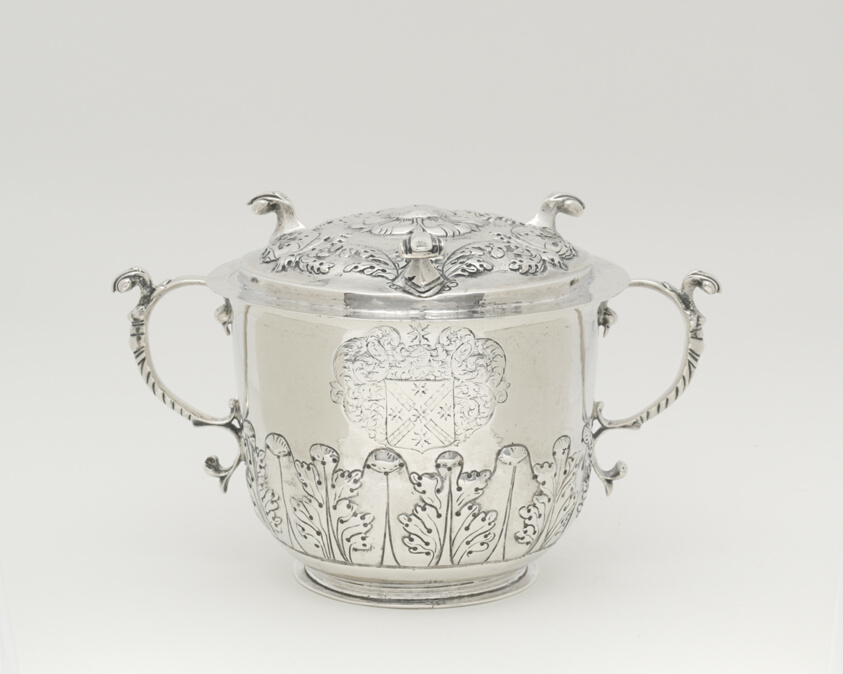
This luxurious vessel, by one of New York’s foremost early silversmiths, was used to serve syllabub, a sweetened or flavored wine, cider, beer, or ale into which milk was whipped. The cover helped preserve the frothy drink and also, using its three equidistant handles as legs, could be inverted into a stand for the cup. The vessel bears the mark CK, standing for Cornelius Kierstede, a third-generation New York silversmith of Dutch descent. Kierstede opened a shop around 1698 in New York, where he worked, off and on, until moving to New Haven, Connecticut, in the early 1720s. Like the Van Cortlandt family, who commissioned this cup and whose coat of arms it bears, and the Stuyvesant family, whose descendants owned the object until the Art Institute acquired it, the majority of Kierstede’s patrons were wealthy Dutch colonists. This cup is one of four nearly identical pieces made during the same period by Kierstede and two other well-known New York silversmiths. Evolved from English prototypes, all four have the same nearly straight sides, scroll-like handles, and slightly domed cover as well as variations of the embossed acanthus-leaf ornament.

Medium
Silver
Dimensions

Start the Discussion

Request access to join the discussion

More by Cornelius Kierstede

Spotted works by Cornelius Kierstede

About this work

Cornelius Kierstede, Two-Handled Covered Cup, 1698

This luxurious vessel, by one of New York’s foremost early silversmiths, was used to serve syllabub, a sweetened or flavored wine, cider, beer, or ale into which milk was whipped. The cover helped preserve the frothy drink and also, using its three equidistant handles as legs, could be inverted into a stand for the cup. The vessel bears the mark CK, standing for Cornelius Kierstede, a third-generation New York silversmith of Dutch descent. Kierstede opened a shop around 1698 in New York, where he worked, off and on, until moving to New Haven, Connecticut, in the early 1720s. Like the Van Cortlandt family, who commissioned this cup and whose coat of arms it bears, and the Stuyvesant family, whose descendants owned the object until the Art Institute acquired it, the majority of Kierstede’s patrons were wealthy Dutch colonists. This cup is one of four nearly identical pieces made during the same period by Kierstede and two other well-known New York silversmiths. Evolved from English prototypes, all four have the same nearly straight sides, scroll-like handles, and slightly domed cover as well as variations of the embossed acanthus-leaf ornament.

Medium
Silver
Dimensions
20.3 x 12.7 cm
Year
1698
Seen at
Art Institute of Chicago, Chicago, IL

Related themes

Small Scale, Unique Work

More works by Cornelius Kierstede

Collected by

Art Institute of Chicago