Join The Collection to save, track, and explore works like this.

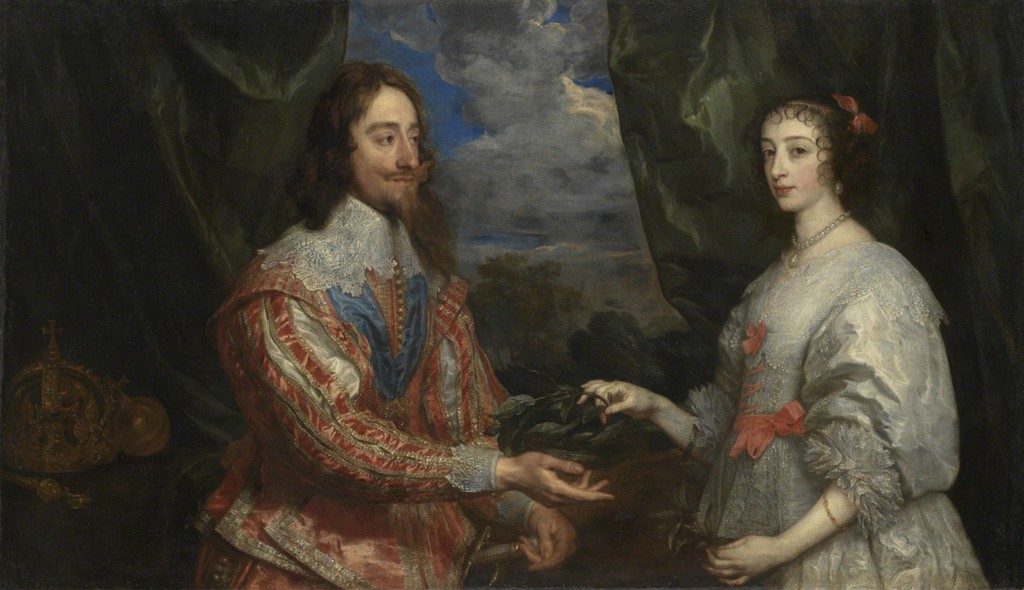
Anthony van Dyck — Charles I and Henrietta Maria Holding a Laurel Wreath
Anthony van Dyck

Charles I and Henrietta Maria Holding a Laurel Wreath

1632

Among the most intimate dynastic portraits to survive from the Caroline court, this 1632 oil on canvas captures Charles I and Henrietta Maria joined in a gesture of shared sovereignty, their hands together upon a laurel wreath that speaks to victory, honor, and the mutual legitimacy of their union. Van Dyck, newly appointed Principal Painter in Ordinary to the King, was already transforming how the Stuart monarchy wished to be seen, and this composition distills that ambition into something surprisingly tender. The laurel, a classical emblem freighted with Roman imperial associations, becomes here not a trophy but a bond, held between two figures whose relationship Van Dyck renders with psychological nuance rare in formal portraiture of the period. The picture's provenance traces to the Archiepiscopal Castle and Gardens at Kroměříž in the Czech Republic, one of Central Europe's most distinguished historic collections, a repository shaped over centuries by figures of considerable ecclesiastical and cultural authority. Works that passed through Kroměříž carry with them a custodial history that itself confers meaning, situating this canvas within a lineage of serious connoisseurship. That the painting has traveled to the Frick Collection for its current presentation places it in a conversation with some of the finest Flemish and Baroque holdings in North America, a context that rewards close looking. For collectors, the appeal is layered. Van Dyck at this precise moment, newly embedded in the English court and working at the height of his powers, produced portraits that defined aristocratic self-presentation for generations. A double portrait of the King and Queen, signed and rendered with the artist's characteristic command of fabric, light, and physiognomy, represents not only a document of a pivotal reign but a demonstration of what painted diplomacy could achieve at its most refined.

Medium
Oil on canvas
Signed
Yes
Location
The Frick Collection, New York, NY

Start the Discussion

Request access to join the discussion

Spotted works by Anthony van Dyck

About this work

Anthony van Dyck, Charles I and Henrietta Maria Holding a Laurel Wreath, 1632

Among the most intimate dynastic portraits to survive from the Caroline court, this 1632 oil on canvas captures Charles I and Henrietta Maria joined in a gesture of shared sovereignty, their hands together upon a laurel wreath that speaks to victory, honor, and the mutual legitimacy of their union. Van Dyck, newly appointed Principal Painter in Ordinary to the King, was already transforming how the Stuart monarchy wished to be seen, and this composition distills that ambition into something surprisingly tender. The laurel, a classical emblem freighted with Roman imperial associations, becomes here not a trophy but a bond, held between two figures whose relationship Van Dyck renders with psychological nuance rare in formal portraiture of the period. The picture's provenance traces to the Archiepiscopal Castle and Gardens at Kroměříž in the Czech Republic, one of Central Europe's most distinguished historic collections, a repository shaped over centuries by figures of considerable ecclesiastical and cultural authority. Works that passed through Kroměříž carry with them a custodial history that itself confers meaning, situating this canvas within a lineage of serious connoisseurship. That the painting has traveled to the Frick Collection for its current presentation places it in a conversation with some of the finest Flemish and Baroque holdings in North America, a context that rewards close looking. For collectors, the appeal is layered. Van Dyck at this precise moment, newly embedded in the English court and working at the height of his powers, produced portraits that defined aristocratic self-presentation for generations. A double portrait of the King and Queen, signed and rendered with the artist's characteristic command of fabric, light, and physiognomy, represents not only a document of a pivotal reign but a demonstration of what painted diplomacy could achieve at its most refined.

Medium
Oil on canvas
Year
1632
Signed
Hand-signed by the artist
Seen at
The Frick Collection, Manhattan, United States

More works by Anthony van Dyck

Collected by

Cleveland Museum of Art