Join The Collection to save, track, and explore works like this.

Robert Delaunay — Formes circulaires
Robert Delaunay

Formes circulaires

1930

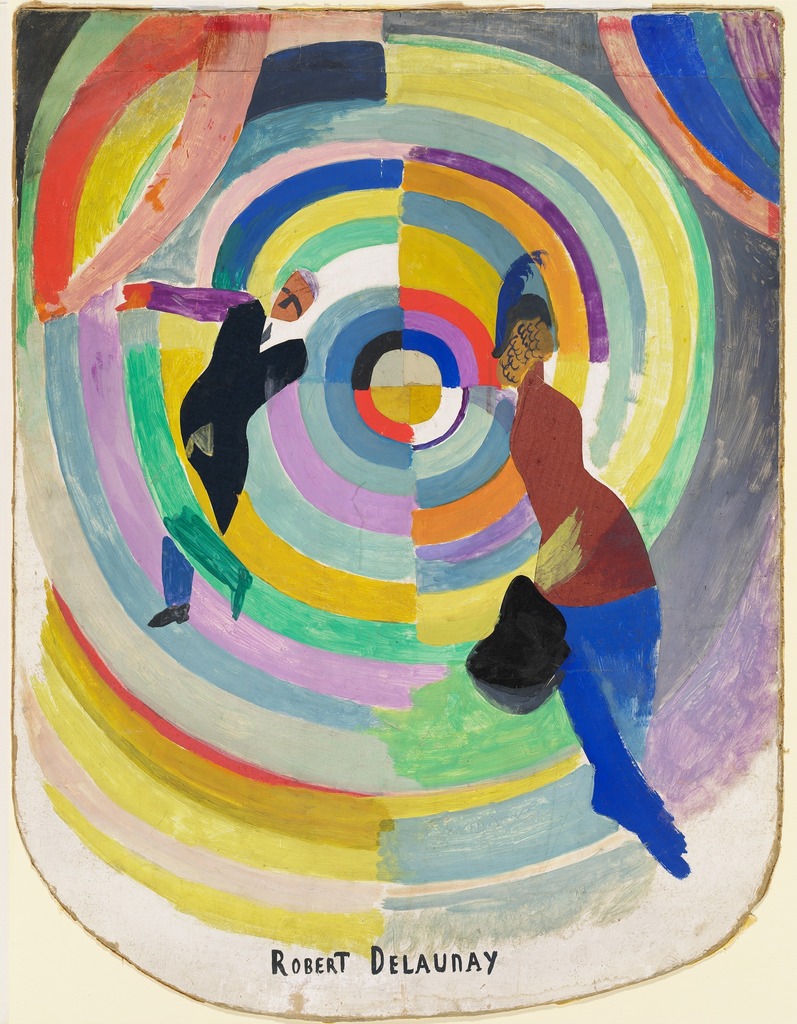
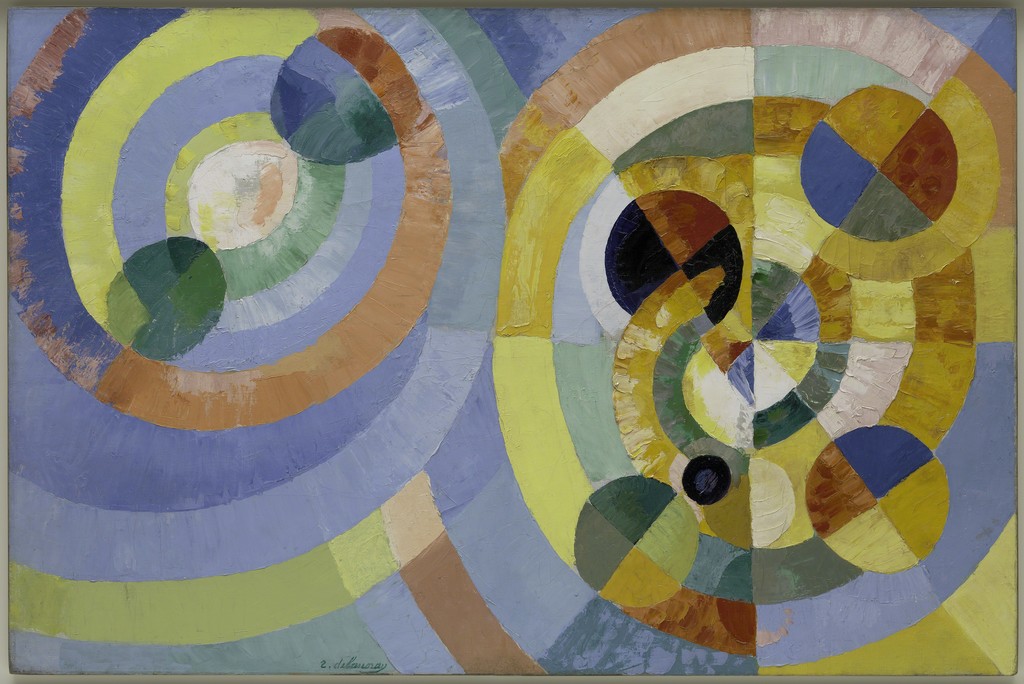
Formes circulaires presents Robert Delaunay at the height of his Orphist vision, deploying interlocking arcs and luminous color fields across a generously scaled canvas that commands immediate spatial presence. Painted in 1930, the work belongs to a pivotal body of research through which Delaunay investigated color as a structural force rather than a decorative supplement. Concentric and overlapping circular forms radiate outward in carefully calibrated sequences of warm and cool tones, generating a sense of optical movement that transforms the static surface into something vibrantly kinetic. The composition reflects Delaunay's sustained engagement with the theories of Michel Eugène Chevreul on simultaneous contrast, translated here into a painterly language of exceptional confidence and maturity. At 128.9 by 194.9 centimeters, the canvas carries genuine physical authority, and its scale ensures that the rhythmic interplay of chromatic zones is experienced bodily as much as visually. This is not a work that retreats into intimacy. The arc formations pulse against one another with the discipline of a practitioner who had spent decades refining the grammar of pure abstraction, and the result is a surface that rewards extended looking, revealing subtle gradations and tonal shifts that photographs cannot fully convey. The painting is signed, affirming its direct connection to the artist, and is currently held at the Guggenheim Museum Bilbao, a provenance context that underscores its institutional significance. For collectors seeking a historically grounded work that sits at the intersection of European modernism and the development of pure abstraction, Formes circulaires represents an unusually rare opportunity. Delaunay's circular compositions from this period are among the most recognizable and theoretically consequential works in twentieth century painting, and examples of this scale and quality rarely enter the market. The work would anchor any serious collection of modern European art with lasting intellectual and aesthetic weight.

Medium
Oil on canvas
Overall
Signed
Yes

Start the Discussion

Request access to join the discussion

About this work

Robert Delaunay, Formes circulaires, 1930

Formes circulaires presents Robert Delaunay at the height of his Orphist vision, deploying interlocking arcs and luminous color fields across a generously scaled canvas that commands immediate spatial presence. Painted in 1930, the work belongs to a pivotal body of research through which Delaunay investigated color as a structural force rather than a decorative supplement. Concentric and overlapping circular forms radiate outward in carefully calibrated sequences of warm and cool tones, generating a sense of optical movement that transforms the static surface into something vibrantly kinetic. The composition reflects Delaunay's sustained engagement with the theories of Michel Eugène Chevreul on simultaneous contrast, translated here into a painterly language of exceptional confidence and maturity. At 128.9 by 194.9 centimeters, the canvas carries genuine physical authority, and its scale ensures that the rhythmic interplay of chromatic zones is experienced bodily as much as visually. This is not a work that retreats into intimacy. The arc formations pulse against one another with the discipline of a practitioner who had spent decades refining the grammar of pure abstraction, and the result is a surface that rewards extended looking, revealing subtle gradations and tonal shifts that photographs cannot fully convey. The painting is signed, affirming its direct connection to the artist, and is currently held at the Guggenheim Museum Bilbao, a provenance context that underscores its institutional significance. For collectors seeking a historically grounded work that sits at the intersection of European modernism and the development of pure abstraction, Formes circulaires represents an unusually rare opportunity. Delaunay's circular compositions from this period are among the most recognizable and theoretically consequential works in twentieth century painting, and examples of this scale and quality rarely enter the market. The work would anchor any serious collection of modern European art with lasting intellectual and aesthetic weight.

Medium
Oil on canvas
Dimensions
overall: 128.9 x 194.9 cm
Year
1930
Signed
Hand-signed by the artist
Seen at
Guggenheim Museum Bilbao

More works by Robert Delaunay

Collected by

Musée d'Art Moderne de Paris, Cleveland Museum of Art