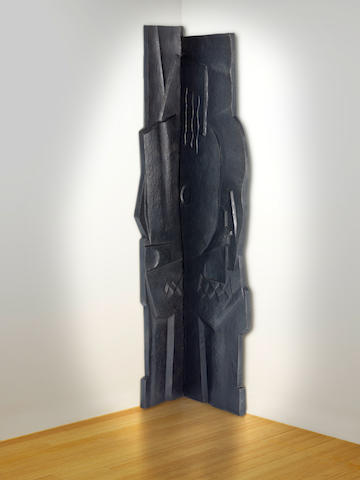
Diptyque Guitare II
1926
Conceived in iron in 1926, Diptyque Guitare II stands as a commanding expression of Henri Laurens's deep engagement with Cubist principles translated into three-dimensional form. At 183 centimeters, the work commands physical presence, its industrial material lending a structural authority that transforms the familiar contours of the guitar into a series of interlocking planes, angles, and voids. Laurens treats iron not as a cold or indifferent medium but as something animated, coaxing from it the rhythmic fragmentation that defined the most ambitious sculptural thinking of the interwar period. Laurens occupies a singular position in the history of modern sculpture, having worked in close dialogue with Picasso and Braque during the formative years of Cubism before forging his own distinctive sculptural language. By 1926, his handling of the guitar as a subject had evolved far beyond homage or experiment, and Diptyque Guitare II reflects a mature confidence in the duality suggested by its title. The pairing implied within the work, two complementary formal propositions held in sculptural tension, speaks to his belief that sculpture could embody contradiction and resolution simultaneously, much as Cubism had done on canvas. For collectors, the work represents a rare opportunity to acquire a signed, large-scale iron sculpture from one of the defining figures of twentieth-century European modernism, currently presented through Bailly Gallery. Its scale, material integrity, and historical significance within the Cubist tradition place it among the most substantial examples of Laurens's output to appear on the market, making it an acquisition of genuine art-historical consequence.
- Medium
- Iron
- Signed
- Yes
- Location
- BAILLY GALLERY, Paris
- Spotted At
- Gallery · BAILLY GALLERYView on map
More by Henri Laurens
Collectors with works by Henri Laurens

Start the Discussion
Request access to join the discussion