Zhou Chunya
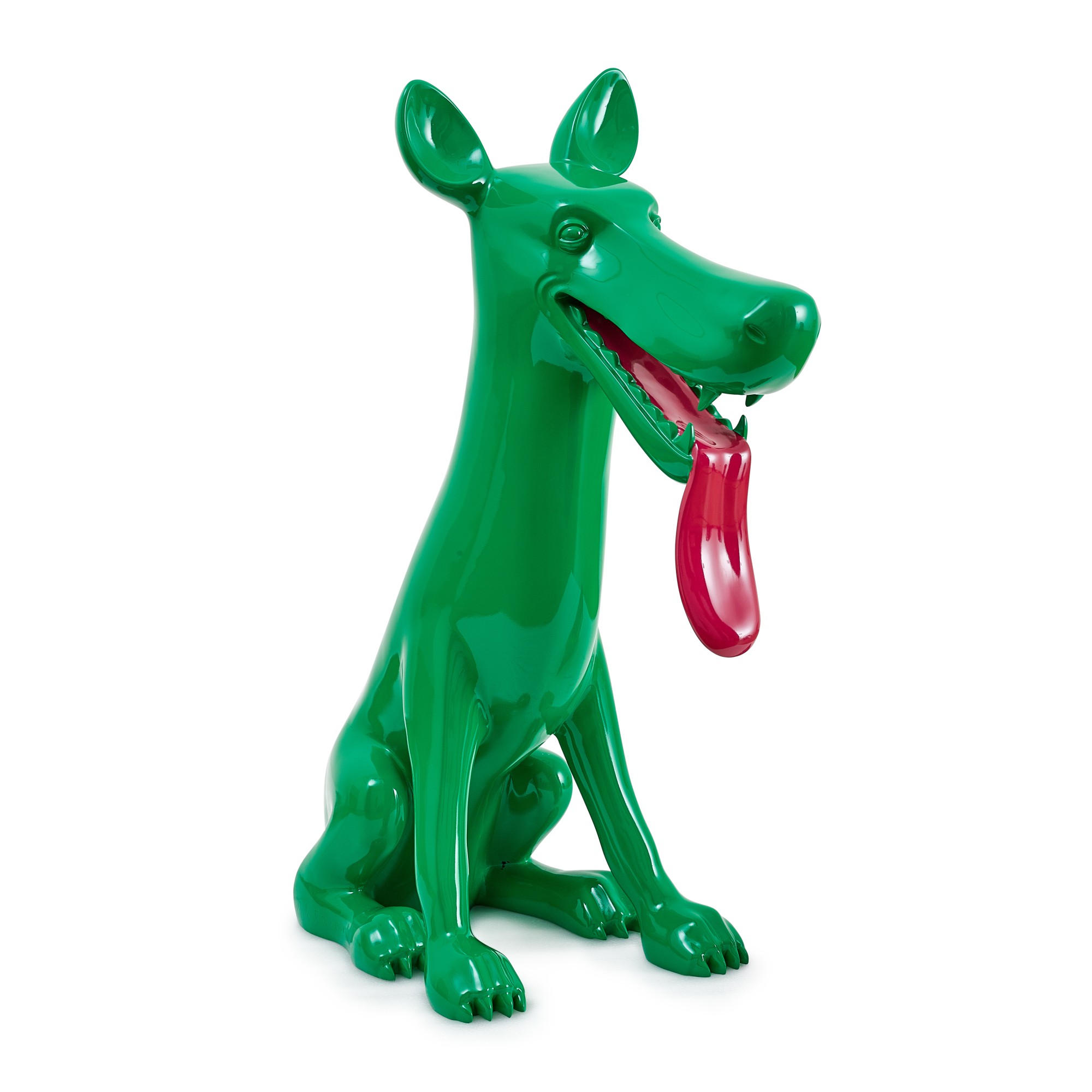
Zhou Chunya: Color, Life, Pure Joy
Artist Spotlight · The Collection Editorial
In the spring of 2019, Sotheby's Hong Kong brought the art world's attention back to a painter whose work had been commanding serious attention for more than two decades. A monumental oil from Zhou Chunya's Green Dog series achieved a result that confirmed what discerning collectors had understood for years: this artist, working from his studio in Chengdu, had built one of the most distinctive and emotionally charged bodies of work in contemporary Chinese painting. The sale was not a surprise to those who had followed Zhou closely. It was, rather, a very public acknowledgment of a reputation long established in the galleries, museums, and private collections of Asia, Europe, and beyond.
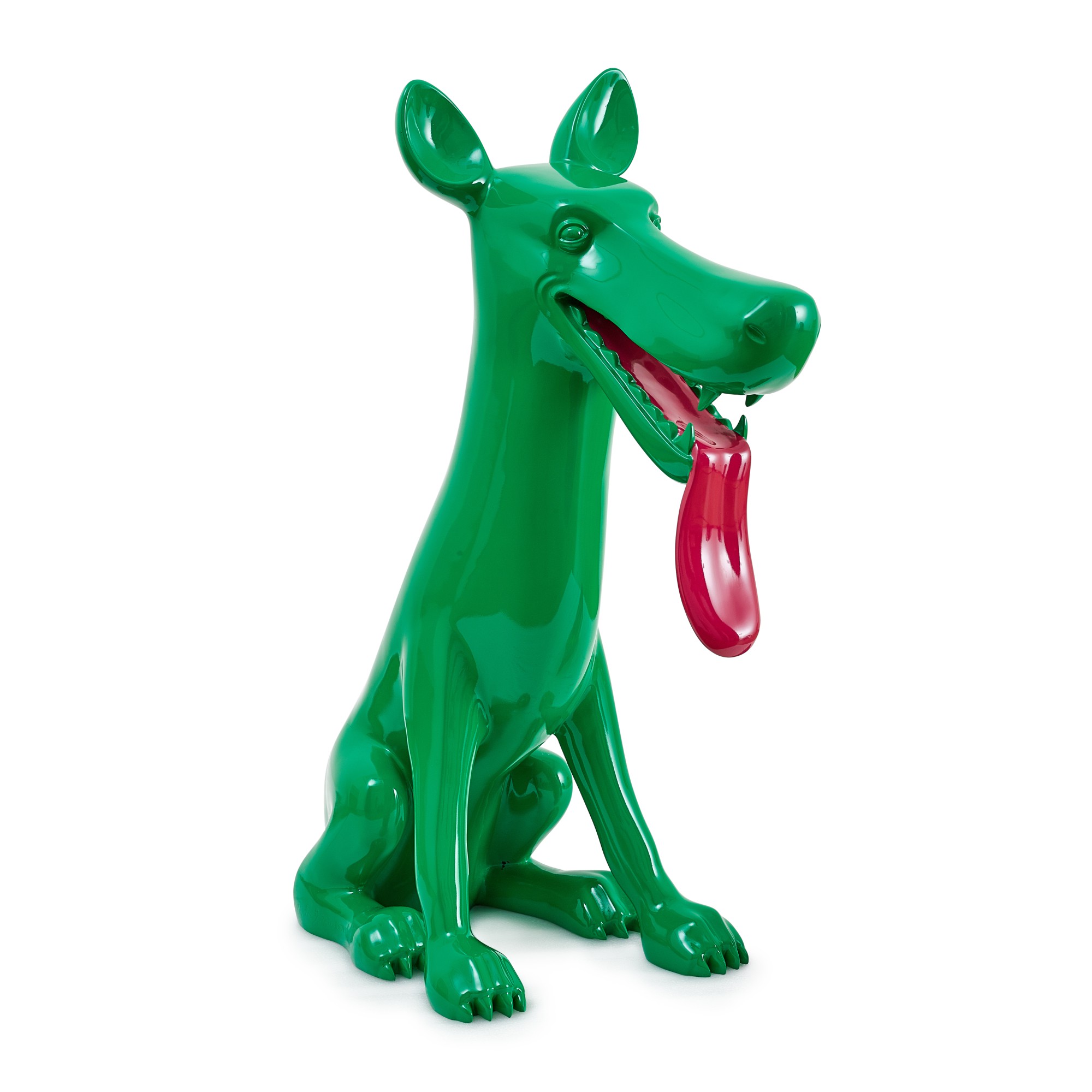
Zhou Chunya
Green Dog 綠狗, 2008
Zhou Chunya was born in 1955 in Chongqing, in the Sichuan province of southwestern China, a region whose lush, humid landscape and rich cultural identity would leave a permanent mark on his sensibility. He came of age during the Cultural Revolution, a period that both suppressed artistic expression and, paradoxically, sharpened the hunger of a generation for something genuine and visceral. He studied at the Sichuan Academy of Fine Arts in Chengdu, an institution that would become a crucible for what is now known as the Sichuan School, a movement defined by its psychological realism and willingness to confront human experience with unflinching directness. It was a formative environment, one that gave Zhou both technical rigour and a deep belief in the power of figuration.
The defining turn in Zhou's formation came when he traveled to Kassel, Germany, in the mid 1980s to study at the Hochschule für Bildende Künste, the Academy of Fine Arts. Kassel in that era was alive with the energy of German Neo Expressionism, a movement that championed raw emotional force, expressive brushwork, and a rejection of cool conceptual distance. Artists such as Georg Baselitz, Anselm Kiefer, and A.R.
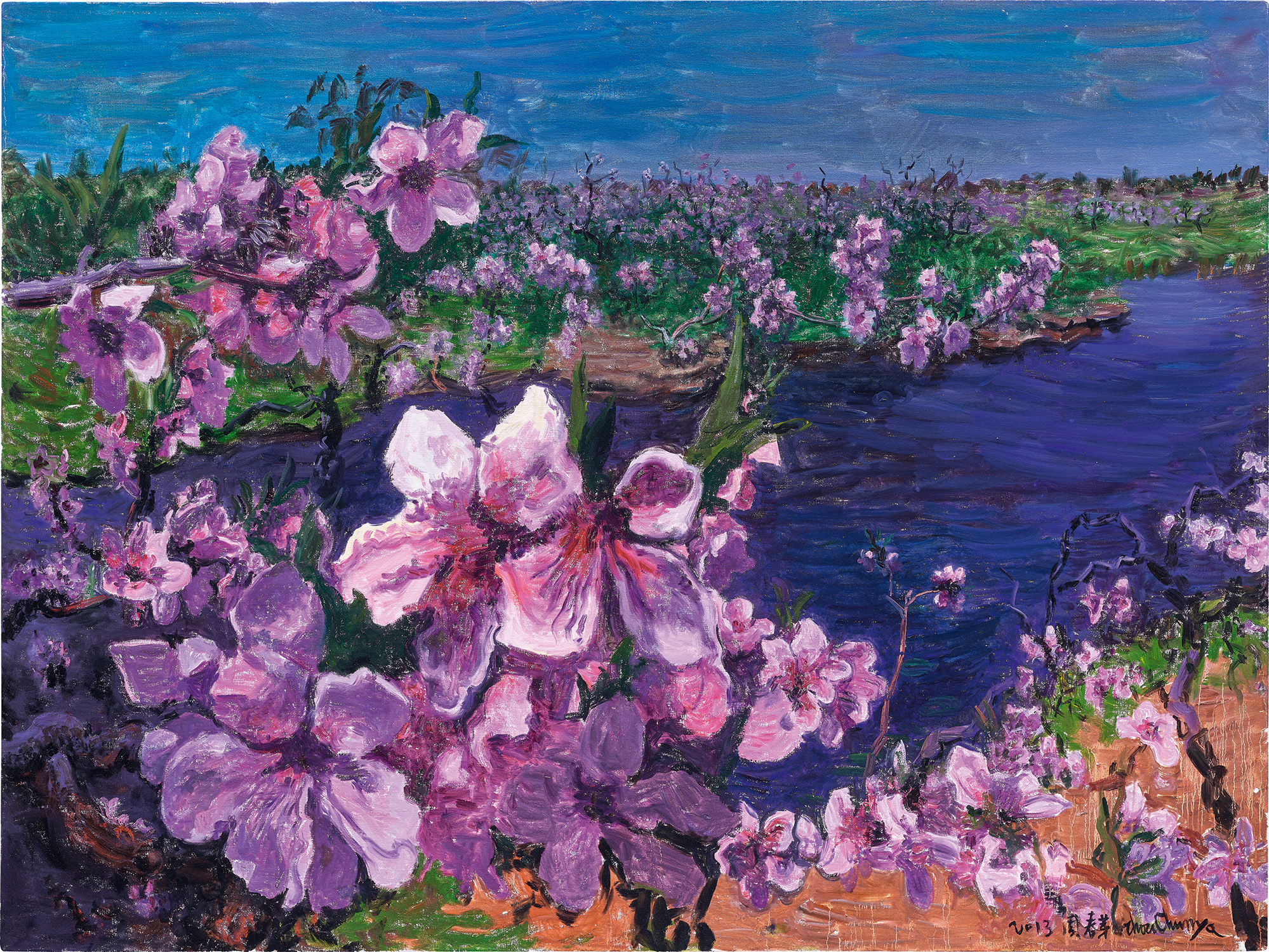
Zhou Chunya
Peach Blossom, 2013
Penck were remaking the possibilities of painting, and Zhou absorbed their lessons deeply. He returned to China not as an imitator of Western modes but as a synthesizer, carrying Neo Expressionist intensity back into contact with the ink traditions, philosophical undercurrents, and material culture of his homeland. The result was a voice entirely his own. By the late 1980s and through the 1990s, Zhou was producing work of remarkable ambition and range.
His early canvases from this period, including works such as The Flower in a Vase from 1993, show an artist already in confident command of color and surface, alive to the tension between decorative beauty and psychological unease. But it was the Green Dog series, begun in earnest in the early 2000s, that would crystallize his international reputation. Inspired by his beloved German Shepherd, Titi, Zhou rendered the dog in luminous, impossible greens, a color choice that transforms a domestic subject into something mythic and strange. The dog becomes a vessel for loyalty, vitality, and an almost feral freedom.
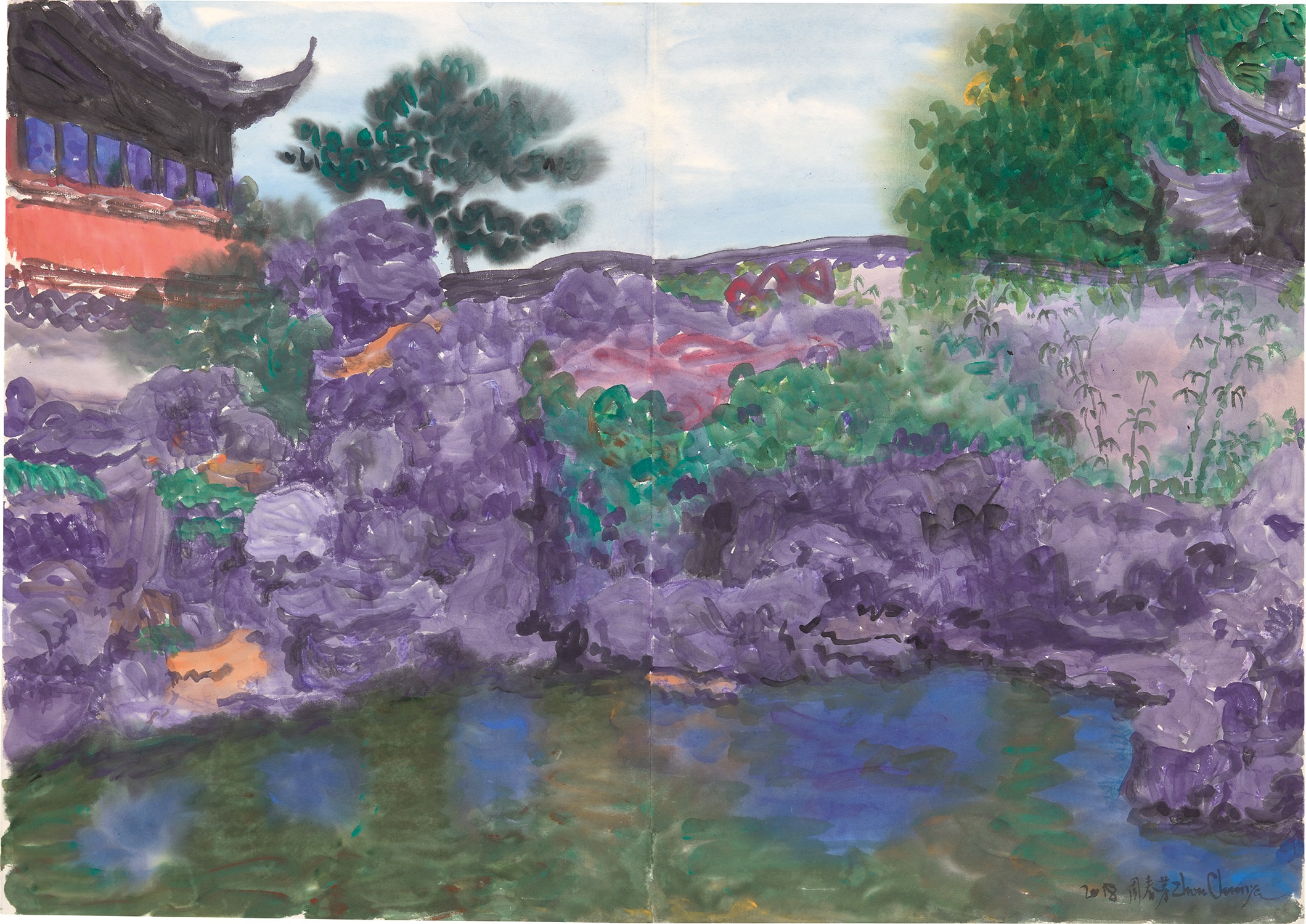
Zhou Chunya
Taihu, 2018
Seen across oils, bronzes, and painted stainless steel, the Green Dog is one of the most immediately recognizable symbols in contemporary Asian art, carrying the same kind of iconic weight that a Hirst spot or a Koons balloon animal carries in the Western market, but rooted in something far more personal and emotionally direct. The Peach Blossom series, developed through the 2000s and into the 2010s, represents the other great pillar of Zhou's mature practice. Here, nude male figures move through or recline beneath explosions of flowering branches, rendered in strokes of furious, joyful color. The paintings draw on the classical Chinese tradition of literati painting, in which the peach blossom carries associations of spring, renewal, and transcendence, but Zhou charges these associations with a bodily, almost Dionysian energy.
The series generated significant critical attention for its openness about male sensuality, a boldness in the context of Chinese contemporary art that spoke to Zhou's consistent refusal to limit his subject matter to what is comfortable or expected. Works from this series, particularly those produced between 2005 and 2015, are considered among the most important paintings of his career. For collectors, Zhou Chunya presents one of the most compelling propositions in the secondary market for contemporary Chinese art. His work spans a genuine range of media, from large scale oil paintings and intimate watercolors such as the 2018 Taihu, which demonstrates his ease with a completely different material register, to sculpture in bronze and painted stainless steel that extends the Green Dog into three dimensions.
Zhou Chunya
Zhou Chunya 周春芽 | Green Dog No. 6 綠狗 六號, 2004
This versatility means that entry points exist at various price levels, though works from the core Green Dog and Peach Blossom series in oil on canvas command the most sustained institutional and collector attention. Auction houses including Christie's, Sotheby's, and Poly Auction in Beijing have all handled significant examples of his work, and prices for major canvases have consistently reflected the strength of demand across Asian and international buyer pools. Collectors drawn to artists such as Zhang Xiaogang, Fang Lijun, or Yue Minjun will find in Zhou a painter whose relationship to Chinese history and identity is equally deep but whose palette and emotional register is distinctly more joyful and life affirming. What ultimately distinguishes Zhou Chunya within the broader story of contemporary art is the quality of genuine warmth that animates his practice.
In an era when much celebrated painting operates through irony, distance, or institutional critique, Zhou paints from a position of love: love of animals, of the human body, of color itself as a carrier of feeling. He has spoken about painting as a form of play, a serious play, but play nonetheless, and this comes through in every canvas. His work sits in important museum collections across China and has been exhibited at major venues including the Shanghai Museum and in retrospectives organized by leading Chinese institutions. As the global art world continues to reexamine and revalue the achievements of Chinese contemporary painters who came of age in the reform era, Zhou's position as one of the defining figures of that generation looks increasingly secure.
His paintings do not ask to be decoded. They ask to be felt, and that is a rare and lasting quality.