Zaha Hadid
Zaha Hadid: Architecture Remade as Pure Art
Artist Spotlight · The Collection Editorial
“There are 360 degrees, so why stick to one?”
Zaha Hadid
In the spring of 2022, the Zaha Hadid Foundation opened its doors in London, transforming the former Victorian warehouse that served as her studio into a living archive and cultural institution dedicated to preserving and extending her extraordinary vision. The gesture felt entirely appropriate for an artist and architect whose work consistently refused the boundary between building and sculpture, between functional object and painterly dream. More than six years after her passing in March 2016, the world continues to reckon with the scale of what she gave us, and the art market has responded in kind, with her paintings, drawings, and sculptural multiples finding passionate collectors across every continent. Zaha Hadid was born in Baghdad in 1950 into a cultured and progressive family.
Zaha Hadid
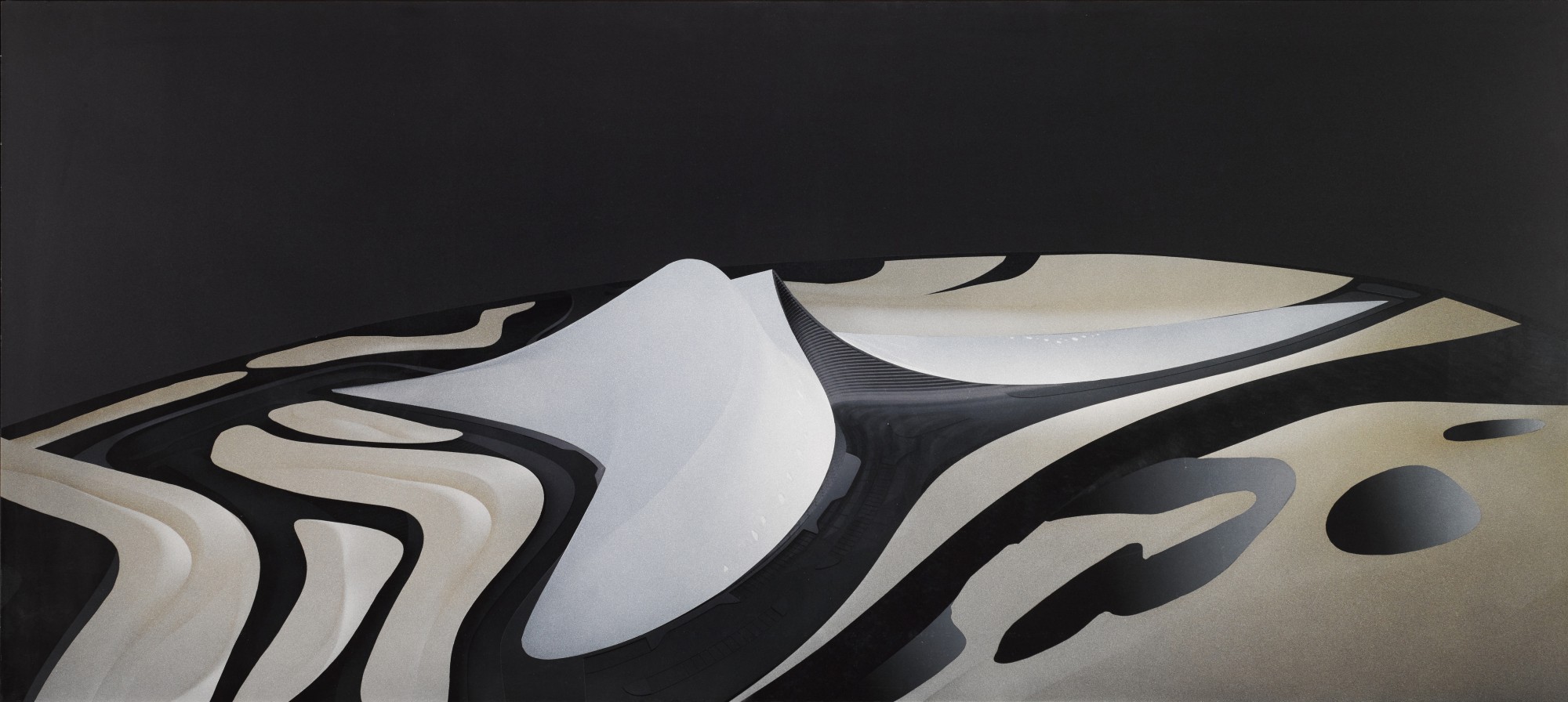
Opera House Dubai, 2006
Her father, Mohammed Hadid, was a prominent politician and co founder of the Iraqi National Democratic Party, and her mother, Wajiha al Sabunji, was an artist. This dual inheritance, civic seriousness and visual sensitivity, shaped her from the earliest years. She studied mathematics at the American University of Beirut before moving to London in 1972 to enroll at the Architectural Association, where she encountered the radical intellectual ferment of the late twentieth century avant garde. It was there that she came under the influence of Rem Koolhaas and Elia Zenghelis at the Office for Metropolitan Architecture, an encounter that catalyzed her most explosive early ideas.
Hadid graduated from the Architectural Association in 1977 and soon began developing a visual language so original it was difficult to categorize. Her early paintings and drawings were not merely representations of proposed buildings. They were complete works in their own right, influenced by Russian Suprematism and the fractured spatial geometries of Kasimir Malevich, whose ideas she absorbed and then pushed far beyond their origins. She became a professor at Harvard, Yale, and Columbia, and her theoretical influence on a generation of architects and designers was immense long before her built projects began to materialize.
Zaha Hadid
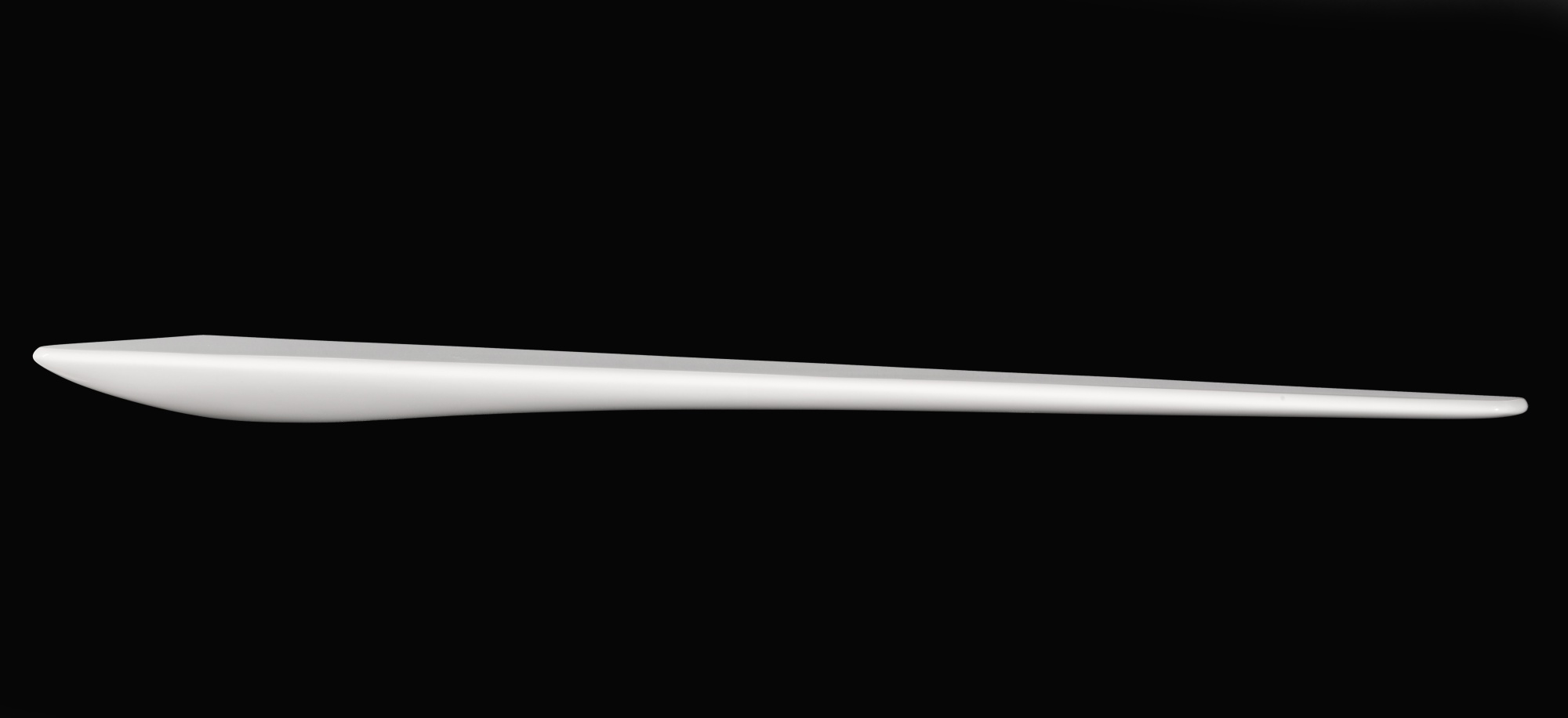
Serif 1 shelf, from the Seamless series
For many years the architectural establishment dismissed her visions as unbuildable, which only added urgency and determination to her practice. The breakthroughs began arriving in earnest in the 1990s and accelerated through the 2000s. The Vitra Fire Station in Weil am Rhein, completed in 1993, announced her as a force of genuine consequence in built form. The MAXXI Museum of 21st Century Arts in Rome, the Rosenthal Center for Contemporary Art in Cincinnati, and the Guangzhou Opera House in China confirmed a global reach and a philosophical consistency that was astonishing in its ambition.
“I don't think that architecture is only about shelter, is only about a very simple enclosure. It should be able to excite you, to calm you, to make you think.”
Zaha Hadid, Interview with Charlie Rose
Her buildings were not static containers but dynamic landscapes, as though the earth itself had folded upward into habitable space. The same sensibility runs through her paintings and sculptural objects, where surfaces flow and curl with an organic inevitability that feels less designed than discovered. Among the works available on The Collection, the two paintings of Dubai Opera House and the London Aquatics Centre, both created in 2006 using acrylic ink and varnish on gelatine and chrome polyester mounted on Dibond, are exceptional examples of her drafting intelligence translated into pure visual experience. These are not architectural renderings in any conventional sense.
Zaha Hadid
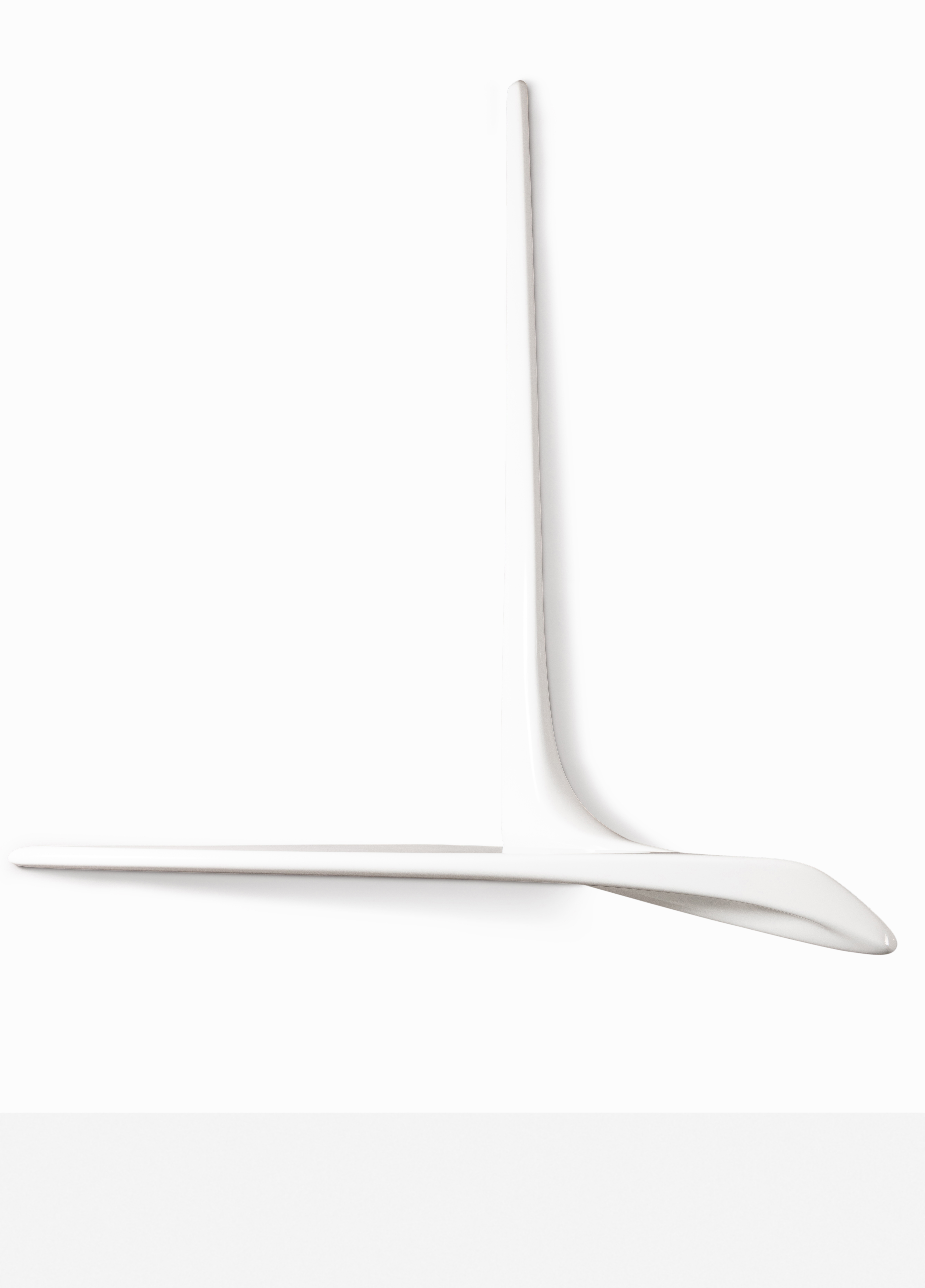
Étagère Serif 2, série Seamless
They are meditations on light, velocity, and form, executed on surfaces chosen for their reflective intensity. The chrome polyester ground gives these works an almost cinematic luminosity, as though the buildings depicted exist in some parallel dimension where physics has become poetry. They belong to a tradition of architectural visionary painting that includes the utopian canvases of Hugh Ferriss and the deconstructivist drawings of Daniel Libeskind, yet they are entirely their own thing. Her sculptural objects represent another dimension of her genius.
The pieces from the Seamless series, including the Serif 1 shelf, the Etagere Serif 2, and the Gyre chaise longue, are realized in polyurethane lacquered polyester resin, a material chosen for its ability to hold extraordinarily complex curves without visible seam or joint. The name of the series is a manifesto in itself: the dream of a world without interruption, without the crude joints and compromises that conventional fabrication imposes on design. Collectors who live with these objects report that they seem to change throughout the day as light moves across their surfaces, revealing depths and shadows that were invisible the moment before. From a collecting perspective, Hadid's works on paper and painted panels occupy a particularly compelling position in the market.
Zaha Hadid
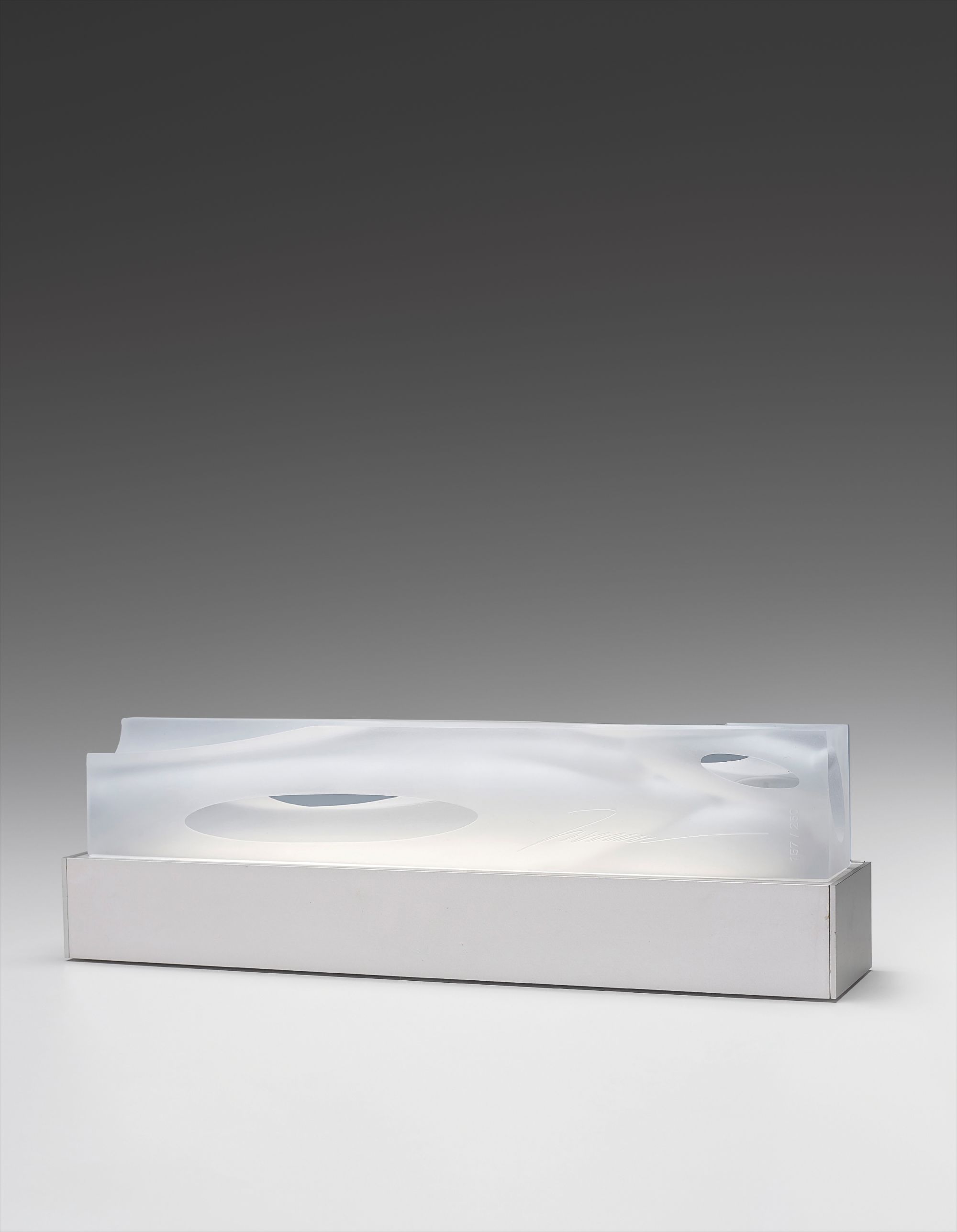
Solid (Edition No. 31)
Her architectural paintings were exhibited at major galleries including Galerie Gmurzynska and featured in museum contexts ranging from the Guggenheim retrospective to presentations at the Design Museum in London. Her multiples, including the vacuum cast polyurethane resin editions contained in their original presentation boxes, offer an accessible point of entry for collectors who wish to hold a physical piece of her thinking. These editions were made with the same seriousness of material and concept that characterizes her largest commissions, and they have appreciated steadily as institutional recognition of her stature has grown. For collectors considering her market, provenance and condition of the painted Dibond works are paramount, as the chrome polyester surfaces reward conservation care.
Hadid's closest artistic relatives in the broader landscape of late twentieth century practice include her mentor Rem Koolhaas, whose own drawings share a visionary intensity, as well as the painter and architect Wolf Prix of Coop Himmelblau, and the sculptor Richard Serra, whose large scale steel works bend and curve space in ways that echo Hadid's formal concerns. In the world of design objects, her dialogue with designers such as Marc Newson and the late Floris Meydam reflects a shared fascination with fluid form and the possibilities of new fabrication technologies. She also belongs to a lineage of women who transformed the disciplines they entered: her achievements are inseparable from the persistence and courage required to work at the highest level of a field that offered her neither easy access nor easy acceptance. What Zaha Hadid leaves behind is not simply a body of buildings, objects, and images but a new understanding of what the designed world can feel like.
She demonstrated that geometry could be simultaneously rigorous and sensuous, that a structure could be as emotionally immediate as a painting, and that the line between art and architecture was always a convention rather than a truth. Institutions from the Centre Pompidou to the Museum of Modern Art in New York hold her drawings in their permanent collections, and the Foundation in London ensures that her archive will continue to generate scholarship and inspiration for decades to come. To collect her work is to participate in one of the great conversations of our era, about beauty, about space, about what human hands and human imagination can make when they refuse to accept limitation.
Explore books about Zaha Hadid
Zaha Hadid: The Complete Buildings and Projects
Aaron Betsky
Zaha Hadid: Complete Works 1983-Today
Aaron Betsky
Zaha Hadid: Space for Art
Aaron Betsky
Zaha Hadid Architects: Project Manual
Zaha Hadid Architects
Zaha Hadid: The Architectural Association Years
Aaron Betsky
Zaha Hadid: Choreography
Aaron Betsky, Angeli Sachs
Zaha Hadid: Buildings and Projects
Deyan Sudjic