Yves Klein
Yves Klein: The Man Who Painted Infinity
Artist Spotlight · The Collection Editorial
“Blue has no dimensions. It is beyond dimensions, whereas the other colors are not.”
Yves Klein, lecture at the Sorbonne, 1959
Picture Paris in 1960, a Thursday afternoon in October, and a man in a dark suit stepping off the ledge of a building on Rue Gentil Bernard in Fontenay aux Roses. Arms outstretched, body surrendering to the void, Yves Klein falls into what he would call the infinite. The photograph, staged and composited by Klein himself with photographer Harry Shunk, became one of the most reproduced images in postwar art history: Leap into the Void. It was not a stunt.
Yves Klein
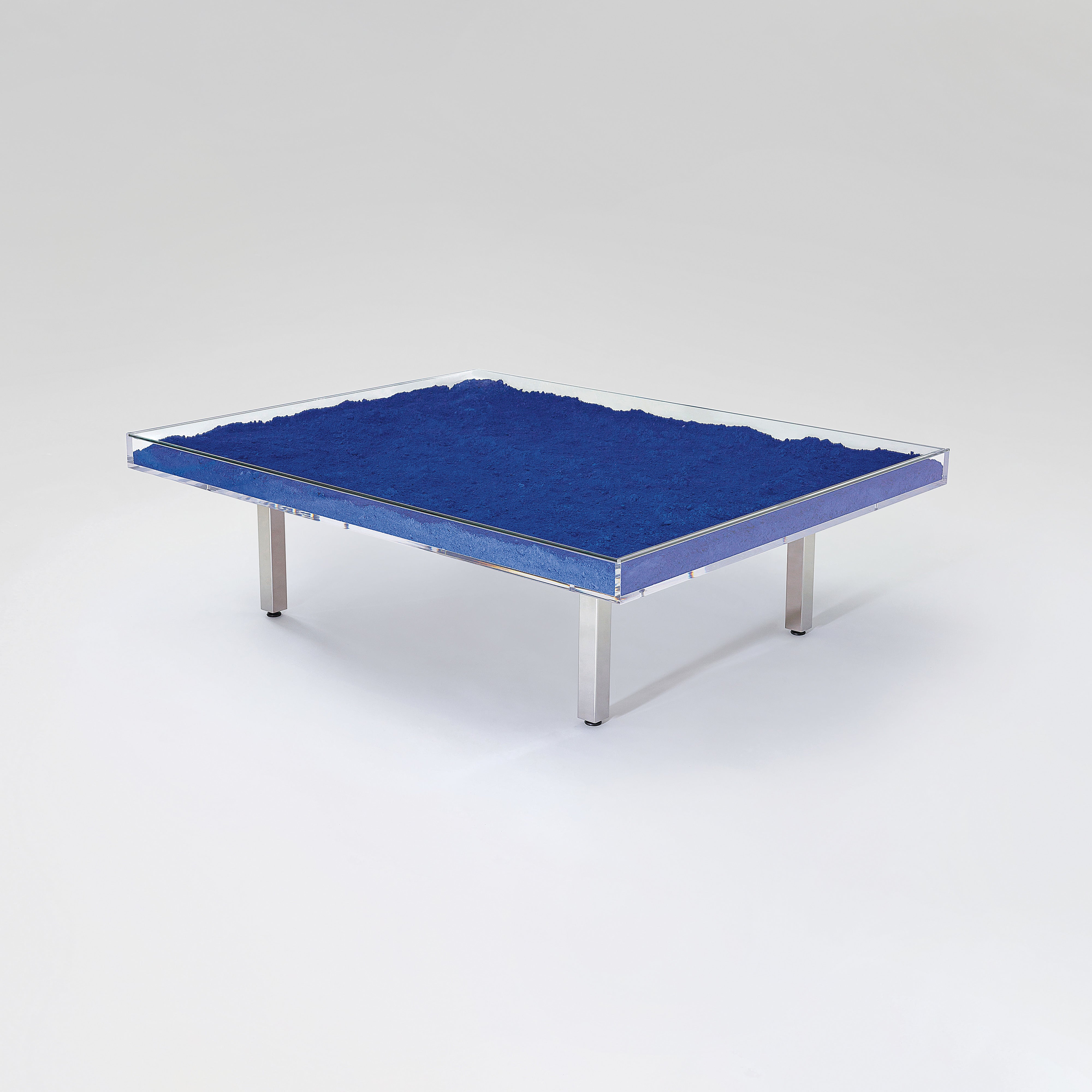
Table Bleue KleinTM / Klein Blue
It was a manifesto made flesh, a declaration that the immaterial was the only territory worth claiming. More than six decades later, that image still arrests the eye and opens the mind, which is precisely what Klein intended. Yves Klein was born on April 28, 1928, in Nice, on the luminous Côte d'Azur, to two painters. His father Fred Klein was a figurative artist and his mother Marie Raymond was a significant figure in the Parisian abstract art scene.
Growing up between studios, canvases, and conversations about form and feeling, Klein absorbed the language of art from infancy. Yet he was never content to simply inherit it. As a young man he trained in judo, eventually earning a black belt and spending two years in Japan studying at the Kodokan Institute in Tokyo. The discipline, philosophy, and spiritual rigor of judo shaped him profoundly.
Yves Klein
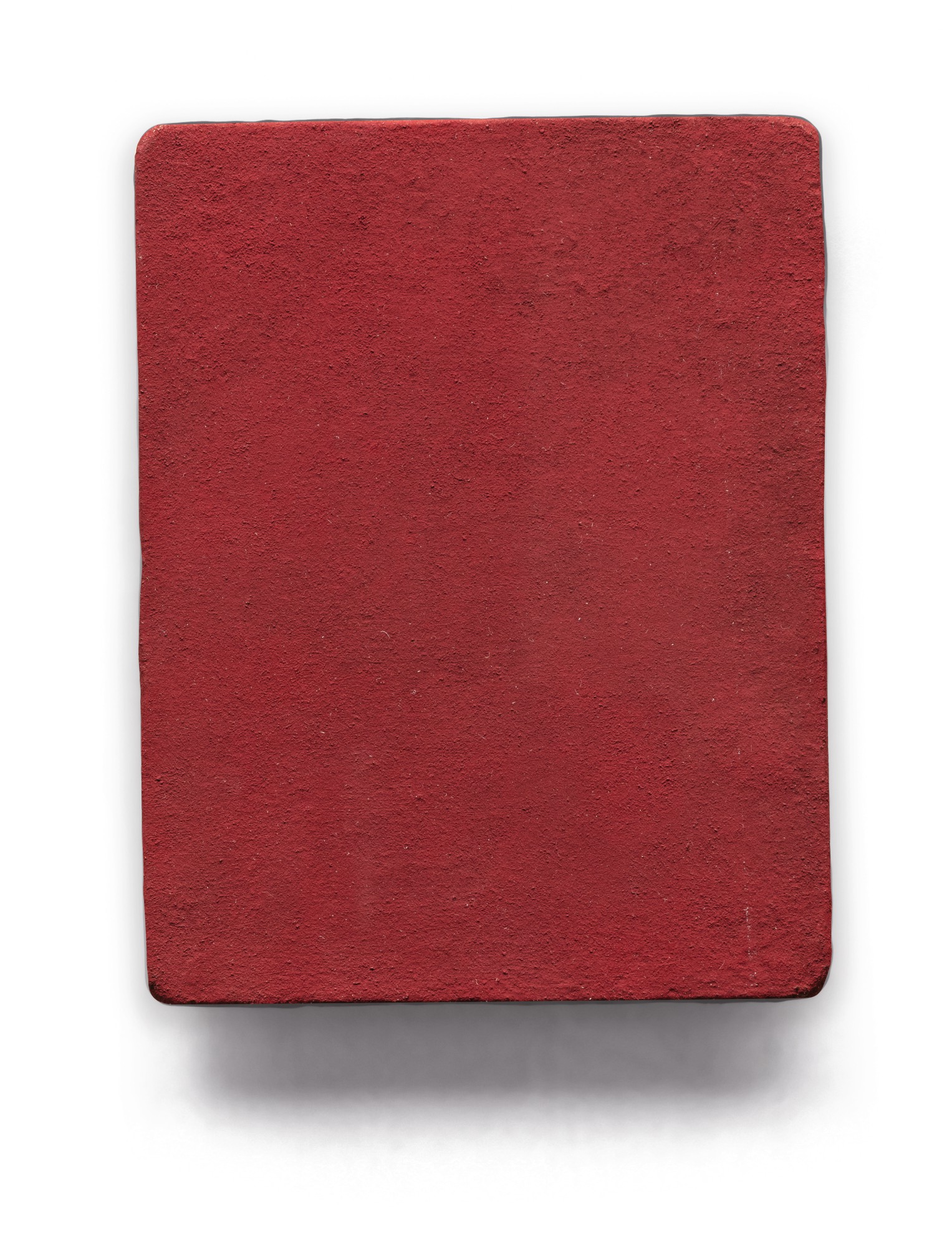
Untitled pink Monochrome, (M 101)
He returned to Europe not as a painter but as something harder to name: a seeker, a sensualist, and a conceptual provocateur years before that term existed. Klein's breakthrough came not with a brushstroke but with an absence. In 1958, at the Iris Clert Gallery in Paris, he presented Le Vide (The Void), an exhibition in which the gallery was entirely emptied and painted white. Thousands of visitors lined up along the Rue des Beaux Arts to enter rooms containing nothing but air and intention.
“I believe that in the future it will be possible to float in perfect physical and spiritual freedom.”
Yves Klein
The work was radical, bewildering, and completely serious. Klein believed that presence could be conjured without object, that the most profound artistic statement was one that had no physical form at all. This was not nihilism. It was a deeply spiritual conviction, rooted in his engagement with Rosicrucianism and his lifelong fascination with the immaterial as the highest order of reality.
Yves Klein
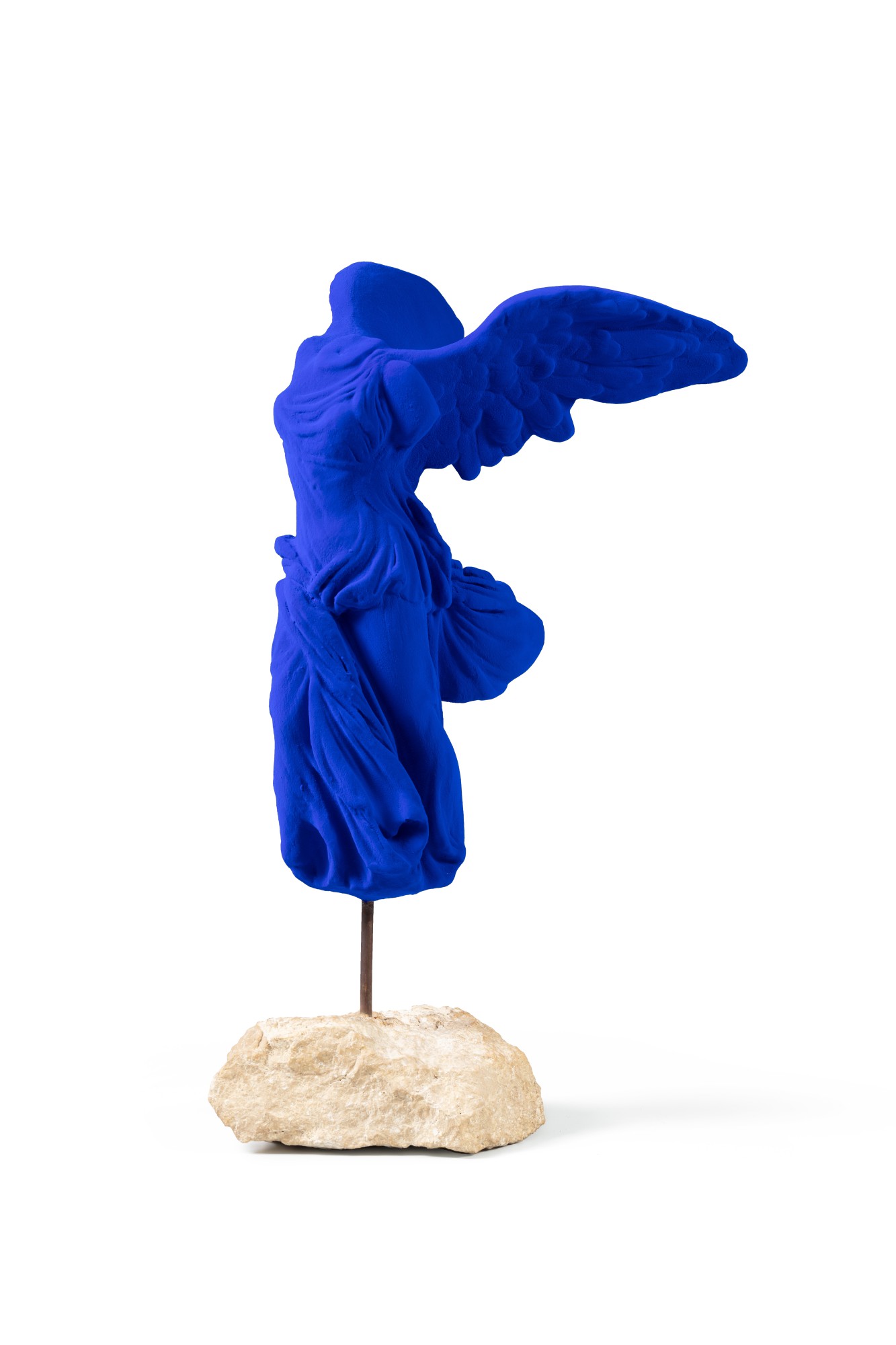
Victoire de Samothrace, 1962
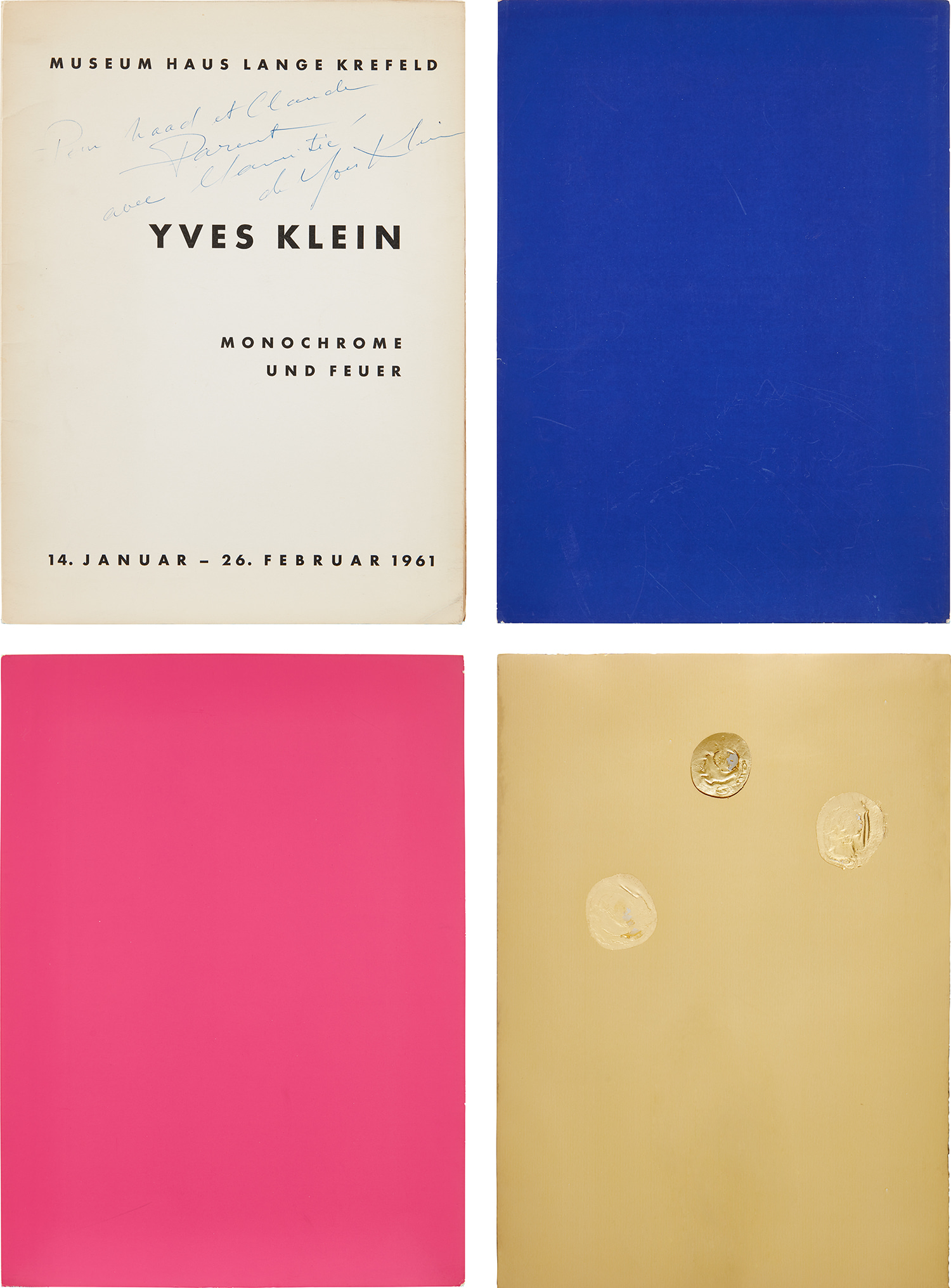
Of course, Klein is most widely known for color, specifically for the precise ultramarine shade he mixed with a synthetic resin binder called Rhodopas and formally patented in 1960 as International Klein Blue, or IKB. The pigment had an almost hallucinatory intensity, a blue so saturated and so matte that it seemed to absorb light rather than reflect it. Klein described it as a doorway to the infinite, and looking at a large IKB canvas, it is not difficult to understand why. His monochrome paintings were not decorative.
They were experiential. He exhibited his first monochromes in Milan in 1957 at the Galleria Apollinaire, and from that moment his trajectory was irreversible. The blue monochromes, the pink monochromes, the gold leaf works, each series was an exploration of a different register of the infinite. Among the most cherished works available to collectors today are pieces like his Table Bleue, in which IKB pigment suffuses glass and Plexiglas set in chrome plated metal, and his Table Rose, its counterpart in luminous pink, both of which transform everyday furniture into meditations on color and presence.
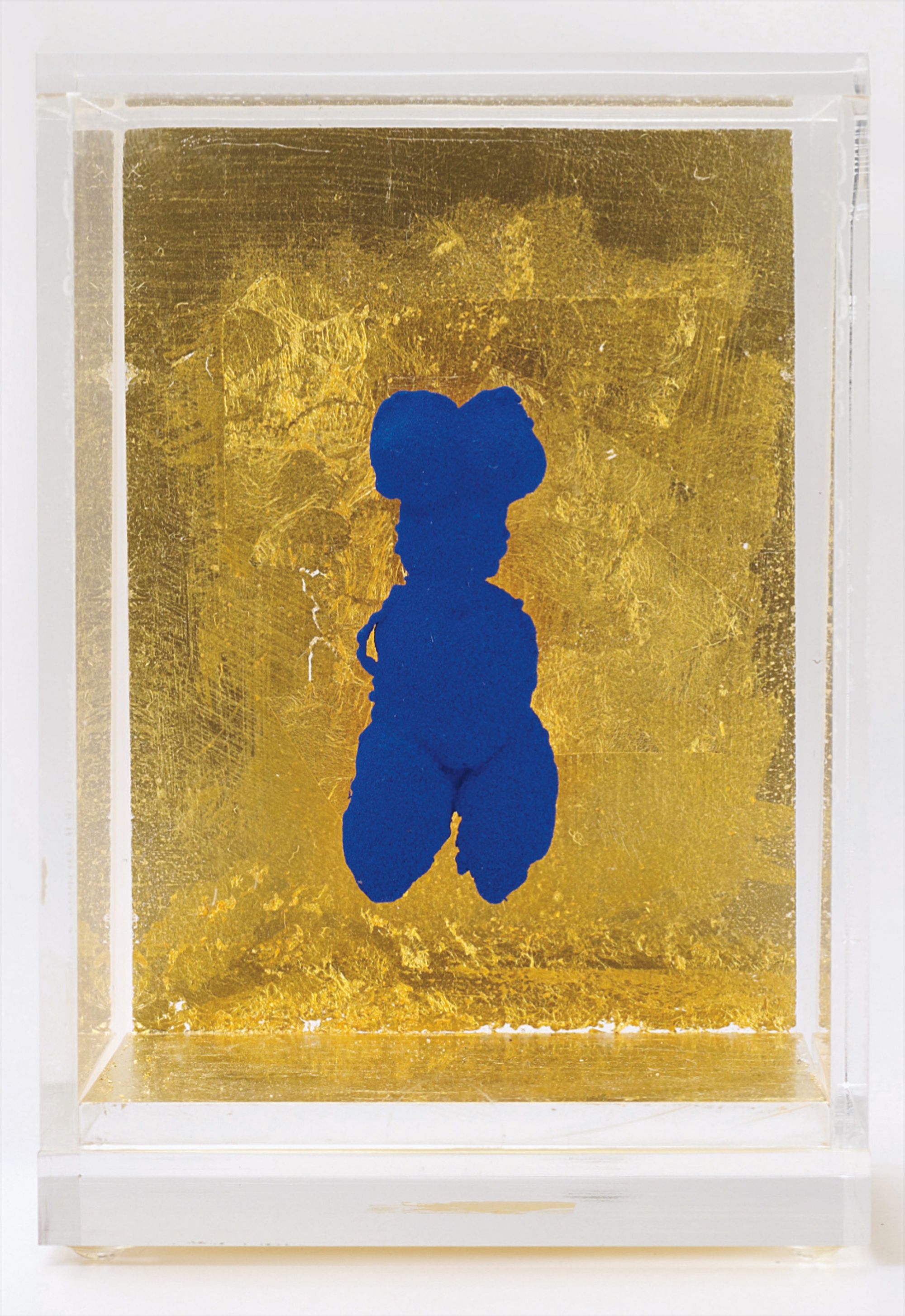
Yves Klein
Petite Vénus bleue
Klein's practice expanded into performance, sculpture, and what he called Anthropometries, a series of works made by pressing models coated in IKB pigment against canvases and paper, sometimes to the accompaniment of his own Monotone Symphony, a single note sustained for twenty minutes followed by twenty minutes of silence. Works such as Anthropométrie Sans Titre (ANT 20), made in 1962, carry the literal imprint of human bodies rendered in blue, a ghostly record of life and gesture. His sculptural reimaginings of classical figures, including the Venus de Milo and the Winged Victory of Samothrace (La Victoire de Samothrace), cast in plaster and saturated in IKB, are among the most poetically charged objects in his body of work. They transpose antiquity into his own visual language with a confidence that feels both irreverent and deeply reverent at once.
For collectors, Klein's work occupies a position of rare distinction. His career lasted barely a decade before his death from a heart attack on June 6, 1962, at just 34 years old, which means the body of work is finite and carefully authenticated by the Klein Archives overseen by the Yves Klein Association. Major auction houses have seen his works achieve significant results consistently across the past two decades, with large IKB monochromes commanding prices in the millions and even smaller works on paper and sculpture drawing serious interest. The variety within his practice is a gift to collectors at different points in their journey: from rare large scale monochromes and Anthropometries to bronzes with IKB pigment, from Plexiglas table works to intimate plaster sculptures.
Each offers a distinct entry point into the same visionary universe. What unites them is the unmistakable quality of intention, the sense that every object Klein made was a vessel for something beyond itself. Klein belongs to a remarkable constellation of postwar European artists who were rewriting the rules of what art could be and do. His work is in deep conversation with that of Lucio Fontana, whose slashed canvases similarly sought to pierce the surface of painting in pursuit of space and the beyond.
Piero Manzoni, his Italian peer and sometime rival, shared Klein's appetite for conceptual provocation and the dematerialization of the art object. Within France, his influence resonates in the Nouveau Réalisme movement he helped found with critic Pierre Restany in 1960, a loose gathering of artists committed to incorporating the real world into art in radically new ways. Members included Jean Tinguely, Niki de Saint Phalle, and Arman, each of whom forged their own distinctive practice in the same ferment of ideas that Klein helped generate. The legacy of Yves Klein is impossible to overstate.
He arrived at ideas that would take the broader art world years to fully absorb: the artwork as event, color as subject rather than attribute, the artist as shaman and the studio as sacred space. His influence flows through minimalism, through conceptual art, through installation and performance, and into the work of contemporary artists who may not even realize how much they owe him. Institutions including the Centre Pompidou in Paris, the Museum of Modern Art in New York, and the Hirshhorn Museum in Washington hold major examples of his work in their permanent collections, testament to how central he has become to any account of modern and contemporary art. To live with a Klein, whether a shimmering blue monochrome or a gilded Venus sealed in Plexiglas, is to live with a question posed in the most beautiful possible terms: what lies on the other side of what we can see.
Explore books about Yves Klein
Yves Klein: A Retrospective
Didier Semin
Yves Klein: 1928-1962
Pierre Restany

Yves Klein: Catalogue Raisonné
Alain Gieksterne and Götz Adriani
Yves Klein: The Complete Works
François Marquet
Yves Klein: Cosmonaute
Daniel Abadie
Yves Klein: The Monochrome Adventure
Pierre Restany
Yves Klein: A Life
Kenneth E. Silver