Wolf Kahn
Wolf Kahn's Light Will Always Find You
Artist Spotlight · The Collection Editorial
“Color is one of those experiences that bypasses the intellect. It goes right to the gut.”
Wolf Kahn
There is a moment in front of a Wolf Kahn painting when the eye adjusts and the world shifts. What seemed at first like abstraction resolves into a treeline, a barn, a river bending through a Vermont meadow, all of it burning with color that could never exist in ordinary daylight yet feels more truthful than a photograph. That experience, disorienting and then deeply consoling, is what drew collectors to Kahn's work for more than six decades and what continues to draw them today. His paintings hang in major American museum collections, appear regularly at auction with sustained demand, and carry with them an emotional warmth that is genuinely rare in postwar American art.
Wolf Kahn
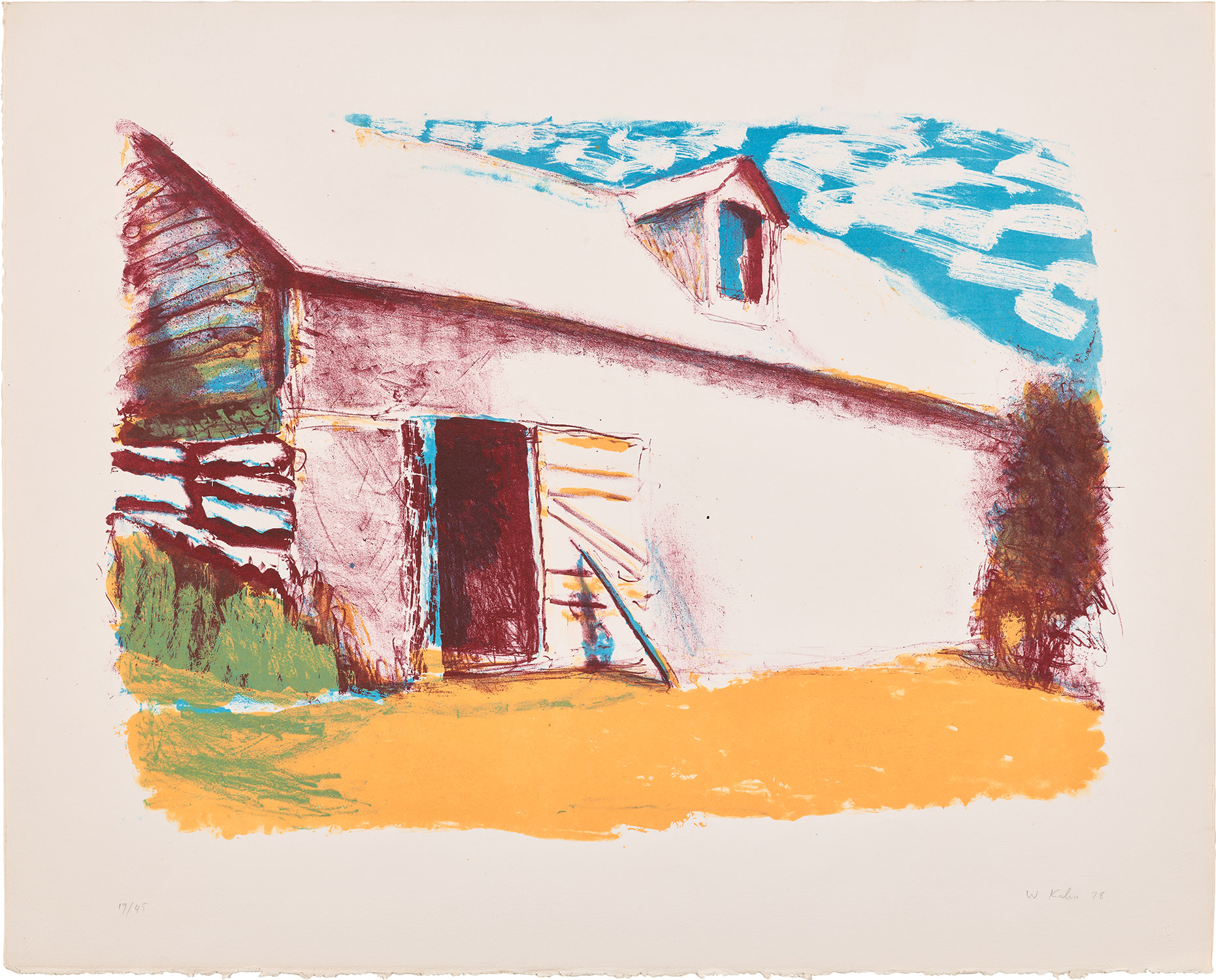
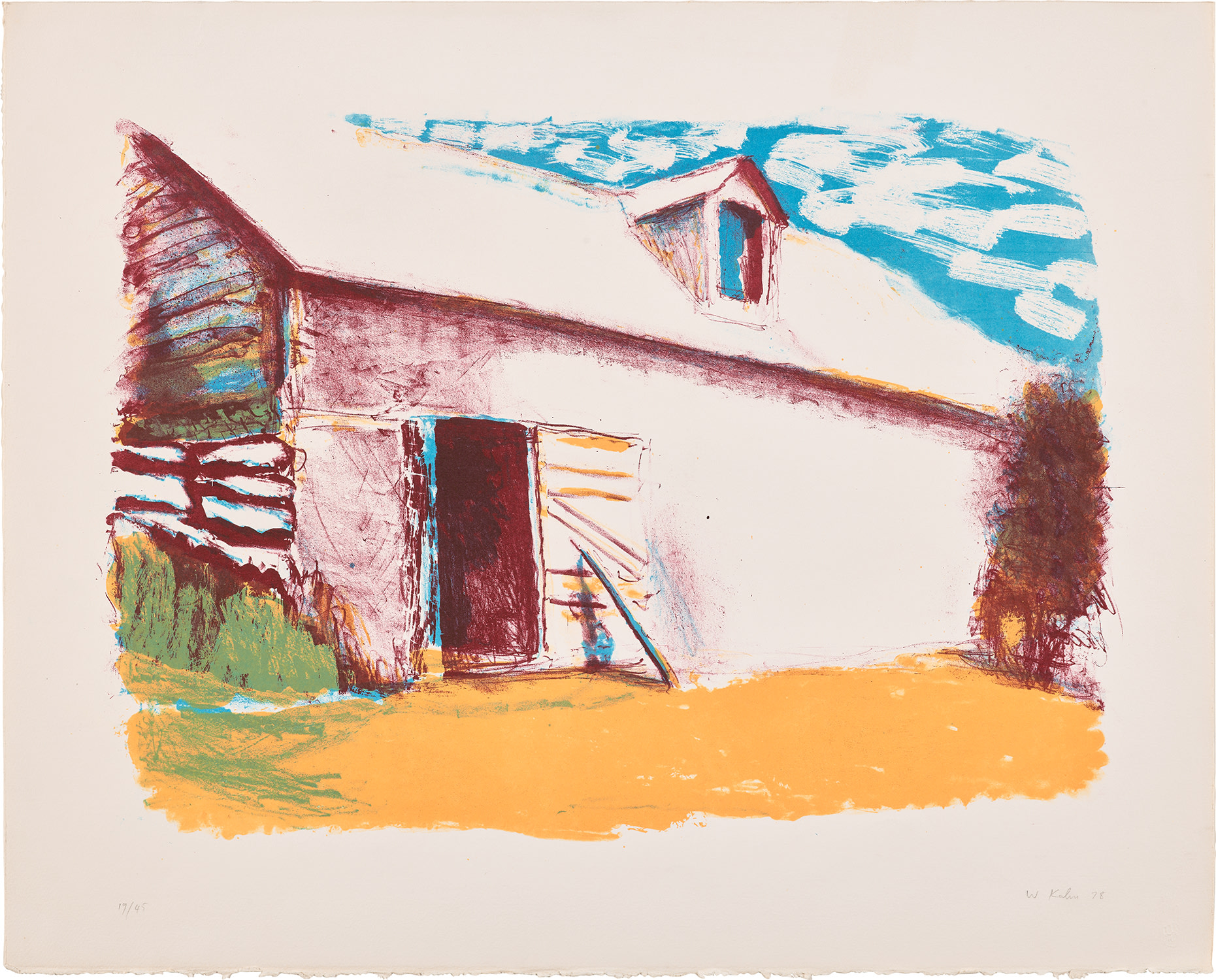
The Open Door
Kahn's story begins in Stuttgart, Germany, where he was born in 1927 into a Jewish family with deep roots in European intellectual and artistic life. When the Nazi regime made life untenable, his family arranged for him to leave Germany through the Kindertransport program, the extraordinary rescue effort that carried thousands of Jewish children to safety in Britain and elsewhere. Kahn arrived in England in 1939 at the age of eleven and eventually made his way to New York City, where he would spend the rest of his long life. That displacement, that rupture followed by reinvention in a new world, runs quietly beneath the surface of his entire body of work.
There is something in the longing with which Kahn painted landscape, as though he were always reconstructing a sense of belonging through color and light. His formal education placed him at the center of one of the most electric moments in American art history. In the late 1940s, Kahn studied with Hans Hofmann, the German born master whose school in New York and Provincetown became a crucible for Abstract Expressionism. Hofmann's teachings about the push and pull of color, the idea that pictorial space could be generated entirely through chromatic tension, left a permanent mark on Kahn's thinking.
Wolf Kahn
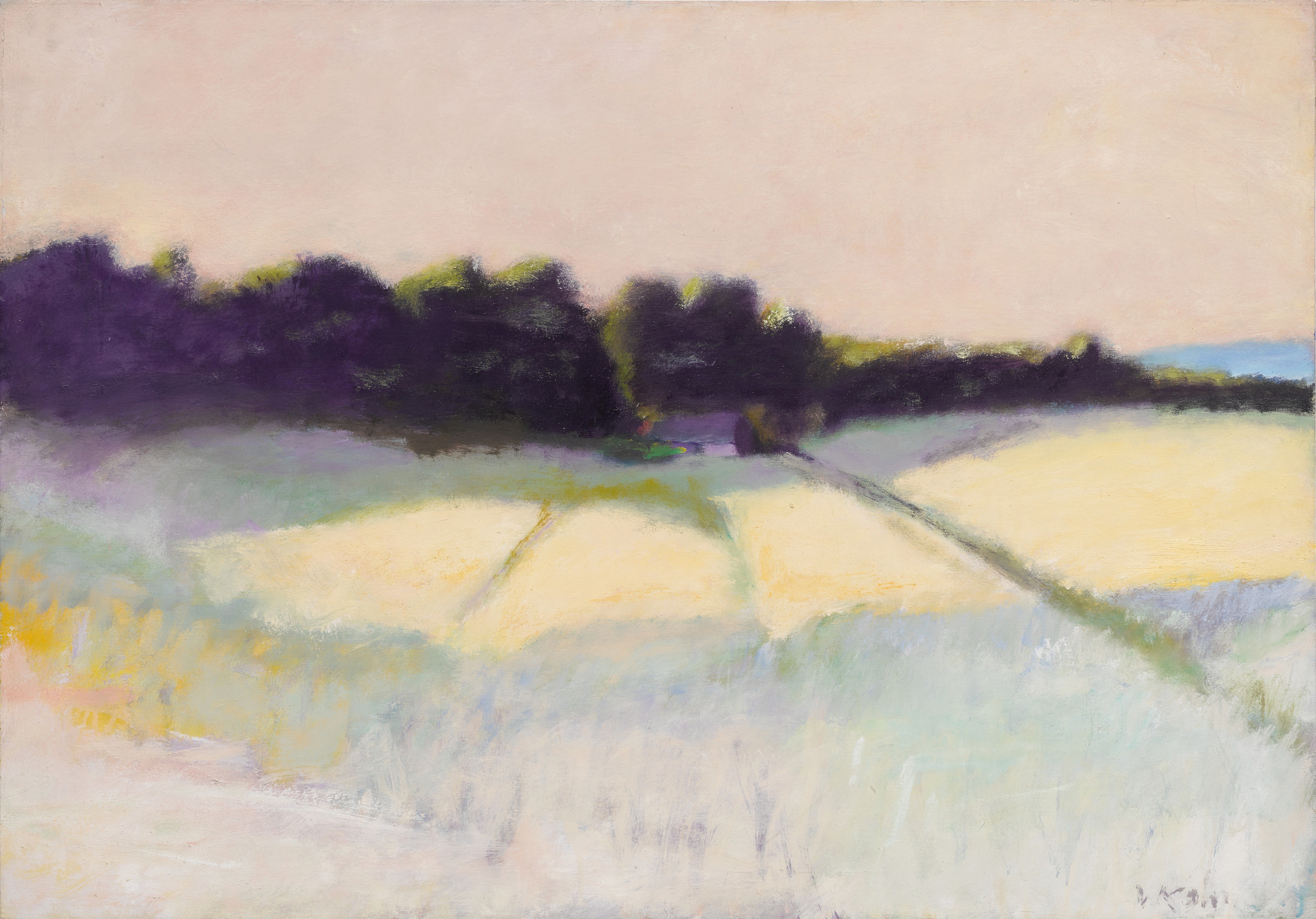
Untitled (Bridal Path, Vermont), 1970
He also studied at the University of Chicago, giving him a broader humanistic foundation that distinguished him from many of his peers. What emerged from this dual formation was not abstract expressionism and not conventional landscape painting but something entirely his own: a practice in which Color Field painting and representational tradition were woven together so completely that they became inseparable. Kahn's artistic development moved through several distinct registers over the decades. In the 1950s and 1960s, he was working out the terms of his own vision, painting landscapes with a growing confidence in his right to push color far beyond observed reality.
“I want my pictures to have the freshness of immediate sensation combined with the complexity of well-pondered thought.”
Wolf Kahn
By the 1970s, works like "Untitled (Bridal Path, Vermont)" from 1970 showed a painter in full command, the Vermont countryside rendered in tones that hover between the real and the ecstatic. Through the 1980s and into the 1990s, Kahn's palette grew more audacious. "Airstrip in a Cornfield II" from 1981 and "Long Connecticut River Painting" from 1984 demonstrate his willingness to hold structural clarity and chromatic intensity in a kind of productive tension. By the time he painted "Orange Sky, Orange River" in 1991, he had arrived at something that felt like a fully realized world, one with its own atmosphere, its own laws of light.
Wolf Kahn
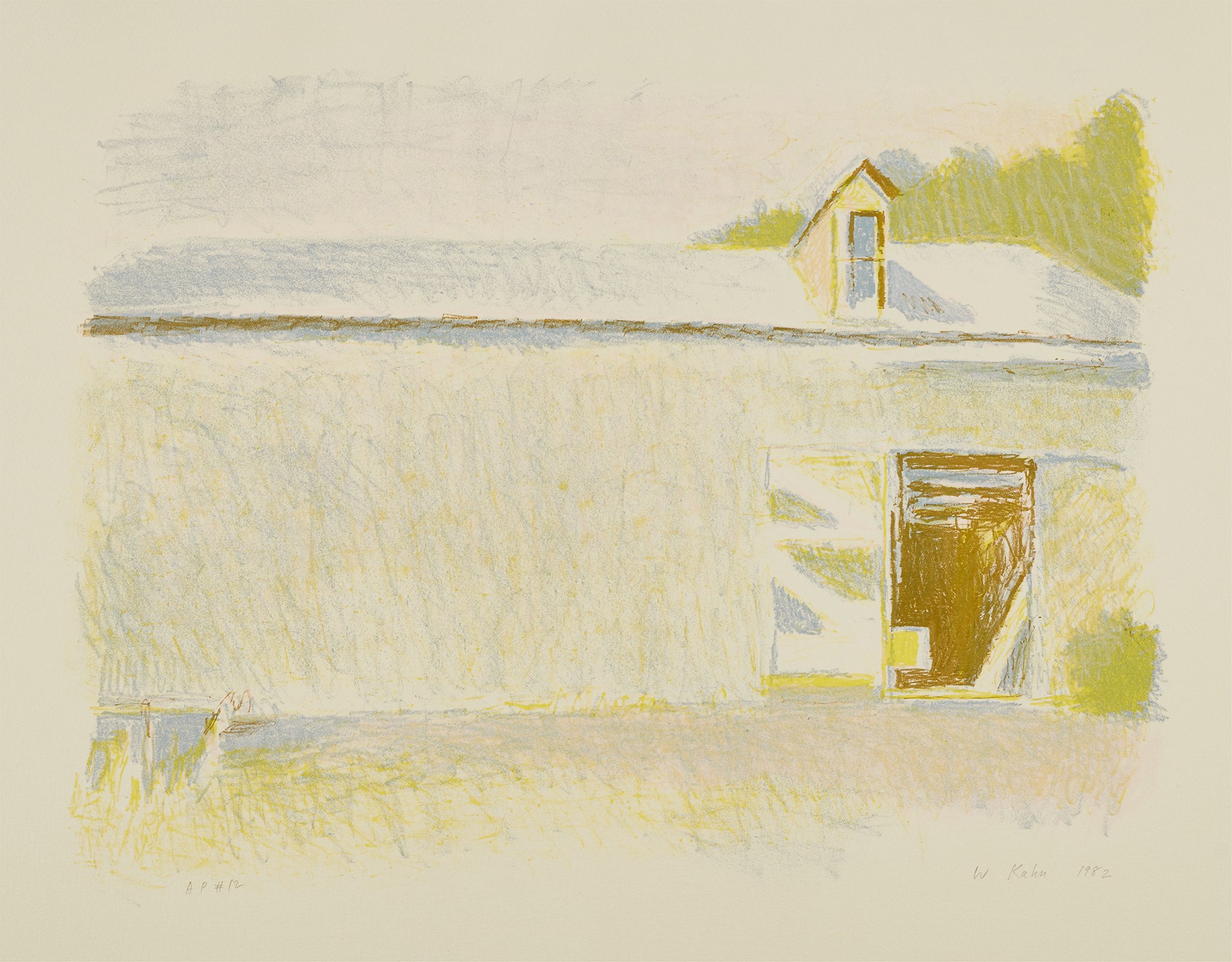
Curing Barn
The works that collectors most treasure tend to be those where Kahn's color reaches its most unexpected conclusions without losing its grip on the observed world. "Yellow Band" from 2007 is a perfect example: a horizontal composition in which a band of acidic yellow anchors a landscape that seems to vibrate with stored energy. "Bald Cypresses" from 2001 brings a southern American landscape into contact with a palette that owes as much to Fauvist influence as to direct observation. His lithographs, including "The Open Door" and "Curing Barn," printed on Arches paper with that characteristic generosity of margin, show that his chromatic intelligence translated seamlessly into the print medium.
These works on paper have attracted a broad collecting audience precisely because they carry the full force of his vision at a more accessible scale. From a market perspective, Kahn occupies a position that any serious collector of postwar American art should understand. His oils on canvas from the 1980s and 1990s represent some of the strongest material, combining the confident draftsmanship of his mature years with the boldest color of his career. Works have appeared consistently at Christie's, Sotheby's, and Swann Auction Galleries, with his larger canvases attracting competitive bidding from private collectors who recognize the combination of art historical significance and immediate visual pleasure that his work delivers.
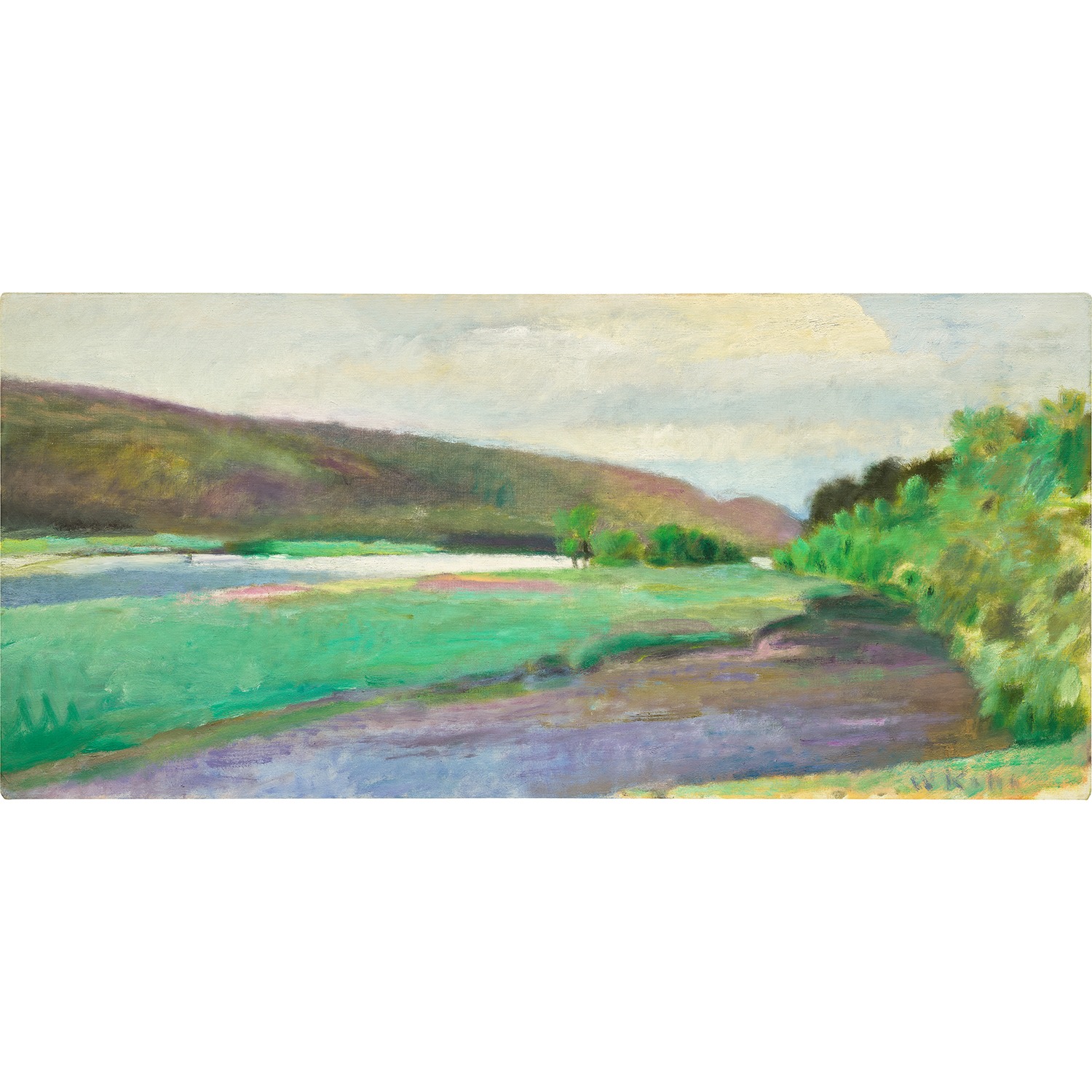
Wolf Kahn
Long Connecticut River Painting, 1984
The Grace Borgenicht Gallery and later the Ameringer and Yohe Fine Art gallery in New York were central venues for his work during his lifetime, and the secondary market has remained active since his passing in 2020. Collectors who are new to Kahn should pay attention to the quality of the color relationships in any given work: the paintings in which warm and cool tones are held in the most delicate balance tend to be the ones that reward long looking. To understand Kahn within the arc of American art history, it helps to think about the artists who surrounded and influenced him. He came of age alongside the generation that included Jane Freilicher and Lois Dodd, painters who also refused the binary choice between abstraction and representation.
His debt to Hofmann connects him to a transatlantic lineage that includes Matisse and the German Expressionists. His sustained commitment to landscape places him in a long American tradition that runs from the Hudson River School through Milton Avery, whose work Kahn acknowledged as an important touchstone. Avery's soft, planar landscapes showed Kahn that color could carry an entire emotional argument without sacrificing the recognizable world, and Kahn carried that lesson further than almost anyone. What makes Kahn's legacy feel so vital in the present moment is precisely its refusal of anxiety.
At a time when the art world often rewards difficulty and opacity, his paintings offer something rarer: they are genuinely beautiful in a way that deepens rather than diminishes with familiarity. Works like "My Meadow" and "Very Blue" hold their ground in any collection, neither shouting for attention nor receding into decoration. They ask the viewer to slow down, to let the eye move through color the way the body moves through a landscape at dusk. That invitation, extended across a career of more than sixty years, is the measure of an artist who understood that painting's deepest purpose is to make us feel more alive in the world we inhabit.
Explore books about Wolf Kahn