William Sidney Mount
William Sidney Mount, America's Joyful Witness
Artist Spotlight · The Collection Editorial
“Paint pictures that will take with the public, never paint for the few but for the many.”
William Sidney Mount, journal entry
There is a particular quality of afternoon light that falls across a barn door in late summer on Long Island, the kind that catches the grain of old wood and turns an ordinary moment into something luminous. William Sidney Mount understood that light intimately, and he spent a lifetime coaxing it onto canvas and paper, transforming the everyday rhythms of rural American life into images so warm and so true that they feel, even now, like memory. To stand before one of his works is to be welcomed into a world that is generous, attentive, and quietly radical in its insistence that ordinary people deserve to be seen. Mount was born in Setauket, New York, in 1807, the third of five children in a family that would shape his sensibility in lasting ways.
William Sidney Mount
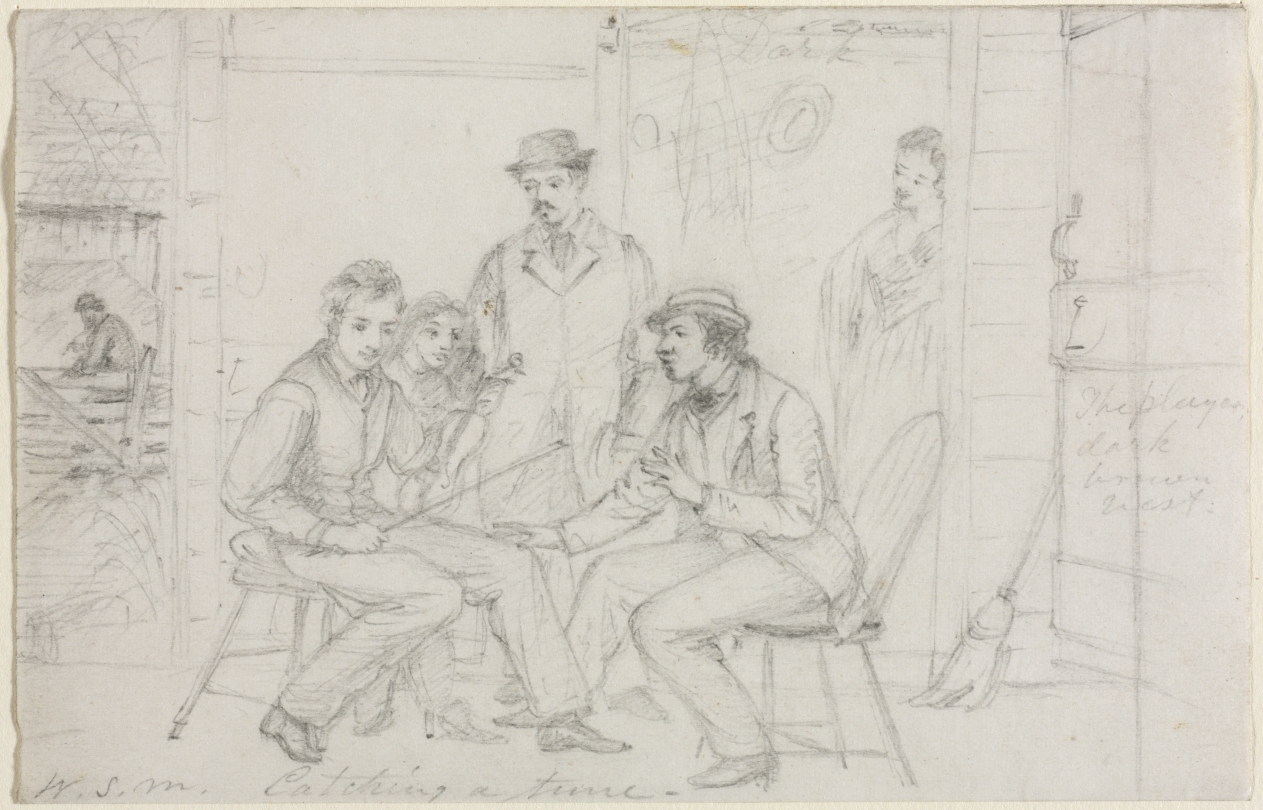
Catching a Tune, 1867
When his father died in 1814, Mount's mother sent her children to live with their grandparents, also in Setauket, on the North Shore of Long Island. That landscape, flat and open, threaded with inlets and framed by old farmsteads, became the enduring subject of his imagination. He never strayed far from it, not really, even when his ambitions took him to New York City to study at the National Academy of Design in the late 1820s. He enrolled there in 1826, learning the fundamentals of figure drawing and composition, and showed early enough promise to exhibit at the Academy by 1828.
But the city never claimed him the way the country did. His artistic development moved through several distinct registers. In his earliest years Mount tried his hand at history painting and portraiture, the prestige genres of his era, and he was not without skill in them. But something shifted when he turned his attention to genre scenes, pictures of American rural life drawn from direct observation rather than literary or classical sources.
William Sidney Mount
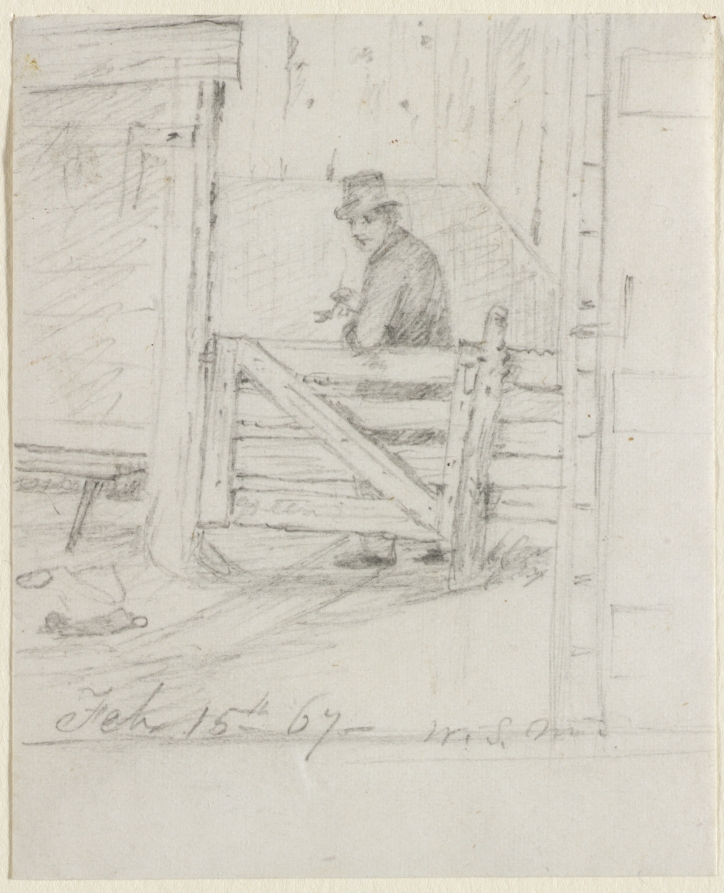
Resting on the Fence, 1867
His 1830 painting "Rustic Dance After a Sleigh Ride" announced this new direction with confidence, and the art world took notice. The National Academy elected him a full Academician in 1832, a remarkable recognition for a painter still in his mid twenties. What distinguished his genre work from the outset was its specific gravity, the sense that these figures inhabiting these particular barns and fields and porches were not types but people. Music runs through Mount's work like a current.
He was himself an accomplished fiddle player, and his deep feeling for vernacular American music, including the African American musical traditions he encountered in the communities around him on Long Island, gave his pictures an interior life that sets them apart. "The Power of Music," completed in 1847 and now among his most celebrated oils, is a masterpiece of both composition and moral attentiveness. The painting depicts a group of white farmworkers gathered near the open door of a barn, listening to an unseen musician playing inside. At the edge of the doorway stands a Black man, excluded from the interior space but fully caught in the music's spell, his posture one of absorbed, dignified listening.
William Sidney Mount
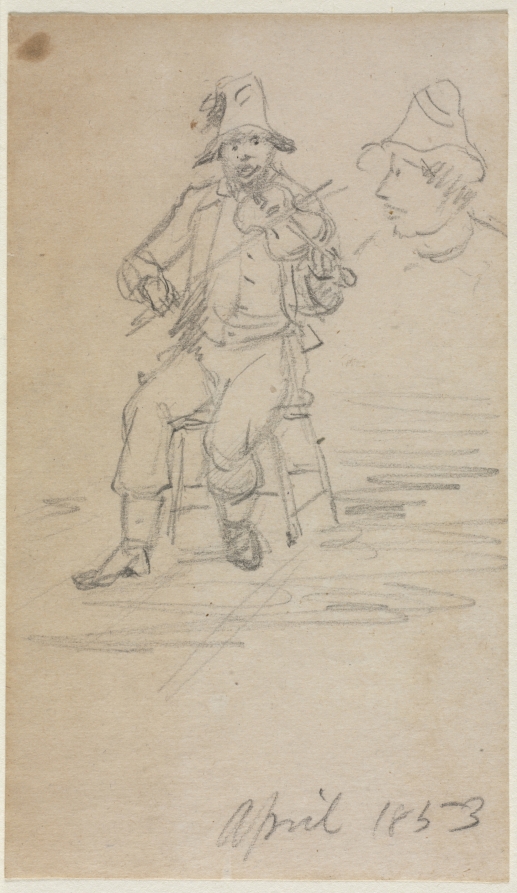
The Fiddling Beggar, 1853
The painting does not editorialize. It simply shows, with devastating clarity, who is allowed inside and who is made to stand at the threshold. It is an image that resonates with uncomfortable relevance well into the present century. The graphite works represented on The Collection reveal another dimension of Mount's practice entirely, one that rewards close looking.
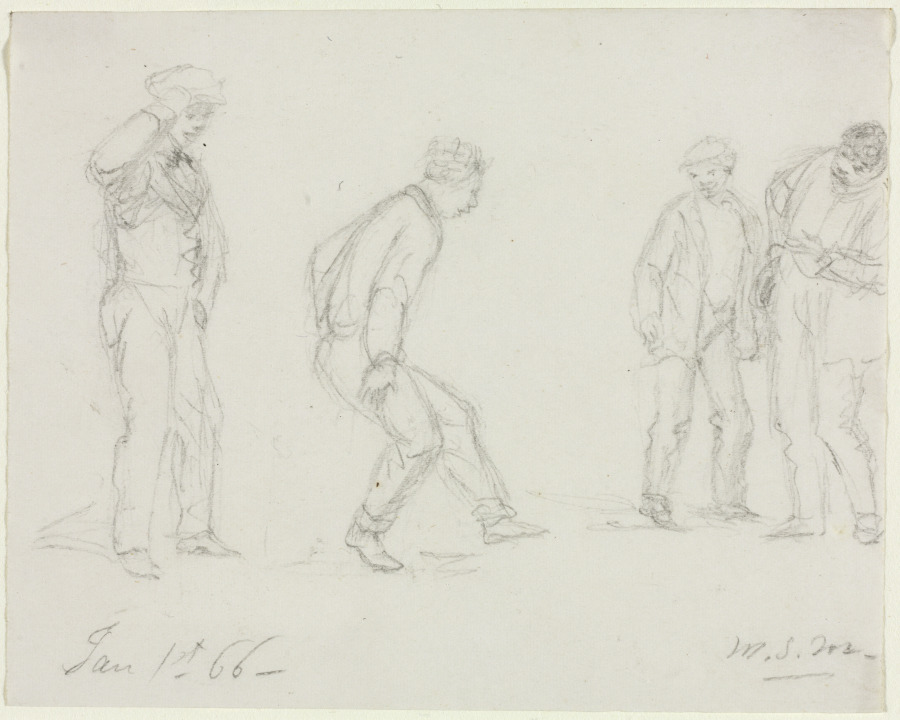
Works such as "Catching a Tune," "Resting on the Fence," and "Tuning," all completed in 1867 near the end of his life, demonstrate a draftsmanship that is both assured and tender. These are not preliminary sketches but finished studies in their own right, capturing gesture and character with an economy of line that feels almost modern. "The Fiddling Beggar" from 1853 and "The Jig" from 1861 continue the musical thread that defines so much of his output, while "Who'll Turn the Grindstone?" from 1850 and "At the Pump" from 1861 show his equally keen eye for the textures of agricultural labor.
William Sidney Mount
The Jig, 1861
Together these works on paper constitute a kind of long meditation on American life at the middle of the nineteenth century, intimate and immediate in a way that his larger oil paintings, for all their achievement, sometimes are not. From a collecting perspective, Mount occupies a position that is historically significant and relatively accessible by the standards of his peers. His oils are held by major institutions including the Museums at Stony Brook, the Metropolitan Museum of Art, and the New York Historical Society, which means that works on paper represent a genuine and meaningful point of entry for private collectors. His graphite drawings, precise and expressive in equal measure, carry the full weight of his artistic intelligence in a format that translates beautifully into domestic and private settings.
Collectors drawn to American realism, to the Hudson River School tradition, or to the broader landscape of nineteenth century American art will find in Mount a figure who is central rather than peripheral, a painter whose influence on later artists including Eastman Johnson and Winslow Homer is well documented and deeply felt. Both Johnson and Homer share with Mount that quality of democratic attention, the conviction that a scene of ordinary life observed with sufficient care becomes art of the highest order. Mount died in 1868, having lived long enough to witness the upheaval of the Civil War and to feel, perhaps, the strain of a nation whose contradictions his work had so honestly mapped. His health had been declining for several years, and his later graphite studies carry a reflective quality, as though he was returning to essentials, to line and observation stripped of ornament.
He never married, and he remained rooted to Long Island until the end, a figure of remarkable consistency whose artistic vision did not waver across four decades of practice. The world around him changed enormously, but his fidelity to what he could see and hear and feel in the landscape of his childhood remained constant. What makes Mount matter today is precisely that quality of witness. In an era when American identity is again a subject of fierce contestation, his images of who gathered around the music and who was left outside the door feel not like history but like an ongoing conversation.
He painted joy and community and the pleasures of rural life with genuine warmth, and he painted exclusion and inequality with equal honesty, never forcing a conclusion but trusting the viewer to sit with what was shown. That combination of celebration and clear sight is rare in any era, and it is why Mount belongs not in the footnotes of American art history but at its very center.
Explore books about William Sidney Mount
William Sidney Mount: Painter of American Life
Deborah J. Johnson
William Sidney Mount and His World
Christopher Crosman
The World of William Sidney Mount
Stiles Tuttle Colwill
William Sidney Mount: Works in the Metropolitan Museum of Art
Metropolitan Museum of Art
Mount's America: Selected Paintings and Drawings
Helene Tomlinson