Wade Guyton
Wade Guyton Rewrites the Rules of Painting
Artist Spotlight · The Collection Editorial
When the Whitney Museum of American Art devoted a full retrospective to Wade Guyton in 2012, it felt less like a career survey and more like a provocation aimed at the entire history of painting. Guyton was barely forty years old, and yet the show made a compelling case that he had already reshaped what it means to make a picture in the twenty first century. Curated by Scott Rothkopf, the exhibition filled the Whitney's galleries with large scale linen works streaked with inkjet ink, sculptural objects folded from stainless steel, and printed matter of every kind, collectively asking a question that still echoes through contemporary art: who, exactly, is the author of a painting when a machine does the mark making? Guyton was born in Hammond, Indiana in 1972 and came of age in a moment when the personal computer was transitioning from a specialized tool into an everyday instrument.
Wade Guyton
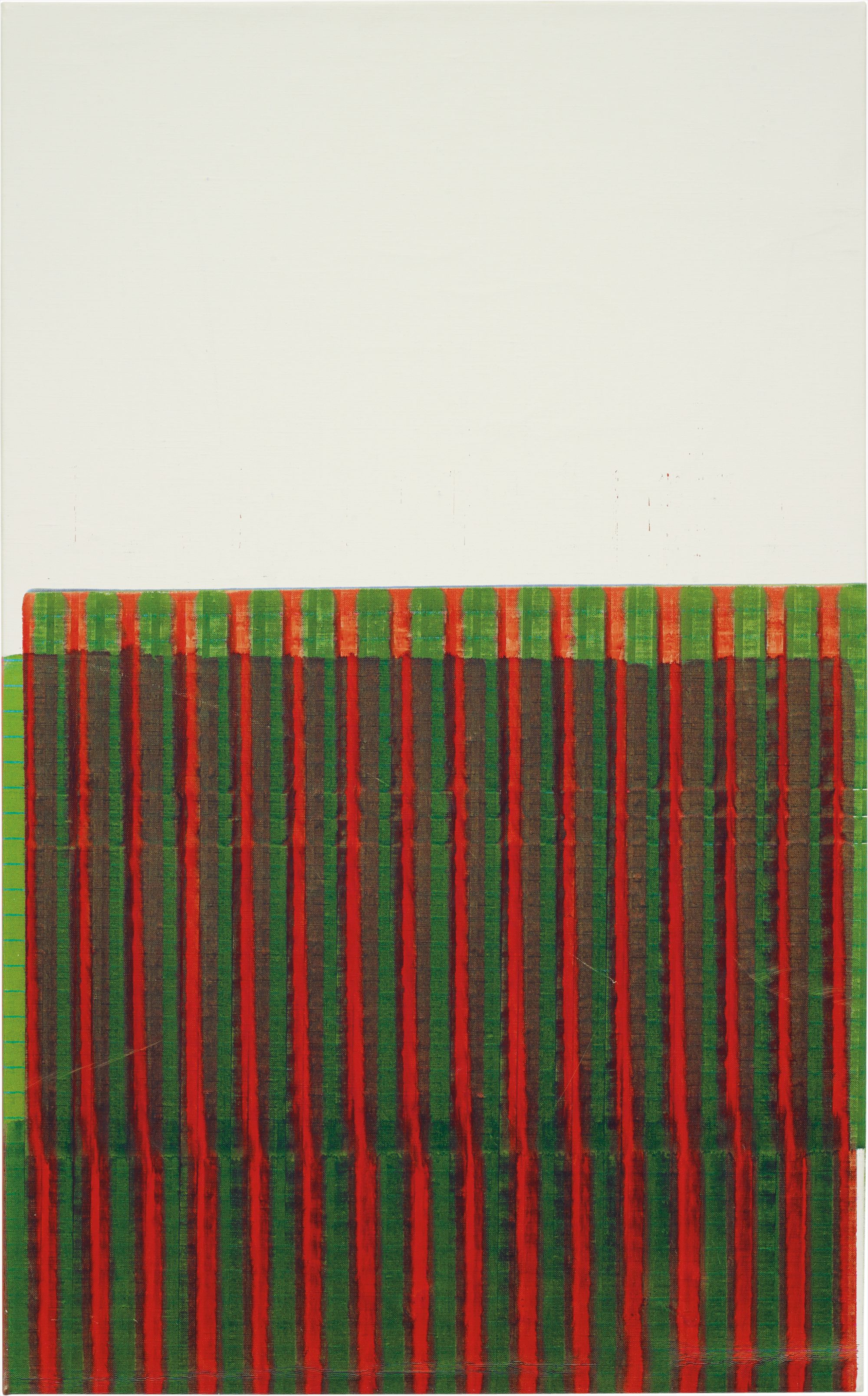
ultrachrome inkjet on linen
He studied at the University of Tennessee before moving to New York, where he completed his MFA at Hunter College in 2001. The city in that period was a crucible for a generation of artists grappling with the aftermath of Pictures Generation appropriation and the growing presence of digital technology in studio practice. Guyton absorbed those energies and found his own quietly radical response to them, one rooted not in grand theoretical statements but in the specific, almost stubborn logic of his chosen tools. The breakthrough came when Guyton began feeding raw linen directly through an Epson inkjet printer, the kind of large format machine ordinarily used for commercial reproduction and photographic output.
The gesture sounds simple, almost perverse in its straightforwardness, but the results are anything but predictable. The printer was never designed to accept unprimed textile, and so the ink pools, skips, streaks, and bleeds in ways that no human hand could choreograph. The machine's errors become the painting's signature. Works rendered in Epson UltraChrome ink on linen from around 2006 onward established Guyton's visual language with striking clarity: monumental black X forms, bold flame imagery sourced from modernist design history, and stark typographic elements that hover between sign and image.
Wade Guyton
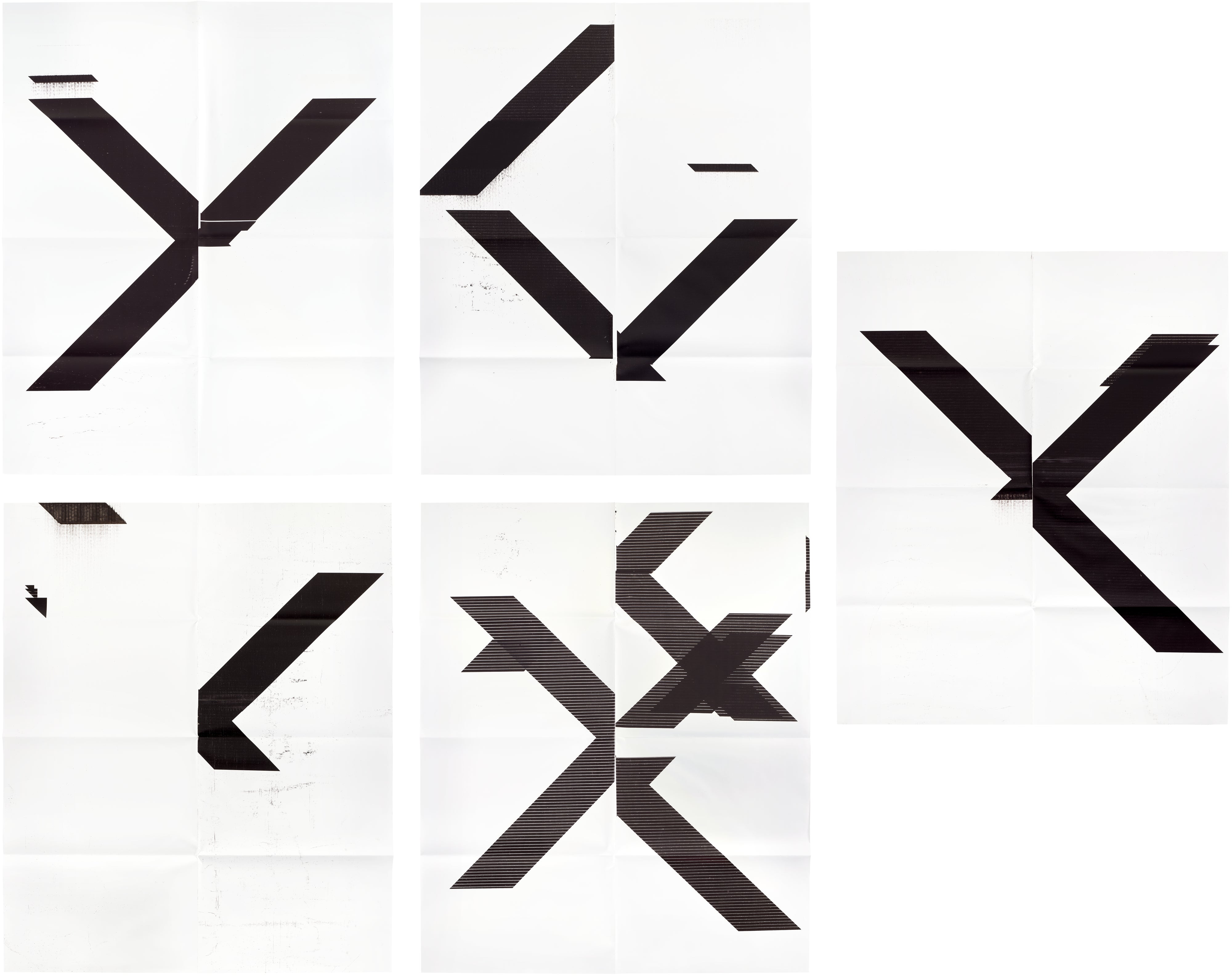
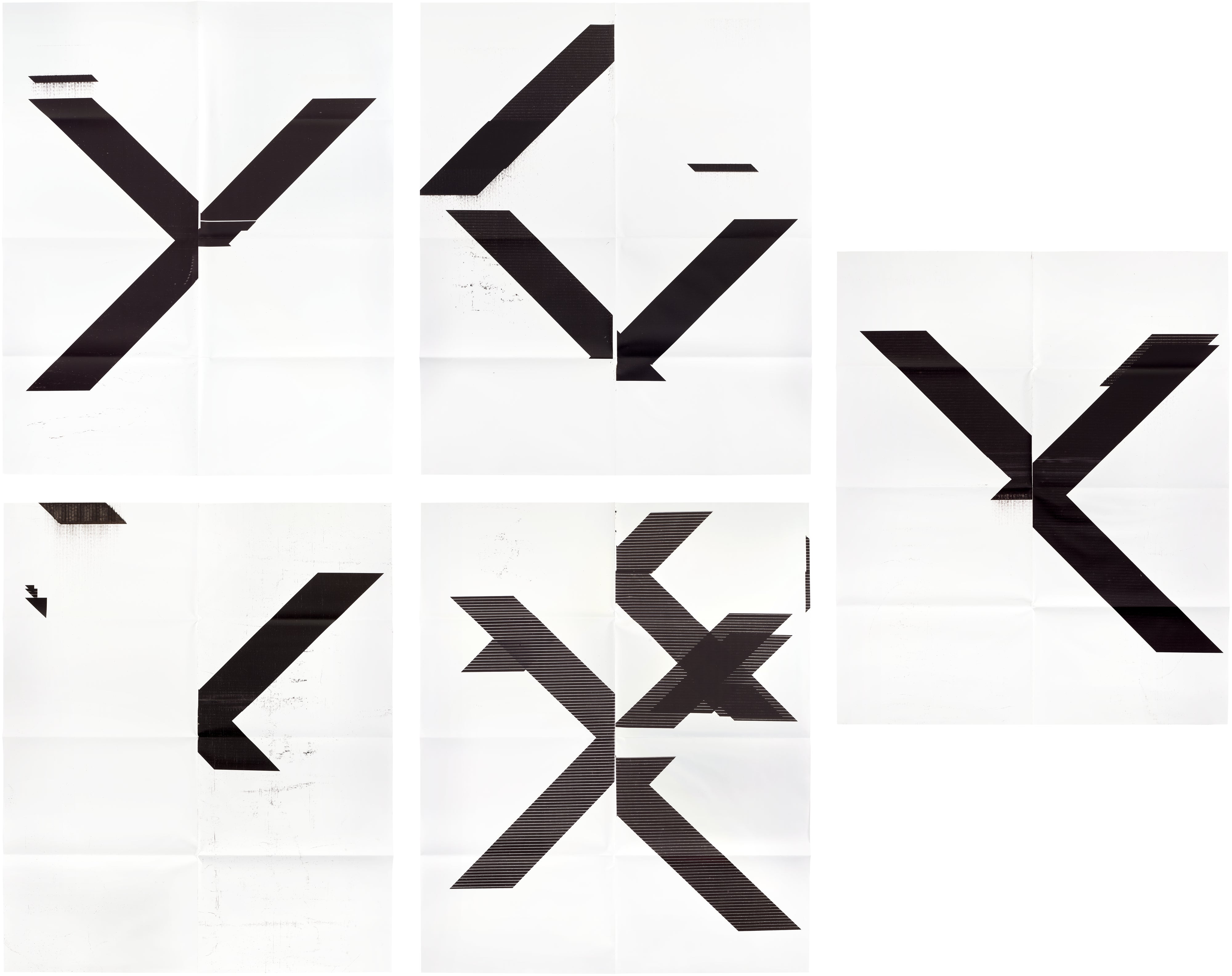
X Posters: five plates
These are not prints pretending to be paintings, nor paintings pretending to be prints. They occupy an entirely new category. What makes Guyton's signature works so compelling is their insistence on process as content. The X paintings, many of them stretching to over eighty inches in height, derive their forms partly from the letter X as a symbol of negation, cancellation, and erasure, yet on the linen they feel monumental and even celebratory.
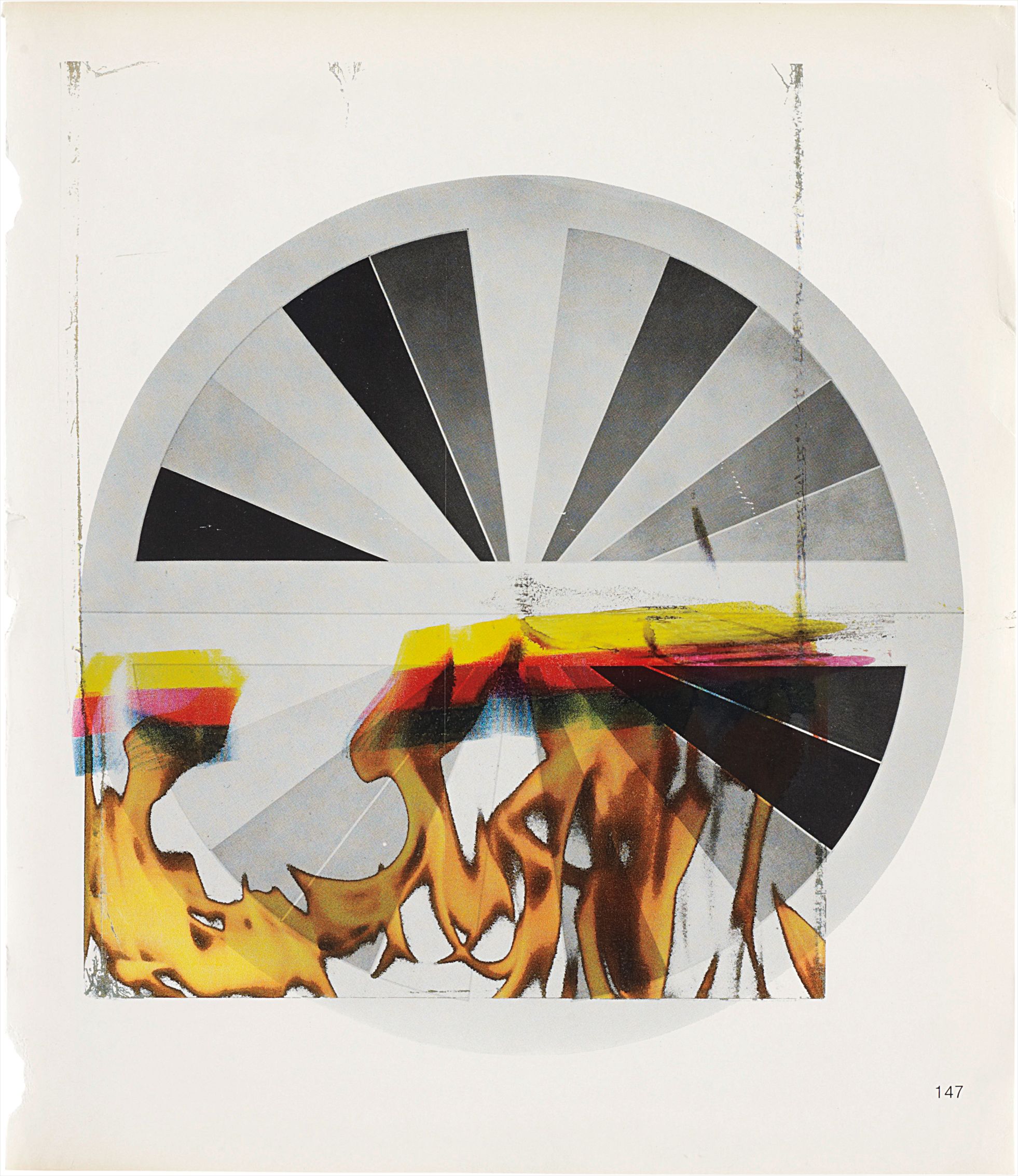
The flame motifs draw on a vocabulary that runs from modernist furniture design through Pop Art, arriving in Guyton's hands transformed into something spectral and slightly unresolved. His works on book pages, using Epson DURABrite inkjet ink printed directly onto pages pulled from art books and catalogues, add another layer of institutional commentary: the printer overwriting the archive, the image consuming its own art historical context. The X Poster series, published by Printed Matter in New York and available in numbered editions, extended his practice into a more accessible format without diminishing its conceptual ambition. Guyton's three dimensional works deserve equal attention.
Wade Guyton
Epson Durabrite inkjet on book page
His U Sculptures and U Stencils, fabricated in stainless steel and mirrored stainless steel, translate the logic of his printmaking into physical space. The U form, derived from a simple bent metal profile, recurs across his practice as both a structural element and a kind of readymade gesture. In mirrored stainless steel, the U Sculpture becomes reflective and environmental, pulling the viewer's surroundings into the object itself and destabilizing any fixed reading of what the work contains. One particularly resonant work in stainless steel carries a title drawn from Guyton's own reflection on the forming process, noting that the metal was made from bending and wondering what would happen if the bending continued.
That spirit of following material logic wherever it leads is central to everything he makes. For collectors, Guyton's work presents a rare combination of intellectual rigour and visual immediacy. His linen works have achieved significant results at major auction houses, with large scale paintings attracting serious institutional and private interest throughout the 2010s. The inkjet on plywood works from 2009 represent a particularly inventive period in which the support itself becomes part of the conceptual equation, the grain of the wood pressing through the printed surface as another form of uncontrollable mark.
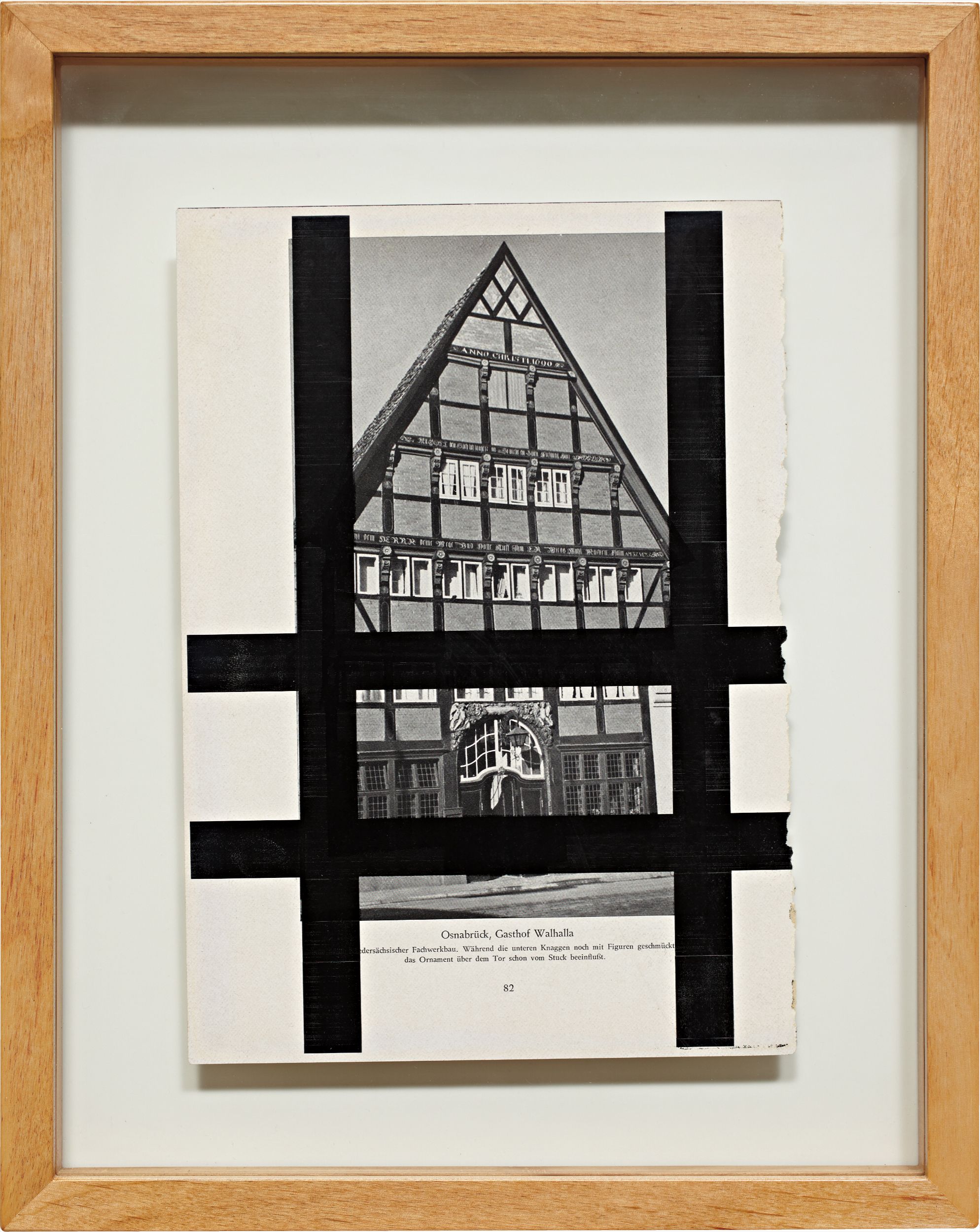
Wade Guyton
Epson DURABrite inkjet print on book page
Collectors drawn to work at the intersection of conceptual and material practice find in Guyton a sustained and coherent body of work rather than a single trademark image. His editions, including the X Poster series from Printed Matter, offer an entry point that is both historically significant and visually strong, while his unique linen works represent some of the most considered paintings produced by any artist of his generation. Within the broader landscape of contemporary art, Guyton's practice sits in productive dialogue with artists who have similarly interrogated painting's boundaries and the role of mechanical reproduction. His concerns rhyme with those of Christopher Wool, whose stencilled and silkscreened canvases raised parallel questions about authorship and surface, and with the process driven paintings of Albert Oehlen, who also enlisted computational and mechanical tools in the service of a post painterly inquiry.
There are echoes too of Kelley Walker's use of digital manipulation and commercial printing, and of the institutional critique embedded in the work of artists associated with the Cologne and New York scenes of the 1990s. Yet Guyton's voice remains distinctly his own, marked by a particular restraint and a willingness to let the machine have the final word. Guyton's legacy is still very much in formation, which is part of what makes collecting his work so rewarding right now. He has demonstrated across nearly two decades of practice that the questions he first posed around 2006 have not been exhausted; if anything they have grown more urgent as inkjet printing has become ubiquitous and the boundary between digital file and physical object has continued to dissolve.
His work does not romanticize technology or mourn the passing of traditional craft. It simply observes, with precision and a certain dry wit, what happens when you place a piece of raw linen into a machine and press print. That the results are so consistently beautiful, so charged with meaning, and so impossible to reduce to a single interpretation is the fullest measure of Guyton's achievement.