Vera Lutter
Vera Lutter Turns Light Into Legend
Artist Spotlight · The Collection Editorial
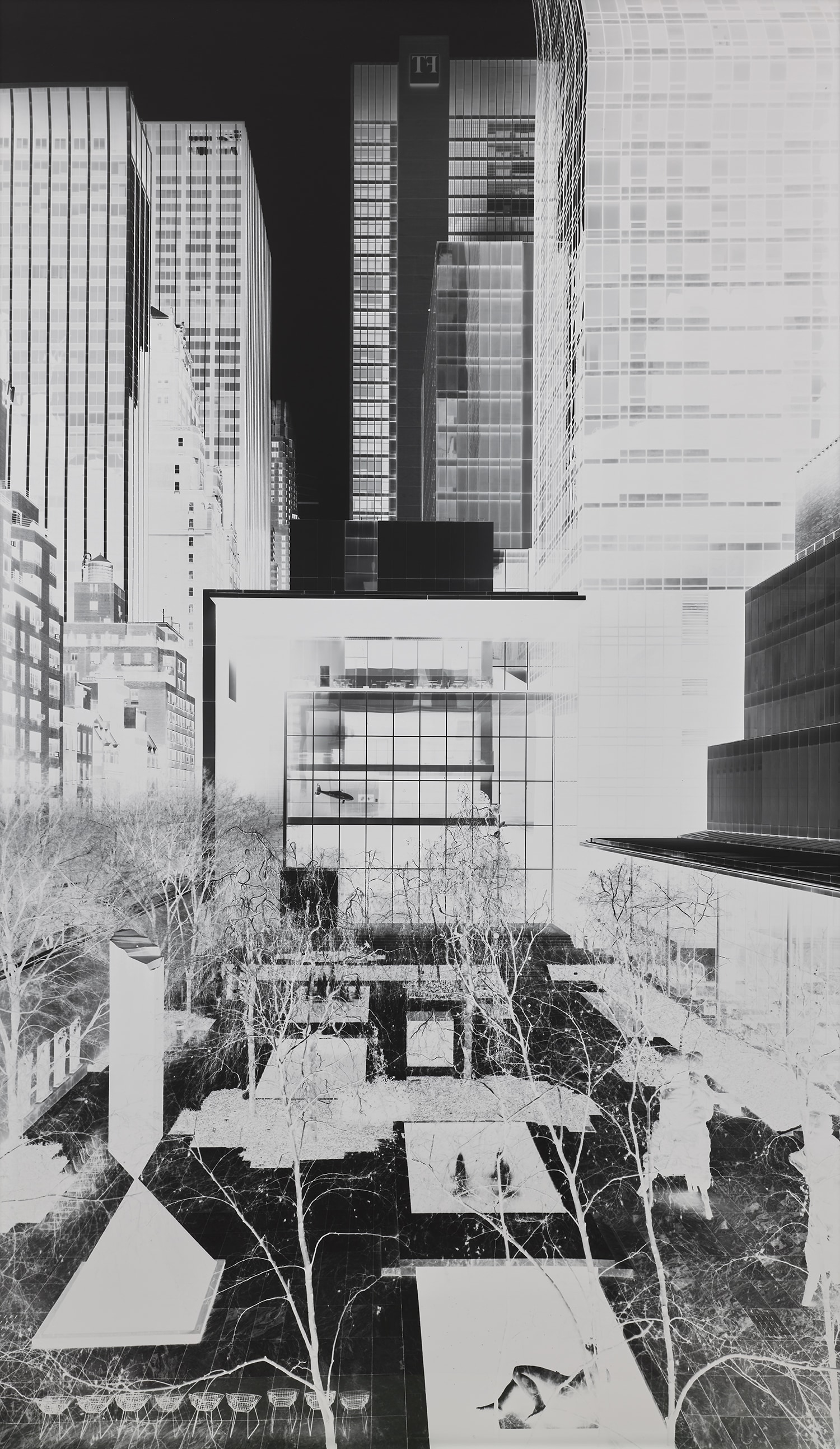
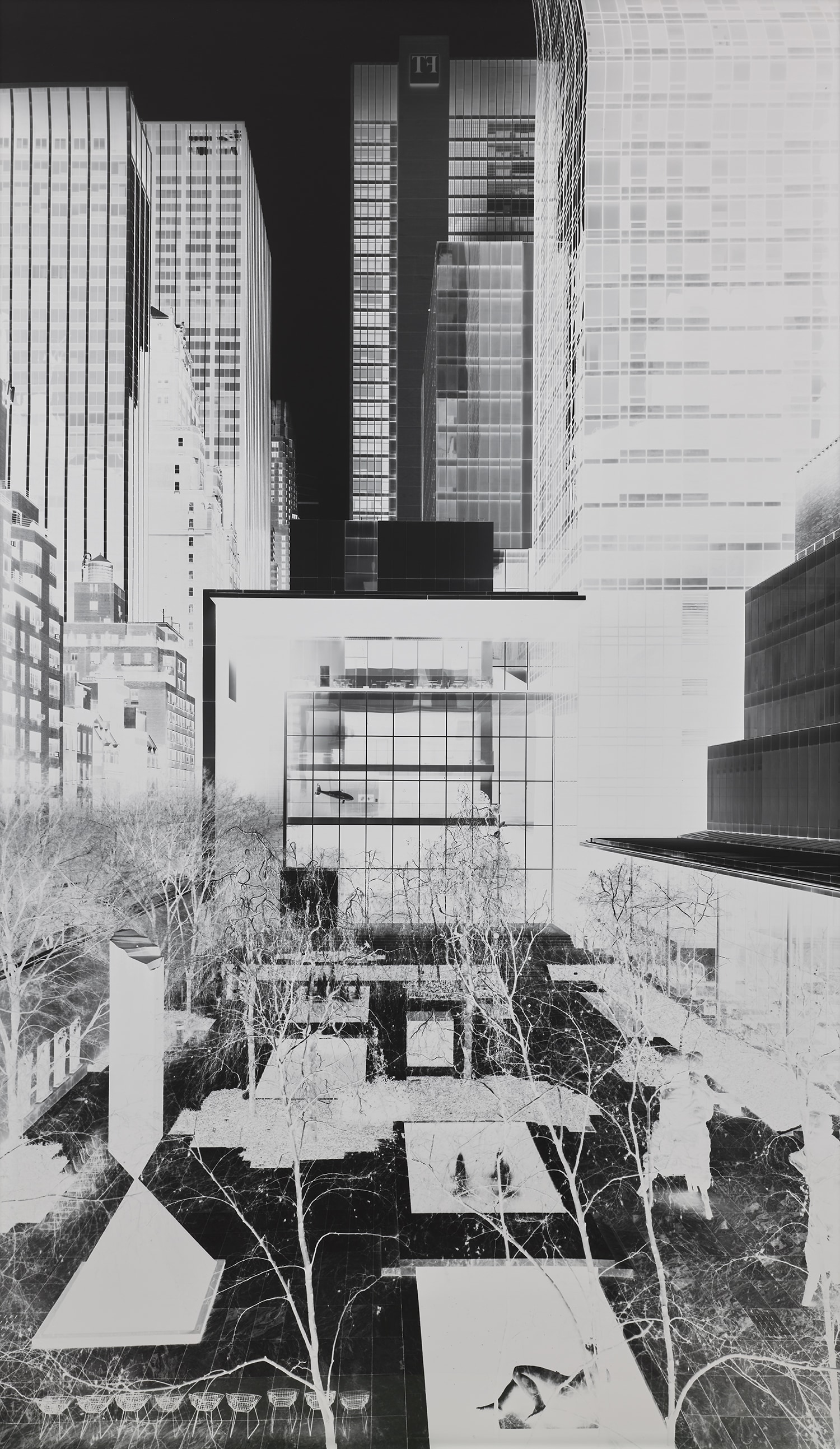
When the Museum of Modern Art in New York invited Vera Lutter to work within its galleries, the result was something few institutions had witnessed before. Lutter sealed off spaces within the museum itself, transforming rooms into vast pinhole cameras, and allowed the building's own architecture to inscribe itself onto enormous sheets of photosensitive paper. The resulting work, "The Museum of Modern Art, V: April 18," stands as one of the most quietly radical gestures in contemporary photography: a world class institution rendered as a monumental negative, pale and luminous, time made visible in a single unique gelatin silver print. It is the kind of image that stops a room.
Vera Lutter
The Museum of Modern Art, V: April 18
Lutter was born in Kaiserslautern, Germany, in 1960, and came of age in a cultural moment when photography was redefining its own ambitions. She studied at the Academy of Fine Arts in Munich before relocating to New York in the early 1990s, a move that would prove formative. New York in that decade was electric with conceptual energy, and Lutter arrived with an appetite for ideas that were as physical as they were intellectual. She was drawn not to the camera as a portable instrument of capture but to the camera as architecture, as room, as total environment.
The breakthrough came when Lutter began converting her own New York apartment into a camera obscura, sealing windows with black material and allowing a single pinhole of light to project the outside world onto photosensitive paper mounted across an interior wall. The resulting images were negatives, tonally inverted so that darkness reads as light and light reads as dark, giving every image an atmosphere somewhere between the archaeological and the celestial. What might have remained a curiosity of process became, in her hands, a sustained and expanding meditation on time, place, and the act of seeing itself. Lutter's practice grew in scale and ambition throughout the late 1990s and into the 2000s.
Vera Lutter
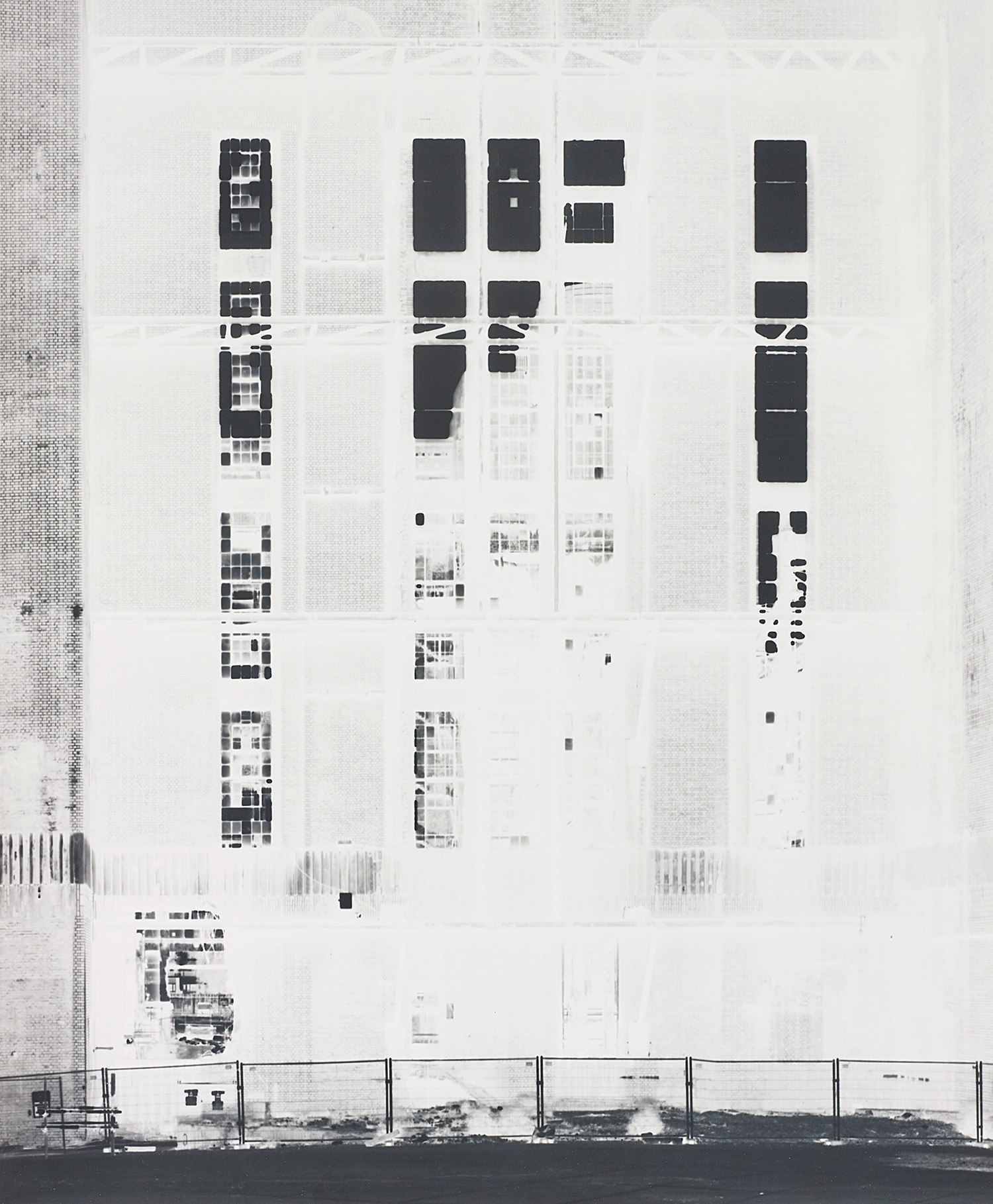
Façade, Battersea Power Station, July 12
She began working in shipping containers, industrial hangars, and temporary structures, positioning them to face some of the most charged architectural and industrial sites in the world. Her "Frankfurt Airport" series, rendered as sweeping diptychs, captures the vast infrastructure of modern transit with a patience that no conventional camera could replicate. Exposures lasting hours, sometimes days, compress time into a single image in which moving aircraft vanish entirely, leaving only the permanent bones of terminals and tarmac. The Battersea Power Station in London, one of the great icons of industrial Britain, became the subject of her "Facade, Battersea Power Station, July 12," a work that reads simultaneously as document and elegy, the building's famous chimneys rising pale against a darkened sky.
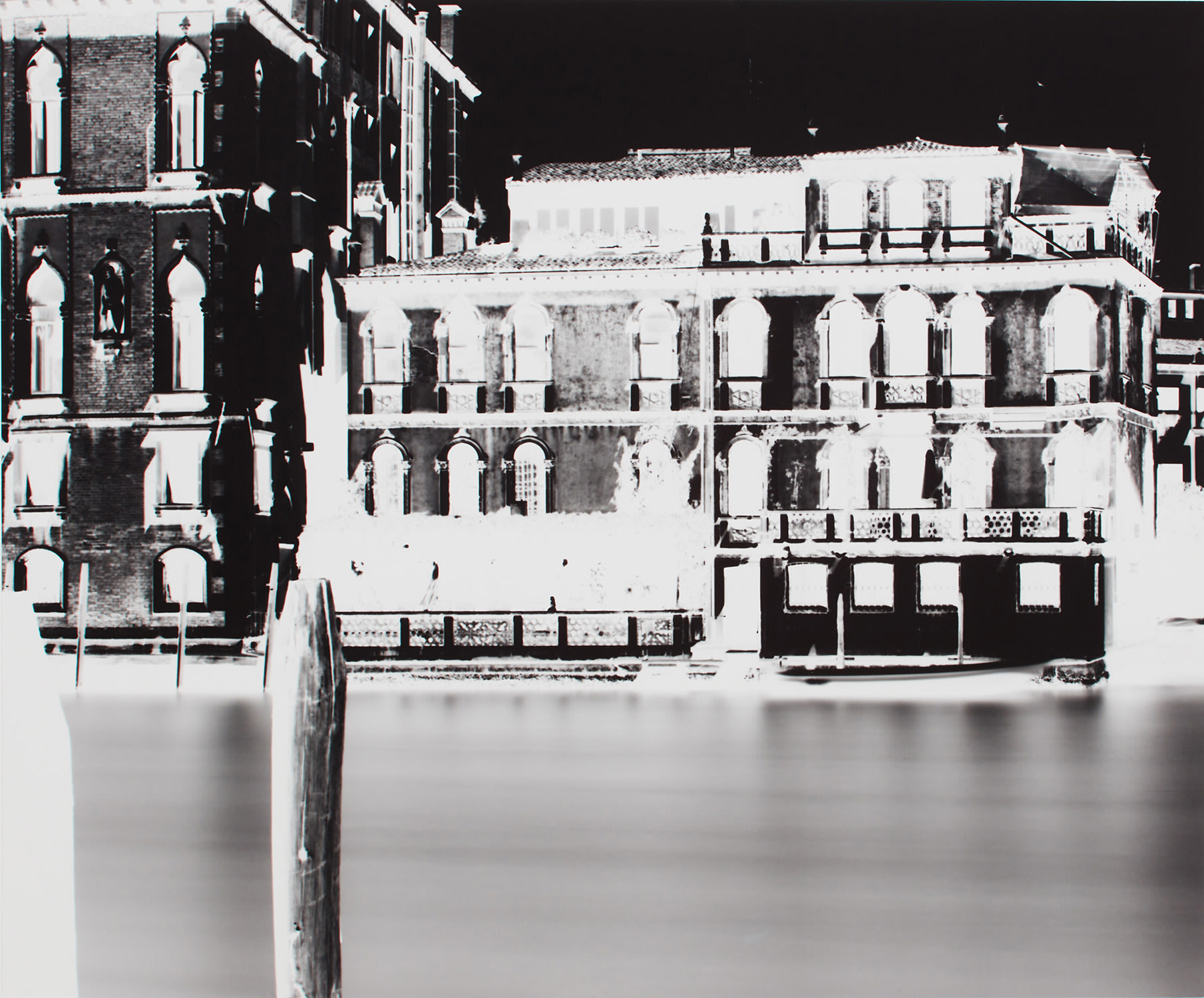
Her visit to Venice produced a series of works including "Ca'del Duca, Venice: July 23" and related pieces that recast the Serenissima's crumbling palaces in the silver tones of slow light, as if the city were being remembered rather than photographed. What distinguishes Lutter most fundamentally from her contemporaries is the absolute singularity of each work. Because she works directly on photosensitive paper inside her camera structures, every image is unique: there is no negative in the conventional sense, no edition, no multiple. A Vera Lutter is not a photograph in the way that most photographs are photographs.
Vera Lutter
Vera Lutter
It is a primary object, closer in ontological status to a painting or a drawing than to a print. This is enormously significant for collectors. When you acquire a Lutter, you acquire the only existing record of that moment of light, that particular duration, that specific encounter between her apparatus and the world. The Chrysler Building captured in "Chrysler Building, June 14" exists in that form nowhere else on earth.
The same is true of "135 LaSalle Street, Chicago, I: October 27, 2001," which carries its date like a timestamp from another era of the city's life. The market for Lutter's work has reflected this understanding of rarity over many years. Her long association with Gagosian Gallery, one of the most powerful platforms in the international art world, has kept her work in serious institutional and private collections across Europe and North America. Works from her airport series, her New York architectural studies, and her Venice pictures have appeared at major auction houses and consistently attracted interest from collectors who understand the category she occupies: blue chip photography with the physical uniqueness of a singular artwork.
Vera Lutter
Ca’del Duca, Venice: July 23
The "View of Plaza, Rockefeller Center" diptych exemplifies what serious collectors respond to in her practice: monumental scale, conceptual clarity, and an irreplaceable relationship to a specific place and time. Her work invites comparison with artists such as Hiroshi Sugimoto, whose long exposure photographs similarly collapse time into image, and with the German tradition of large scale photography associated with the Dusseldorf School and figures such as Thomas Struth and Andreas Gursky. But where those artists work within the logic of the reproducible edition, Lutter operates outside it entirely. The art historical lineage Lutter inhabits is a rich one.
Camera obscura imagery connects her to the very origins of optical representation, to Renaissance painters who used the device to understand perspective, to the earliest experiments that led to photography's invention. Yet her work does not feel nostalgic or antiquarian. It feels urgently contemporary, because the questions it asks, about the nature of time, the stability of place, the reliability of vision, are questions that grow more pressing rather than less as the pace of visual culture accelerates around us. Her images of the Pepsi Cola logo, rendered enormous and tonally reversed in "Small Logo, Pepsi Cola: August 8," turn a symbol of mass culture into something strange and almost unfamiliar, asking the viewer to look again at what they thought they already knew.
Vera Lutter's legacy rests on a body of work that is genuinely without parallel in contemporary art. She has built a practice that is technically singular, philosophically serious, and visually arresting, and she has done so with a consistency that spans decades and continents. For collectors, her work represents one of the most compelling arguments in photography for the value of the unique object. For institutions, she has demonstrated that the camera can be a form of architecture and that an image can be a room.
For anyone who spends time with her photographs, the experience is one of slowed attention and expanded perception, which is, in the end, what the greatest art has always offered.
Explore books about Vera Lutter