Timothy O'Sullivan
Timothy O'Sullivan: Light Across Uncharted Ground
Artist Spotlight · The Collection Editorial
There are photographs that document, and then there are photographs that witness. Timothy H. O'Sullivan belonged firmly to the second category, and the art world has never stopped returning to his work to understand why. The Getty Museum, the Library of Congress, and the Metropolitan Museum of Art all hold significant bodies of his prints, and major survey exhibitions in recent decades have repositioned him not merely as a historical documentarian but as one of the supreme visual artists of the nineteenth century.
Timothy O'Sullivan
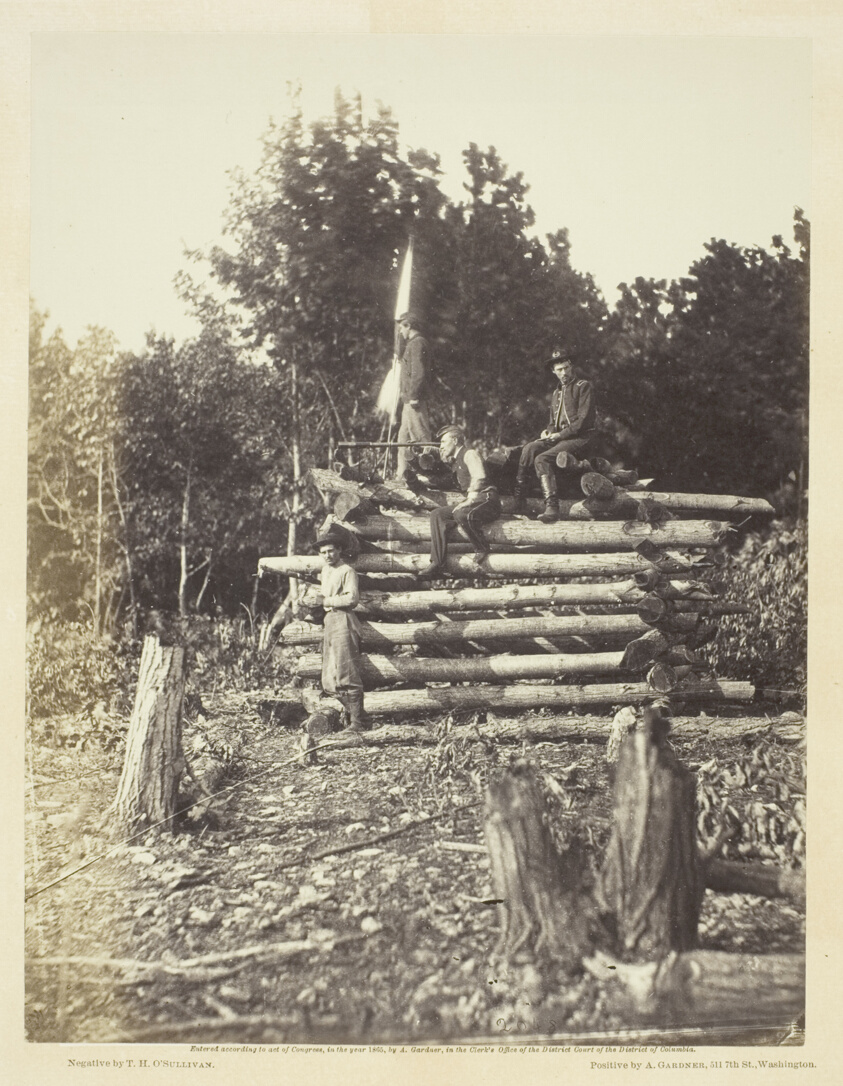
Signal Tower on Elk Mountain, Maryland, 1862
When a set of his Wheeler Survey albumen prints appears at auction, the room tends to go quiet in a particular way, the way it does when something both beautiful and irreplaceable enters the light. O'Sullivan was born in 1840, likely in Ireland or to Irish immigrant parents who settled in New York, and his formal education in photography began in the most consequential studio of the era. As a teenager he apprenticed under Mathew Brady in New York, absorbing the discipline of the wet collodion process and learning what it meant to approach the camera as a tool of serious purpose. When the Civil War broke out, he moved into the field operation run by Alexander Gardner, Brady's chief operator, and it was in that crucible that O'Sullivan's singular vision began to take shape.
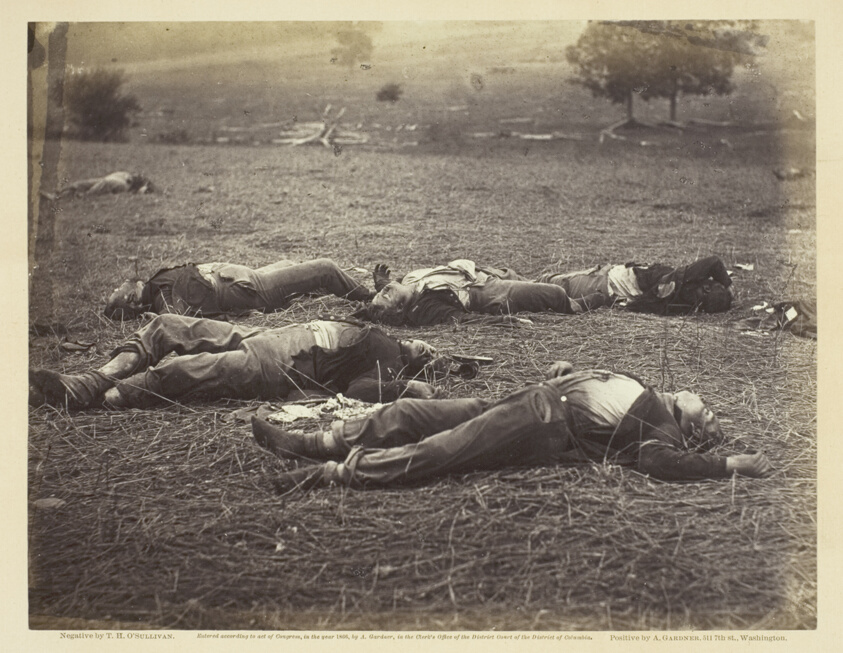
By the time he was in his early twenties, he was carrying glass plates and a portable darkroom tent onto some of the most dangerous ground in America. The Civil War years forged O'Sullivan's aesthetic in ways that no studio training could have managed. His 1863 image "The Harvest of Death," made at Gettysburg and later published in Gardner's Photographic Sketch Book of the War, showed fallen Union soldiers scattered across a misty field with a compositional gravity that still arrests viewers more than 160 years later. Unlike many of his contemporaries who arranged scenes for dramatic effect, O'Sullivan brought an unflinching directness to his subjects, a quality that some early audiences found difficult and that later generations have come to revere as a form of moral honesty.
Timothy O'Sullivan
Field Where General Reynolds Fell, Gettysburg, 1863
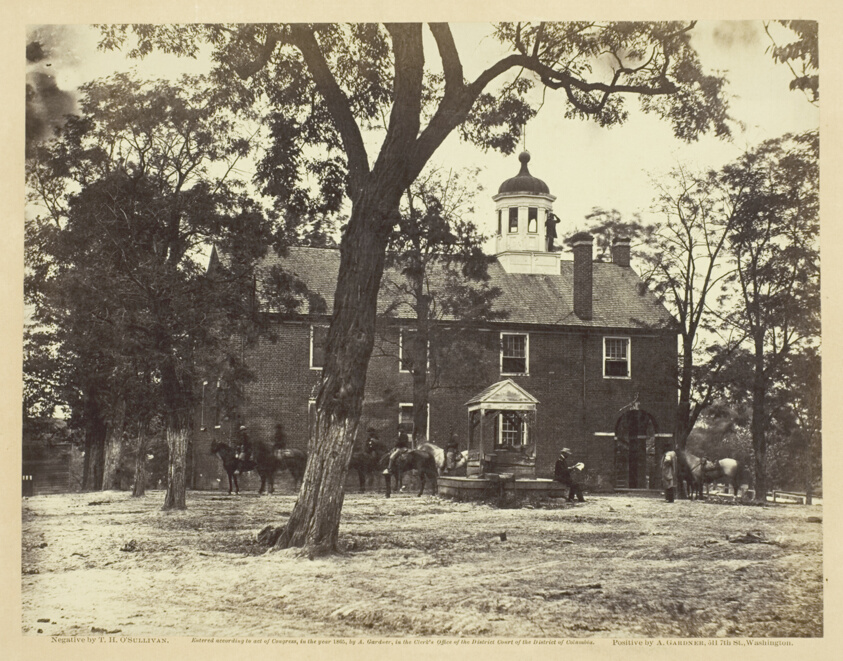
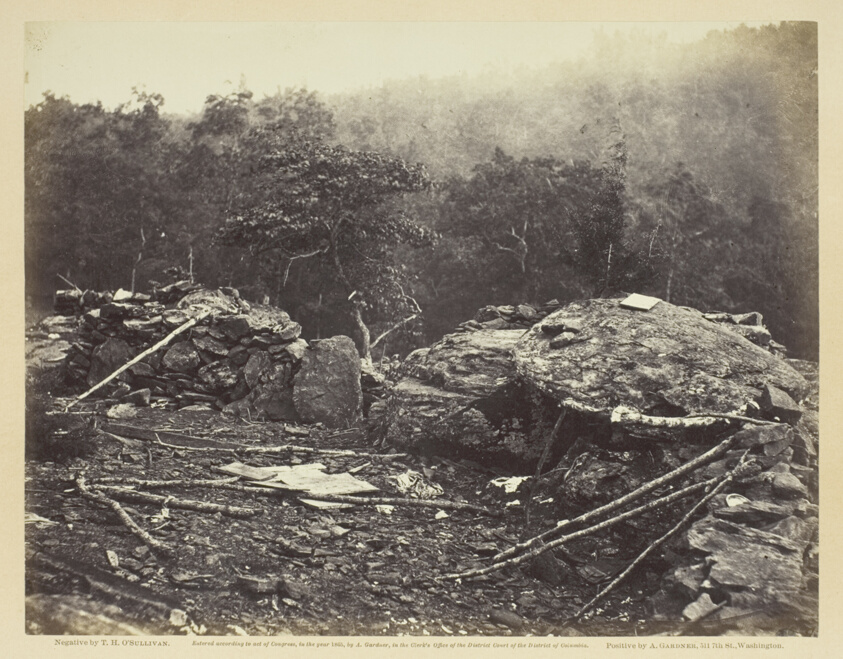
The Sketch Book plates from this period, including "Interior of Breastworks on Round Top, Gettysburg" from 1863 and "High Bridge Crossing the Appomattox, Near Farmville" from 1865, demonstrate his extraordinary command of light, geometry, and emotional weight working in absolute concert. After the war O'Sullivan made the choice that would define the second and perhaps even more celebrated chapter of his practice. Between 1867 and 1874 he joined a series of government survey expeditions into the American West, first with Clarence King's geological survey of the 40th parallel and then through multiple seasons with Lieutenant George Wheeler's survey west of the 100th meridian. The logistical challenges were staggering.
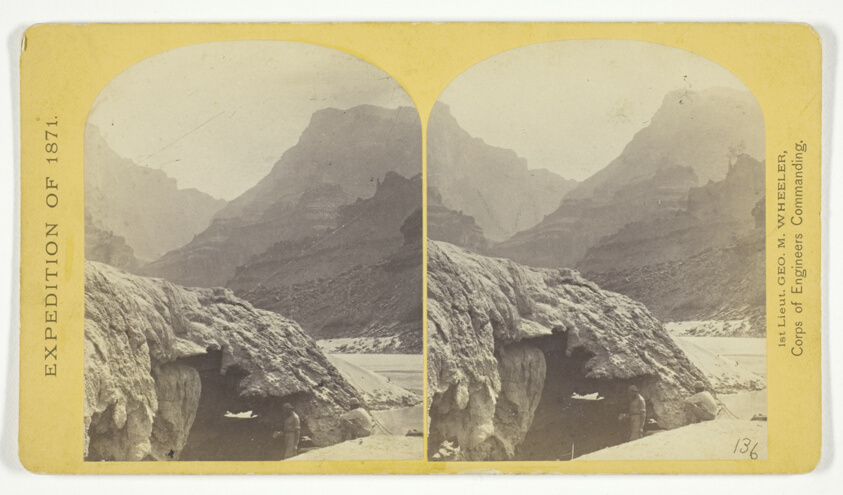
He transported glass plates and chemical solutions by mule through desert canyons, by boat through the turbulent waters of the Colorado River, and on foot through high alpine terrain. The resulting images are among the most formally audacious landscape photographs ever made. Works such as "Black Canon, Colorado River, from Camp 8, Looking Above" from 1871 and the remarkable Apache Lake views from 1873 reveal an artist who understood space, scale, and the relationship between human presence and geological time with a sophistication that anticipates much of what we now call conceptual landscape photography. The Wheeler Survey works occupy a particularly distinguished place in O'Sullivan's output and in the broader history of American photography.
Timothy O'Sullivan
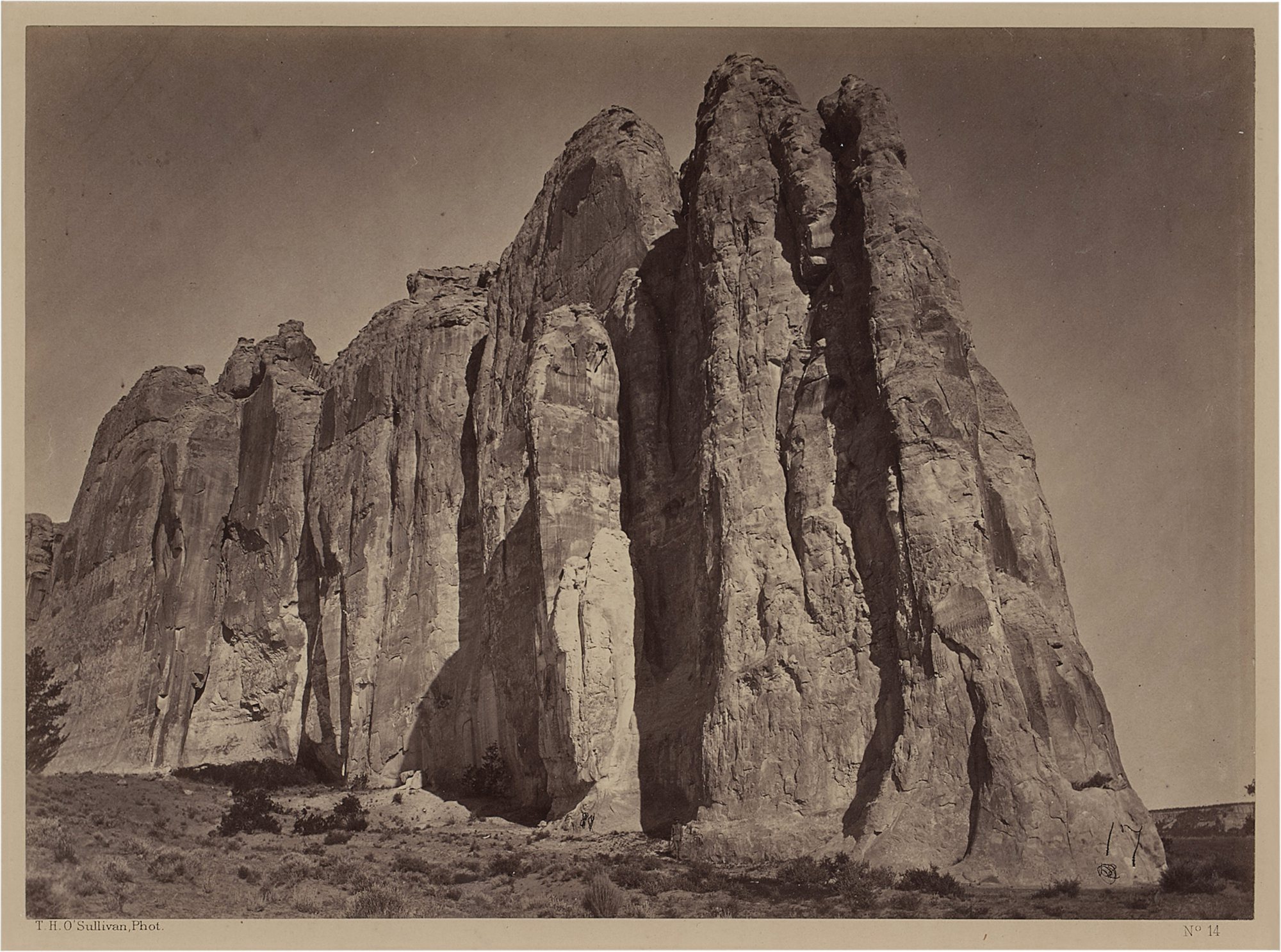
'South Side of Inscription Rock, N. M.'
His images of Cañon de Chelle, now Canyon de Chelly in Arizona, including "Ancient Ruins in the Cañon de Chelle" from 1873, introduced Eastern audiences to Ancestral Puebloan architecture nestled in sheer sandstone walls that seemed to belong to another world entirely. The formal Wheeler Survey mounts on which these prints were presented, with their letterpress credits, decorative cartouches, and survey notations, give the surviving objects a remarkable document quality that collectors prize deeply. "The South Side of Inscription Rock" and "Historic Spanish Record of the Conquest," both from 1873, similarly fuse archaeological witness with compositional mastery, layering centuries of human inscription against the geological permanence of the rock face itself. These are photographs that think.
For collectors, O'Sullivan presents a compelling and carefully navigated field. Albumen prints from the Wheeler Survey albums, particularly those retaining their distinctive two toned mounts with intact letterpress information, represent some of the most sought after material in nineteenth century American photography. Condition is paramount given the albumen process and the age of the material, and prints with even, warm tonality and minimal fading command serious premiums. Works that passed through the original survey album structure carry additional provenance weight.
Timothy O'Sullivan
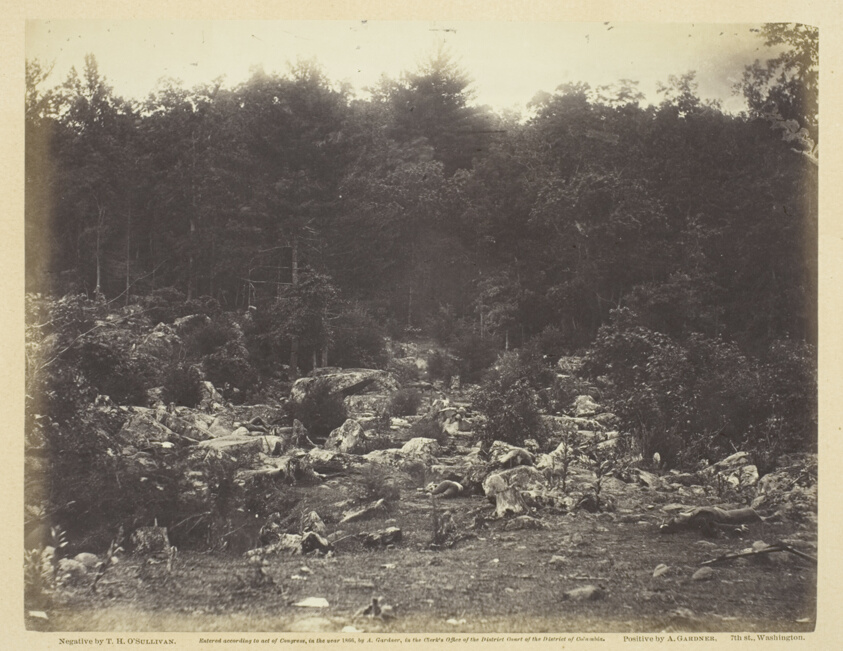
Slaughter Pen, Foot of Round Top, Gettysburg, 1863
The Civil War material, particularly plates from Gardner's Photographic Sketch Book of the War in either volume, appears less frequently at auction and draws sustained interest from both photography specialists and Civil War historians. Major auction houses including Christie's and Sotheby's have handled significant O'Sullivan material over the years, and prices for top condition examples have risen steadily as his critical reputation has expanded. To understand O'Sullivan fully, it helps to place him alongside the artists and photographers who define his moment and his legacy. Carleton Watkins, who was working the Yosemite Valley in the same decade with similarly large format equipment, offers the closest parallel in Western landscape photography, though Watkins tended toward the panoramic sublime while O'Sullivan favored a more austere, geologically minded gaze.
William Henry Jackson, another survey photographer, shared the same extraordinary conditions but often worked with a more promotional pictorialism. In terms of the Civil War documentation, George Barnard's work stands as the other great body of images from that conflict, and the two bodies of work in dialogue reveal just how wide the expressive range of early photography already was. Later artists including Ansel Adams acknowledged the weight of this tradition, and contemporary photographers working in documentary and landscape modes continue to reckon with what O'Sullivan established. O'Sullivan died in 1882 at just 42 years old, likely from tuberculosis, leaving behind a body of work whose full dimensions took the better part of a century to appreciate properly.
The scholar Joel Snyder and later the art historian Robin Kelsey, whose 2011 book Archive Style devoted sustained attention to the survey photographers, helped bring critical rigor to the understanding of O'Sullivan's practice as genuinely artistic rather than merely functional. Today his prints hang in the finest collections in the world and command the attention of scholars, curators, and collectors who recognize in his images something that transcends their historical moment entirely. He looked at a nation in the process of defining and sometimes destroying itself, and he made photographs of such formal intelligence and quiet power that they continue to expand in meaning with each passing generation.
Featured Works
Explore books about Timothy O'Sullivan
Timothy O'Sullivan: The King Survey Photographs
William Current
Timothy O'Sullivan: Photographs
Joel Snyder

The Great West Photographed: Photographs by William Henry Jackson, John K. Hillers, and Timothy O'Sullivan
Beaumont Newhall
Timothy O'Sullivan: The Shoshone Falls and the King Survey
William Current
Desert and Plain: The Photographs of Timothy O'Sullivan
Thomas F. Barrow