Thomas Hart Benton
Thomas Hart Benton, America's Great Visual Storyteller
Artist Spotlight · The Collection Editorial
“I work from nature. I work from life. I work from the American scene as I find it.”
Thomas Hart Benton, artist statements
There is a particular kind of looking that Thomas Hart Benton demands of you. Standing before one of his canvases, you feel the grain of American soil beneath your feet, hear the clatter of a train on a long prairie curve, sense the particular stillness of a summer evening on Martha's Vineyard. It is no accident that the Whitney Museum of American Art, which mounted a landmark retrospective of his work in 1998, described him as one of the most ambitious chroniclers of American life the country has ever produced. Decades after his death in 1975, the market for Benton's paintings, drawings, and prints has deepened considerably, with institutions and private collectors alike recognizing that his work offers something rare: a full throated, formally rigorous account of what it felt like to live in the United States during one of its most turbulent and transformative centuries.
Thomas Hart Benton
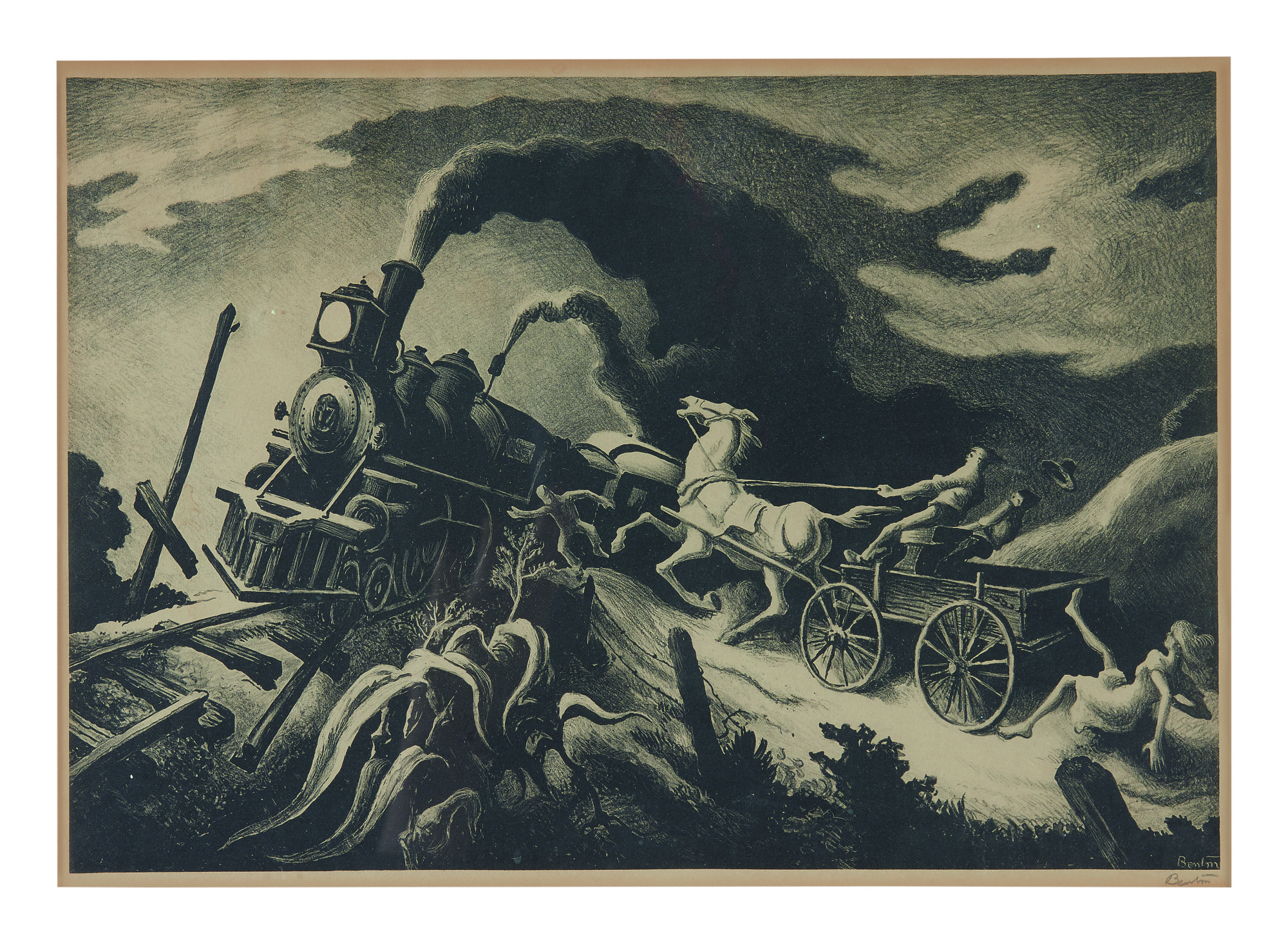
Wreck Of The Ol' 97 (fath 63)
Thomas Hart Benton was born on April 15, 1889, in Neosho, Missouri, into a family steeped in American political life. His great uncle was the formidable senator Thomas Hart Benton of Missouri, and his father Maecenas Benton served as a congressman. Politics, rhetoric, and the texture of ordinary American experience surrounded him from childhood. He showed early aptitude for drawing and, against his father's wishes, enrolled at the Art Institute of Chicago in 1906.
He then traveled to Paris, spending several years from 1908 onward studying at the Académie Julian, where he absorbed Post Impressionism, Synchromism, and the formal experiments circulating through the European avant garde. These lessons never left him, but he grew restless with their remove from lived experience and returned to the United States around 1912, eventually settling for stretches in New York. The years that followed were ones of restless searching and gradual, deliberate reinvention. Benton spent time working in the navy during World War One, where he was assigned to make documentary drawings of the Norfolk Naval Station, an experience that sharpened his eye for industrial scale, human labor, and the drama of machines.
Thomas Hart Benton
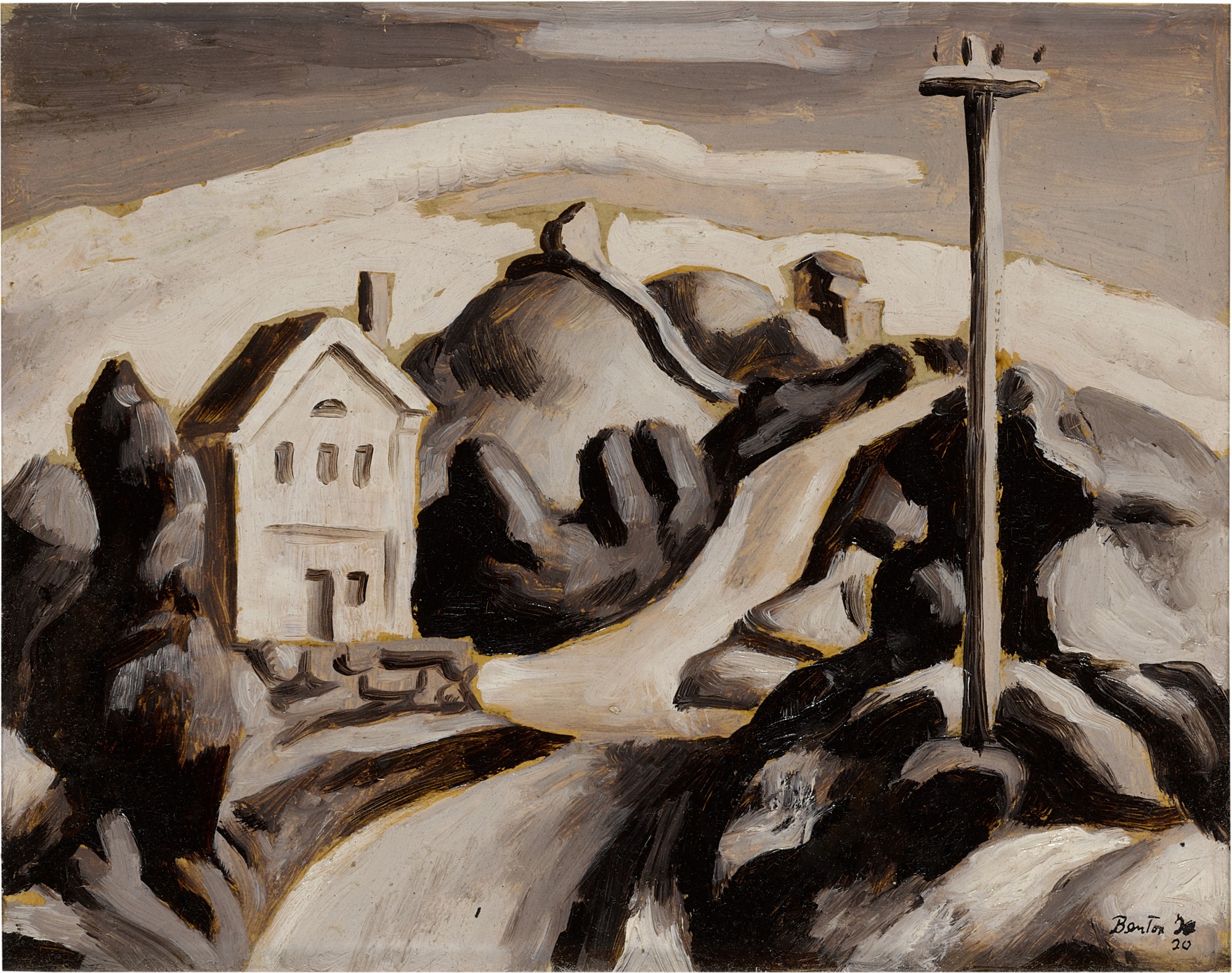
Martha's Vineyard (Beetlebung Corner), 1920
Through the 1920s he undertook a series of extended journeys across the American South and Midwest, traveling by river, on foot, and by rail, filling sketchbooks with the faces of sharecroppers, fiddlers, preachers, and field workers. These drawings became the raw material from which his mature style would be forged, a style that borrowed the muscular, undulating forms of Renaissance fresco, the spatial compression of El Greco, and the narrative hunger of American folk tradition. Benton's breakthrough as a major figure came in the early 1930s when he was commissioned to create large scale mural cycles that would define his reputation. His America Today mural series, completed in 1930 for the New School for Social Research in New York, announced a painter capable of holding an entire civilization in a single panoramic vision.
“I am an American and I paint the life of my country as I see it.”
Thomas Hart Benton
The murals pulsed with energy, crowding their surfaces with steel workers, jazz musicians, farmers, and city dwellers in compositions that twisted and surged like rivers in flood. The Indiana murals created for the 1933 Chicago World's Fair cemented his national prominence. By this point Benton had become the most visible figure in the Regionalist movement, alongside Grant Wood and John Steuart Curry, a loose grouping of painters committed to celebrating distinctly American subjects and turning away from the perceived elitism of European modernism. Among the works available on The Collection, several speak with particular eloquence to the breadth of Benton's practice.
Thomas Hart Benton
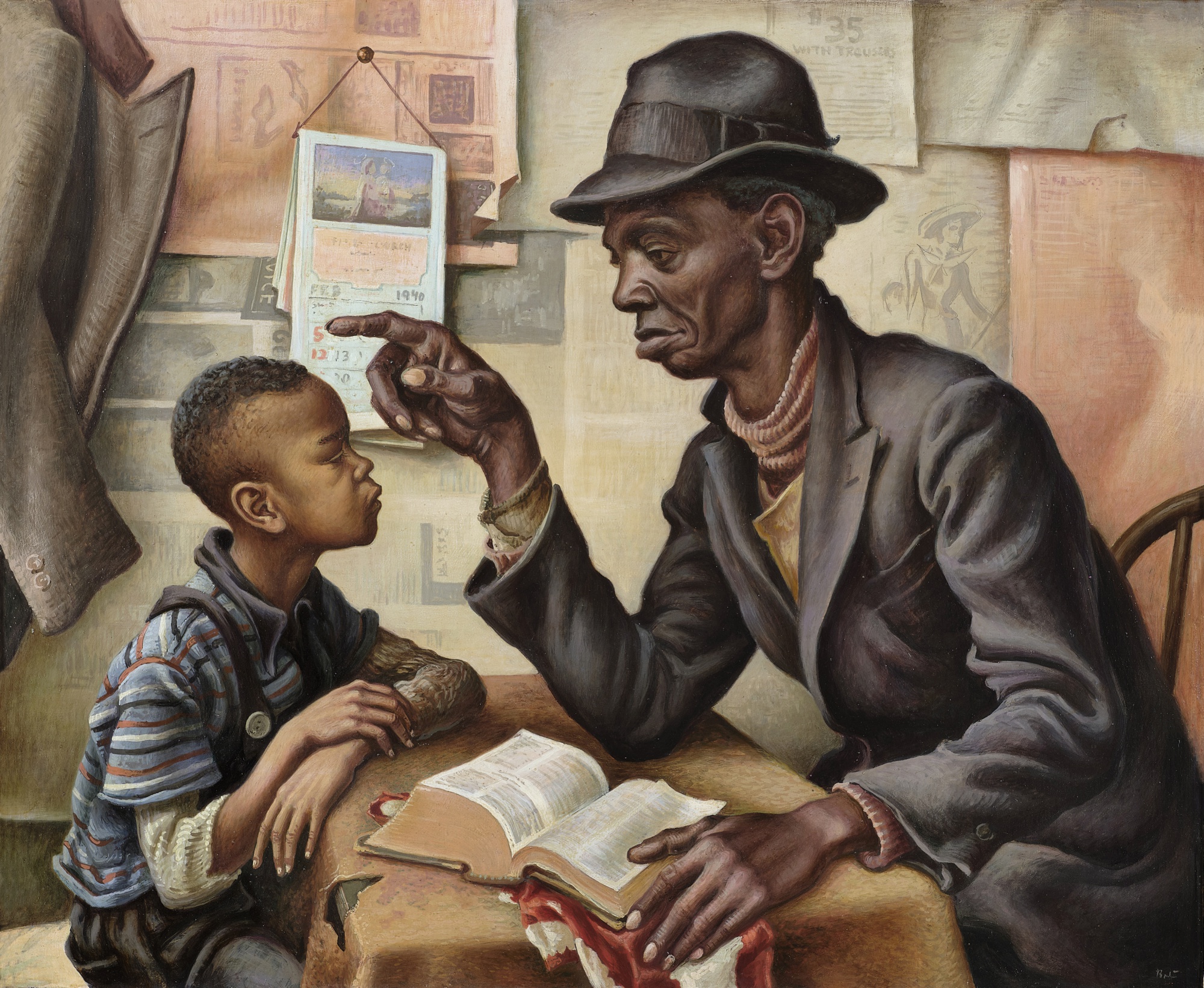
Instruction (The Bible Lesson), 1940
Martha's Vineyard (Beetlebung Corner), an oil on paper laid down on board from 1920, is a quietly extraordinary early work, showing the island landscape that Benton returned to throughout his life with an intimacy that feels almost private. The island was his great refuge, and the paintings it inspired have a lyrical softness that counterbalances the muscular drama of his social realist subjects. Instruction (The Bible Lesson) from 1940, executed in tempera on canvas mounted on panel, demonstrates his mastery of a technique that places him in dialogue with the great American Regionalists and with the older traditions of European panel painting. The Race (F.
56) and Island Hay (F. 68), both lithographs on wove paper with full margins, reveal a printmaker of exceptional skill, someone who understood that the graphic medium could carry all the rhythmic weight of his painted compositions. The Station from 1929, oil on canvas tacked over panel, is one of those works where Benton's feeling for the American landscape as a place of transit, longing, and democratic possibility comes through with particular force. For collectors, Benton's work presents a genuinely compelling range of entry points.
Thomas Hart Benton
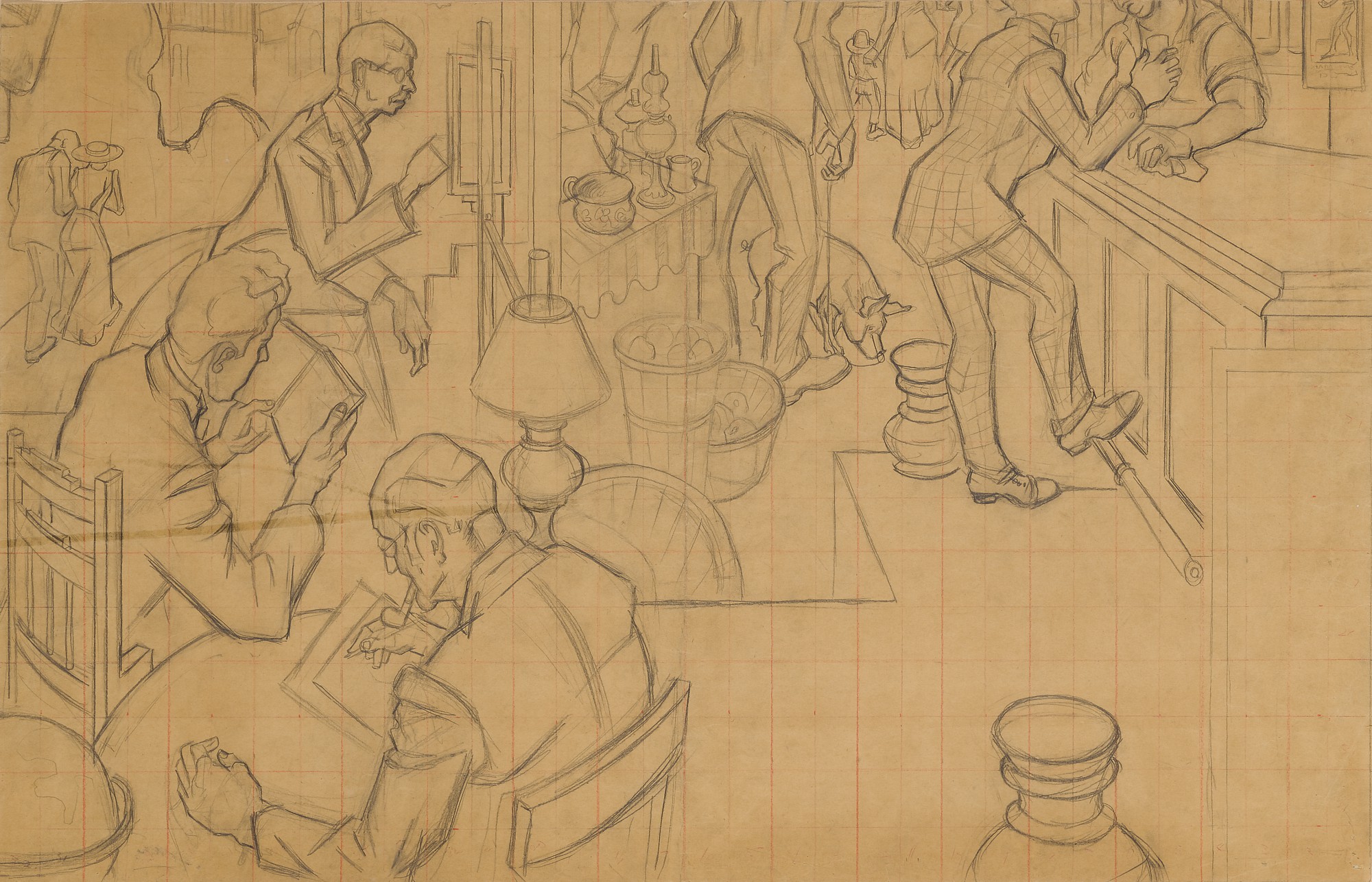
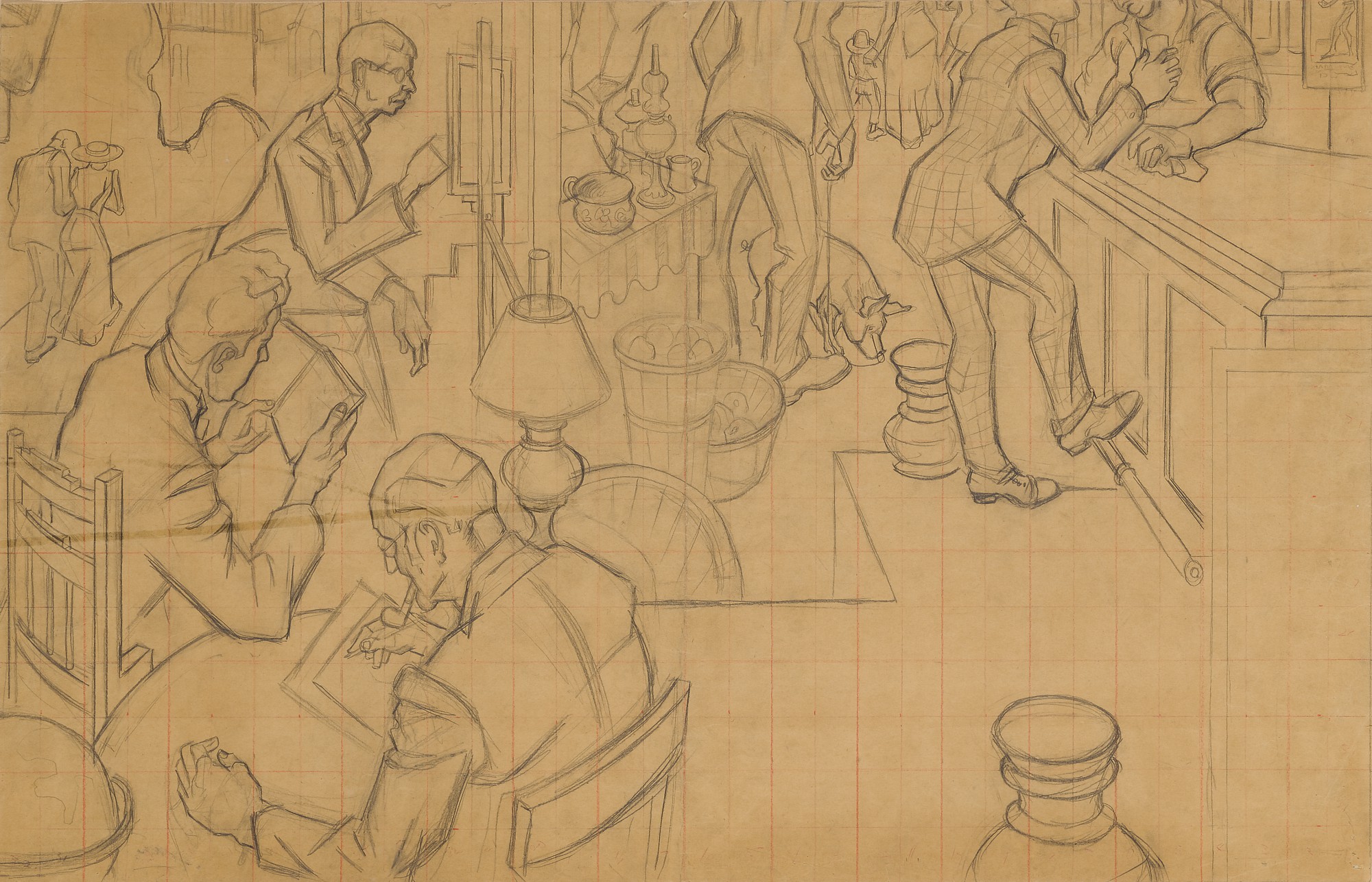
Study for Leisure and Literature , 1932
His prints, particularly the lithographs produced in the 1930s and 1940s in collaboration with the printer George Miller, have long attracted serious attention for their accessibility and their quality. Works in fine condition with full margins, as with the examples on The Collection, represent the prints at their best. His works on paper, including the preparatory drawings and studies in pencil and colored pencil, such as the Study for Leisure and Literature from 1932, offer an intimate view into his process and his exceptional draftsmanship. Major paintings from his peak years carry significant price tags at auction, but works from his later period and from his time on Martha's Vineyard offer opportunities for collectors drawn to his quieter, more personal register.
Christie's, Sotheby's, and Heritage Auctions have all seen robust bidding on Benton material in recent years, reflecting sustained institutional and private demand. To understand Benton fully it helps to place him within a broader American tradition. His work invites comparison with Winslow Homer in its commitment to American landscape and vernacular life, and with John Singer Sargent in the sheer confidence of its execution. Among his contemporaries, Grant Wood shares his Regionalist affiliations and his gift for transforming American scenes into something monumental, while Reginald Marsh shared his appetite for crowded, energetic figuration rooted in the everyday.
It is also worth noting that Benton was the teacher of Jackson Pollock, a historical fact that carries enormous resonance: the man who would become the avatar of Abstract Expressionism spent his early years learning draftsmanship and compositional structure from the great champion of American Regionalism. The dialogue between Benton's figuration and Pollock's abstraction is one of the most fascinating continuities in twentieth century American art. Benton died on January 19, 1975, in his studio in Kansas City, Missouri, reportedly while working on a mural, a fitting end for a man who gave his entire life to the act of painting. His legacy is that of an artist who believed, with genuine conviction, that the lives of ordinary Americans deserved the grandest possible treatment, that a farmer baling hay or a congregation lifting their voices in song was as worthy of formal ambition as any classical subject.
In a moment when questions of representation, regionalism, and the meaning of American identity feel more urgent than ever, Benton's work arrives with fresh relevance. He painted a country in motion, contradictory and alive, and the best of his images still carry that current.
Explore books about Thomas Hart Benton
Thomas Hart Benton: An American Original
Elizabeth Broun
Thomas Hart Benton and the American South
Justin Wolff
An Artist in America
Thomas Hart Benton
The Drawings of Thomas Hart Benton
Henry Adams
Thomas Hart Benton: Regionalism and Beyond
Erika Doss
Thomas Hart Benton: A Life
Justin Wolff
American Regionalism: Its History and Significance
M. Sue Kendall