The Haas Brothers
Where Wild Things Bloom Into Gold
Artist Spotlight · The Collection Editorial
“We want to make things that feel alive, that have a presence, that you feel like might move when you leave the room.”
Nikolai Haas, Interview Magazine
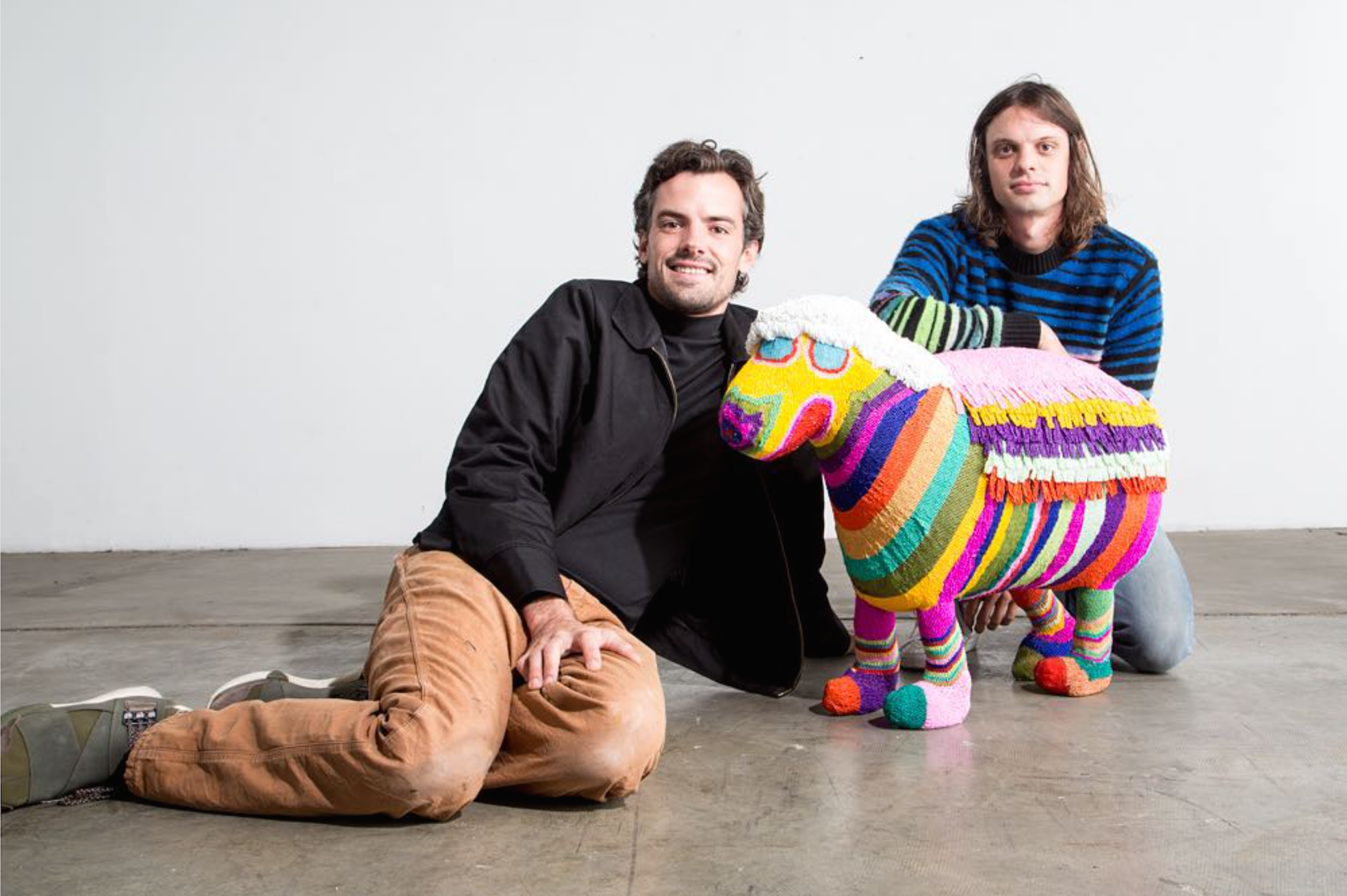
In the sprawling, sun saturated ecosystem of the Los Angeles art world, few studios generate the kind of devoted, almost feverish attention that surrounds the Haas Brothers. Nikolai and Simon Haas, the twin duo born in 1984 in Santa Monica and raised in Austin, Texas, have spent the better part of a decade building a body of work that resists every easy category. Their recent years have seen them move fluidly between gallery presentations, major design fairs, and private commissions, each new work arriving as a kind of creature unto itself, something between sculpture, furniture, myth, and organism. The momentum shows no sign of slowing.
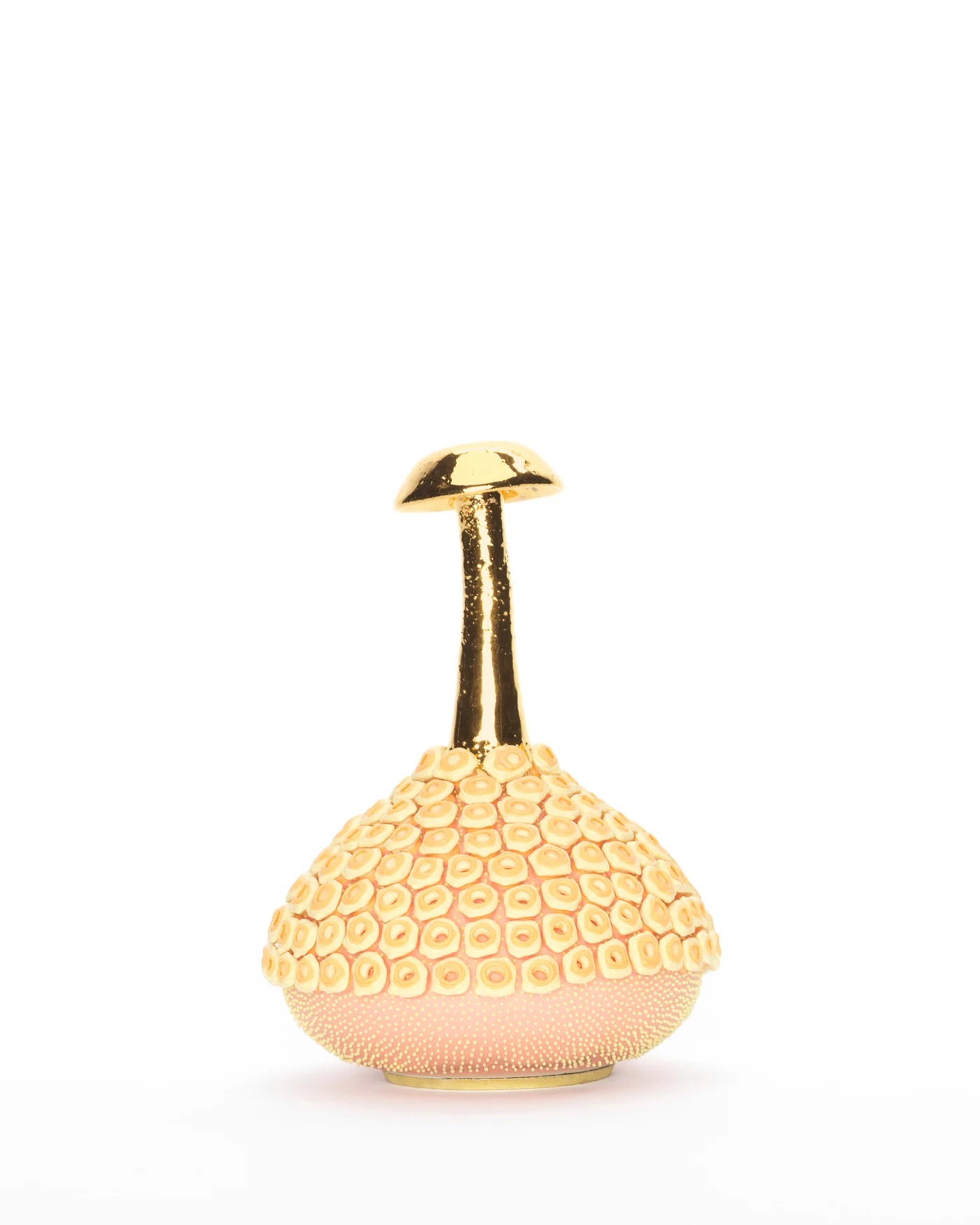
The Haas Brothers
Superhole Sunday, 2020
To understand the Haas Brothers is to understand the household that made them. Their father, Berthold Haas, was a sculptor, and their mother, Emily Tracy, was an opera singer, two disciplines that share a devotion to the handmade and the performed. Their older brother is actor Lukas Haas. It is a family of makers and performers, people who understand that the body, the voice, and the hand are the primary instruments of meaning.
Before the twins began working together, Simon studied painting at the Rhode Island School of Design, while Nikolai pursued music. When they eventually folded their separate practices into a shared studio in Los Angeles, the result was something genuinely new: a sensibility that is simultaneously rigorous and riotous, deeply craft literate and cheerfully subversive. The studio they founded in Los Angeles became a crucible for an approach to making that refuses to separate fine art from design, or animal from object, or the beautiful from the strange. Looking at the works themselves, you encounter this immediately.
The Haas Brothers
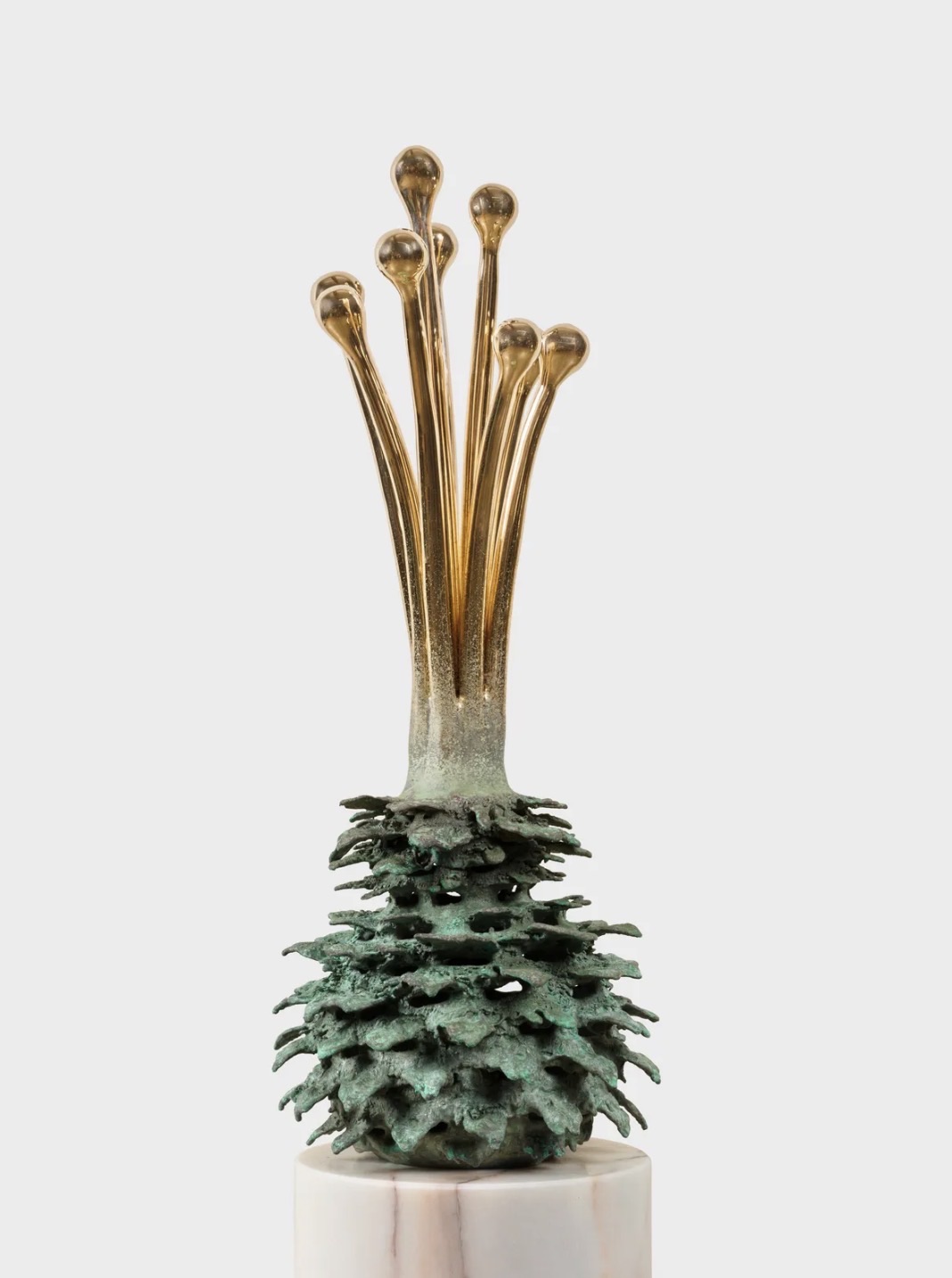
Ball Giamatti, 2024
Consider Ball Giamatti, a 2024 sculpture in patinated cast bronze set on a marble base: from a textured, pine cone like body covered in rough, verdigris green scales, a cluster of elongated golden stalks rises upward, each one tipped with a smooth, gleaming orb. The effect is at once botanical and alien, like something that germinated in a tide pool and finished growing in a cathedral. The transition from dark oxidized bronze at the base to luminous polished gold at the tips is handled with the confidence of a master metalsmith who also happens to be a poet. The Beasts, the anthropomorphic fur and bronze figures that have become one of the studio's most recognizable signatures, offer a different but equally compelling proposition.
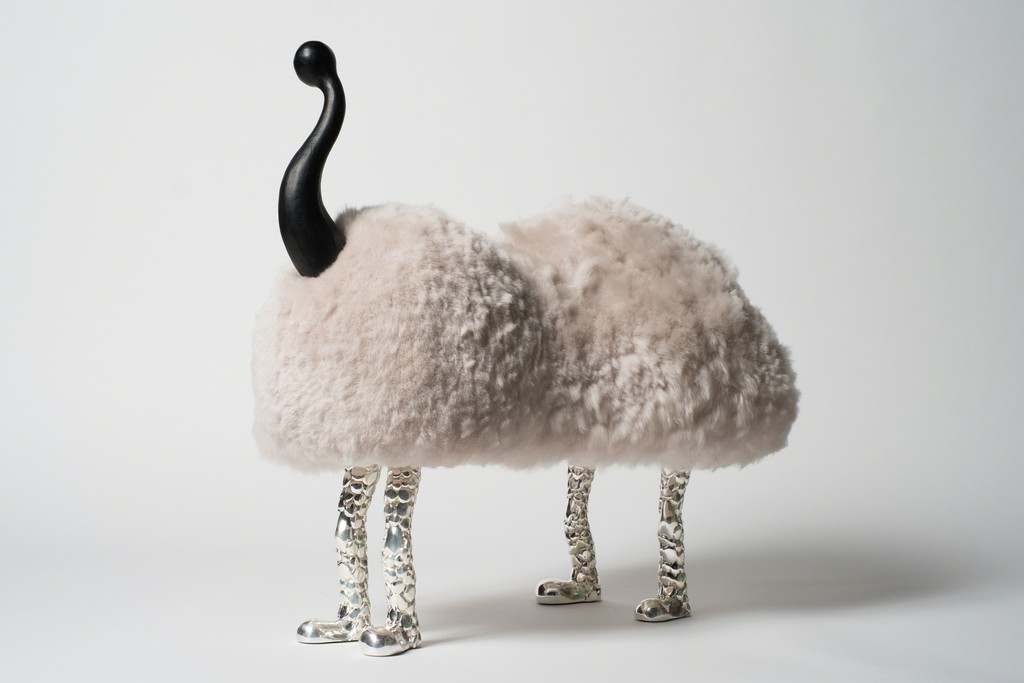
Sway Dunaway, created in 2016, is a compact creature upholstered in alpaca fur, with four cast bronze legs modeled after cheetah paws and a single curving ebony horn rising from its body like a question mark. Its palette is soft and dusty, a warm cream against the cool silver of the metal feet, and its silhouette reads as simultaneously ridiculous and deeply dignified. Screwlia Roberts, from 2019, presents a similar architecture in Mongolian lamb fur with gold toned bronze legs and a pair of spiraling horn like protrusions that twist upward through the fur like antennae from another world. These are not decorative objects with artistic pretensions.
The Haas Brothers
Sway Dunaway, 2016
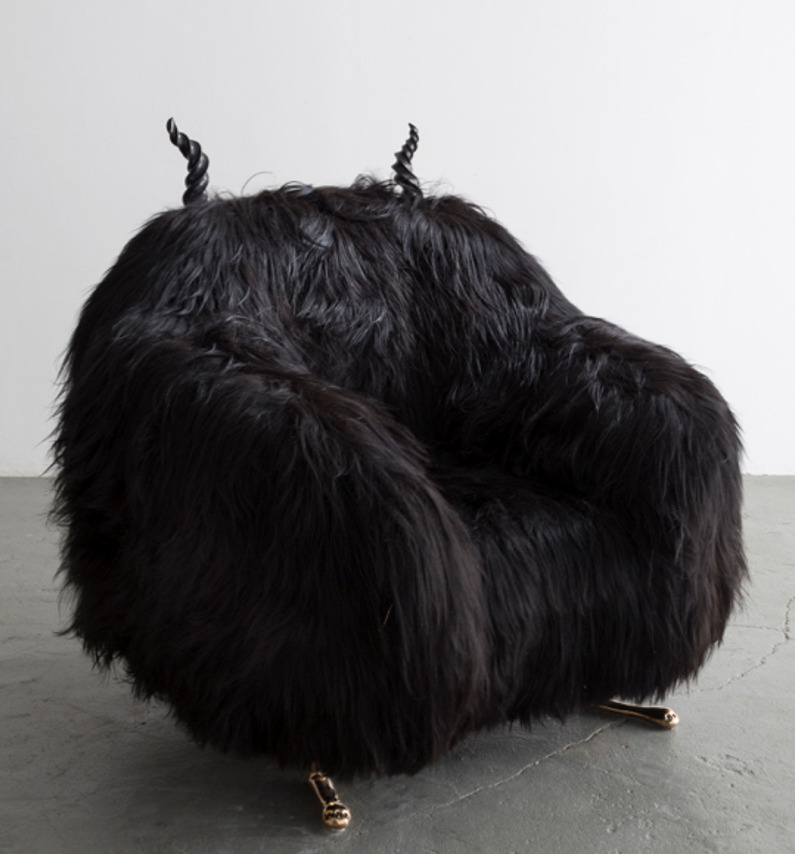
They are fully realized sculptural beings, each with a distinct personality, a distinct mood, a distinct way of occupying space. Hairy Nilsson, the Beast club chair from 2016, scales this sensibility up to human proportions. Covered entirely in long, black Icelandic sheepskin and fitted with four cast bronze lion paw feet, it sits on the floor with the authority of a creature that has claimed its territory. Two spiraling horns emerge from the top of the backrest, twisted like narwhal tusks, rendered in darkened material that contrasts with the gleam of the bronze feet.
You could sit in it. You might not want to. It is simultaneously the most comfortable looking and the most unnerving object in any room it enters, which is precisely the point. The Haas Brothers understand that furniture and sculpture share a body, and they press that shared body to its most extreme and rewarding conclusions.
The Haas Brothers
Hairy Nilsson , 2016
What makes this practice so genuinely difficult to place, and so rewarding to collect, is the range of materials and references it moves through without ever feeling scattered. Bronze, marble, alpaca, Mongolian lamb, Icelandic sheepskin, ebony, porcelain, gold plated pewter, Venetian glass beads: each material is chosen with care, each combination engineered for maximum productive tension. The works speak to the history of surrealism, to the biomorphic sculptures of artists like Jean Arp and Louise Bourgeois, to the craft traditions of metalsmithing and textile art, and to the long lineage of anthropomorphic object making that runs from ancient ritual figurines through twentieth century design and into the present. The brothers are fully aware of this lineage and move through it with ease and irreverence.
From a collecting perspective, the Haas Brothers occupy a position that is both accessible and increasingly urgent. Their work spans a range of scales and price points, from smaller tabletop sculptures and ceramic pieces to the large scale Beasts and custom installations, meaning that there are meaningful entry points for collectors at different stages of their journey. The studio's emphasis on handcraft and limited production ensures that scarcity is genuine rather than manufactured. Collectors who have come to the work early tend to speak of it with the particular affection reserved for things that genuinely surprised them, that arrived in their homes and changed the atmosphere of a room in ways they had not anticipated.
The works have a presence that photographs cannot fully convey and that reveals itself slowly, over time, in lived space. The broader context for their practice is one of renewed institutional and critical interest in work that takes craft seriously as a vehicle for complex ideas. Alongside artists like Lynda Benglis, whose own poured and cast forms interrogate the boundaries between sculpture and material process, or Claire Tabouret, who brings a similar emotional intensity to figurative work, the Haas Brothers represent a generation of makers for whom the handmade is not a retreat from conceptual ambition but its fullest expression. Their work belongs to the present moment in the deepest sense, which is to say it is addressed to people living now, in bodies, in rooms, surrounded by objects that either deaden or enliven the senses.
What the Haas Brothers have built, over a decade of relentless invention, is a universe. It has its own creatures, its own materials, its own mythology, and its own rules. To spend time with these works is to be briefly admitted into that universe, to sit beside a sheepskin beast on bronze lion feet, to lean in toward a verdigris pine cone from which golden tendrils reach toward the light, and to feel, in that encounter, something that is both ancient and absolutely new. That is a rare gift in contemporary art, and it is why the conversation around this studio is only getting richer.
Featured Works
Explore books about The Haas Brothers